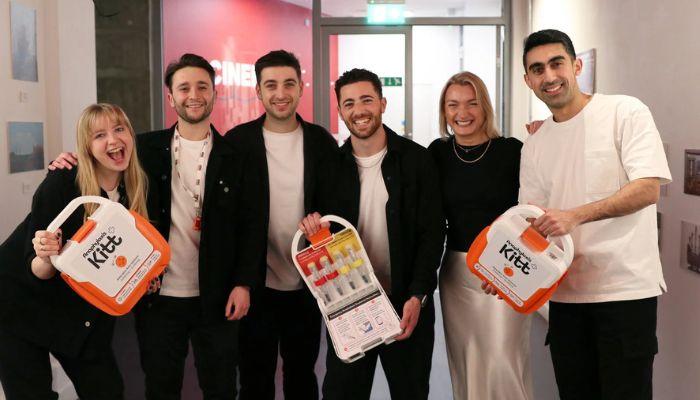
Picture a child at school. She takes one bite of a snack. Within minutes, her throat feels tight. Her allergy pen is at home. What happens next? For most of history, the answer was scary. Staff would call 999 and hope help came fast. But Kitt Medical wants to change that story.
This UK startup puts emergency allergy pens on the wall, right next to the defibrillator. So when every second counts, help is already in the room.
In this listicle, you will learn how Kitt Medical began, how its service works, and why new UK law is driving demand. You will also get clear steps you can take, whether you run a school, a business, or a startup of your own.
What Is Kitt Medical and How Does It Work?
At its heart, Kitt Medical is a simple idea done well. The company calls its product “like a defibrillator, but for allergies.” In short, it gives schools and businesses a ready-to-use kit for a severe allergic reaction, also known as anaphylaxis.
So what is inside? Each Anaphylaxis Kitt is a bright, wall-mounted case. It holds spare adrenaline auto-injectors, often called allergy pens. Staff can grab it fast, just like a defib. Furthermore, the kit is easy to spot, so nobody wastes time hunting through a first-aid cupboard.
More Than a Box on the Wall
Here is the clever part. Kitt Medical does not just sell a box. Instead, it sells a subscription service. The company supplies the pens, tracks when they expire, and swaps them before they go out of date.
On top of that, staff receive online CPD-accredited training. They learn to spot the signs of a reaction and use a pen with confidence.
There is also a web portal. The web portal assists sites in managing stock and logging any incidents involving pen usage. As a result, the admin burden on a busy school office stays low.
The Numbers So Far
The growth has been rapid. According to Deborah Meaden’s investment page, the company has placed over 2,000 Kitts across the UK. Its online course has also trained more than 35,000 people in allergy awareness.
Better still, the kits work in real life. In September 2026, Loughborough University reported that Kitts had treated more than 50 life-threatening reactions. Those cases include both children and adults. For instance, one was a teacher with allergies who had a severe reaction at work.
The client list is growing too. Big names like Center Parcs, Haven, and DHL now use the service. In fact, Center Parcs trained around 1,000 staff through Kitt Medical as part of its rollout.
Our take: Most first-aid gear fails quietly. A pen can sit in a drawer for years and expire unseen. So the real product here is not the box. It is the promise that the pen will work on the day it is needed.
The Kitt Medical Founder Story: From Peanut Toast to Dragons’ Den
Every successful startup story has a “why.” For co-founder Zak Marks, the “why” is personal. When he was five, a friend’s mom offered him toast. He took one bite and knew something was wrong. Soon he broke out in hives and became very ill. That day, he found out he had a severe nut allergy.
Since then, Zak has lived with the daily worry that many allergy sufferers know well. Pens are difficult to get. They expire. And they are easy to leave at home. In fact, the company says that almost half of people with allergies do not carry their pens when they go out.
A University Project With Real Purpose
In 2020, Zak went to Loughborough University to study industrial design. For his final-year project, he designed a concept called “ana.” It was a public allergy kit. Then a small £2,500 grant from the university’s Start-up Fund allowed him to move forward.
Next, Zak teamed up with co-founder James Cohen. Together, they raised money and tested the idea in schools. In early 2023, they officially launched Kitt Medical.
The first real use came soon. A 14-year-old girl named Ava had a severe reaction at school. The Kitt was there, and staff used it. Her family later said they dreaded to think what could have happened without it. That moment proved the idea was not just a design project. It saved a life.
The Dragons’ Den Moment
In February 2025, the pair walked into BBC’s Dragons’ Den. They asked for £75,000 for a 7% stake. As a result, two Dragons said yes. Deborah Meaden and Steven Bartlett each put in £37,500.
The TV spot brought giant reach. However, the founders had already done the hard work. By then, they had raised around £750,000 in total, according to Jewish News. Their story had also gone viral on TikTok.
Meaden provided a concise summary. She said the best businesses often come from personal experience. Kitt Medical is a clear example of that. Today, the team has grown to ten people, and the mission has stayed the same.
Why Allergy Emergencies Need a Public Safety Net
You might wonder why allergy pens need to be on the wall at all. After all, people with allergies are told to carry their own. But real life is messy, and the numbers tell a worrying story.
Allergy Hospital Admissions Have Doubled
According to the UK medicines regulator, the MHRA, allergy and anaphylaxis admissions in England hit 25,721 in 2022–23. That is more than double the figure from twenty years before. Food-related cases rose even faster, by 154%.
Furthermore, many initial reactions happen to people who do not know they have an allergy. They have no pen because they have never needed one. In those cases, a public kit is the only fast option.
Because a reaction can start within minutes, waiting for an ambulance is a real risk. So a pen on the wall can buy precious time until paramedics arrive.
Benedict’s Law Changes the Rules
Then, a pivotal moment occurred. In 2021, five-year-old Benedict Blythe died after a reaction to cow’s milk protein at his school. His parents, Helen and Peter, led a long campaign for change.
Their work led to Benedict’s Law. It forms part of the Children’s Wellbeing and Schools Act 2026. In July 2026, the Department for Education published new statutory guidance. Then, from 1 September 2026, schools in England must follow it.
So what does it require? According to Allergy UK, schools must keep spare in-date adrenaline pens for emergencies. They also need allergy policies and staff training. Plus, the guidance suggests allergy drills, much like fire drills.
This matters because the gap was big. Research from the Benedict Blythe Foundation found that around half of schools had no spare pens before the change. Now, every school in England must close that gap. Since the law passed, demand for Kitt Medical has naturally jumped.
Product Overview: What the Anaphylaxis Kitt Includes
The Anaphylaxis Kitt is a subscription-based service with four core components:
- Secure, visible wall-mounted kit—like a defibrillator cabinet, with breakable emergency key access, intended for quick retrieval in emergencies.
- Medication supply—contains 2×300 µg and 2×150 µg adrenaline auto-injectors in coded slots; automatically replaced annually or when used, via secure reporting software.
- CPD-accredited online training—a 30-minute video-quiz course created with Anaphylaxis UK, including guidance from allergy experts like Professor Adam Fox and Dr Helen Evans-Howells. Already completed by thousands of staff.
- Kitt Portal software—enables incident tracking, expiration management, renewal scheduling, and compliance reporting for institutions.
How Kitt Medical Copies the Defibrillator Playbook
Here is a view you will not find in most write-ups. Kitt Medical is not just building a product. It is copying a public health playbook that has already worked once before.
What Made Defibs Normal
Think back a few decades. Public defibs were rare. Today, you see them in stations, shops, and village halls. So how did that shift happen? The shift can be attributed to four key factors.
- First, there was a clear story. People learned that swift action saves lives in a cardiac arrest.
- Second, there was a visible kit. Bright green boxes became a familiar sight.
- Third, there was training, so ordinary people felt able to help.
- Finally, there was a national map.
The British Heart Foundation now lists over 110,000 defibs on The Circuit, so 999 call handlers can send people to the nearest one.
Where Kitt Medical Fits
Now look at Kitt Medical. It already meets the first three criteria. The story is clear. The kit is bright and easy to spot. And the training comes built in.
Moreover, Benedict’s Law gives it something Defibs took years to get: a legal push. Schools must now hold spare pens. This creates an almost instant demand in the market.
The Missing Piece
Still, one piece is missing, and that is the map. Right now, a 999 call handler can direct you to a defib. But they cannot yet tell you where the nearest allergy pen is. This represents the next significant advancement for the entire category.
If Kitt Medical or a partner builds an “allergy circuit,” the impact could be huge. Imagine a café worker calling 999 and hearing, “There is a Kitt next door.” In our view, that is how allergy care truly becomes as common as defibs.
So watch this space. The company that maps the network may end up owning the standard.
Suggested reading: EdgeUp: How Two Founders Are Disrupting Exam Coaching in India Using AI
Lessons From Kitt Medical for Schools, Businesses, and Founders
So what can you take from all these lessons? The answer depends on who you are. Below are clear, simple steps for each group.
Action Steps for Schools and Workplaces
If you run a school or a public site, start here:
- Verify your current stock: Do you hold spare pens? Are they in date? Additionally, please identify who is responsible for checking them.
- Know the rules: Schools in England must follow Benedict’s Law. Therefore, you should read the DfE guidance or consult your trust lead for clarification.
- Place pens near your defib: Keep them easy to locate and quick to reach. The guidance says spare pens should be reachable fast.
- Train your team: Ensure staff can spot a reaction and use a pen. Also, run a short drill each term.
- Plan for expiry: Pens go out of date. So set reminders, or use a managed service that swaps them for you.
For businesses, the logic is the same. Hotels, gyms, offices, and leisure parks all serve food and host crowds. A single kit can make your site safer. Plus, it shows staff and guests that you care. And if you use a managed allergy pen service, the upkeep is simple too.
Lessons for Startup Founders
Founders can learn a lot here too.
- First, solve a pain you know well. Zak’s own allergy gave him insight that no market report could.
- Second, sell a service, not just a product. Kitt Medical earns trust by managing expiry dates. That also brings steady monthly revenue.
- Third, take advantage of the policy wave. The team built its network before Benedict’s Law passed. Therefore, when the law passed, the team was ready.
- Finally, borrow a mental model people already trust. “Like a defib, but for allergies” explains the whole idea in seven words. Good framing like that can save you months of explaining.
Conclusion: Why Kitt Medical Matters
Kitt Medical started with one boy, one slice of toast, and one scary reaction. Today, it is a growing number of UK startups with a clear goal. It wants every defib in the country to have an allergy kit as its next-door neighbor.
The results thus far are impressive. The company has placed over 2,000 Kitts and trained tens of thousands of people. Most importantly, its kits have treated more than 50 life-threatening reactions. Each of those cases was a real person who got help in time.
Timing helps too. Allergy hospital admissions have more than doubled in twenty years. Meanwhile, Benedict’s Law now requires schools in England to hold spare pens and train staff. As a result, the case for public allergy kits has never been stronger.
Yet the bigger lesson goes beyond one company. Defibs became normal because of clear stories, a visible kit, training, and a national map. Allergy care can follow the same path. And Kitt Medical is leading the way.
Frequently Asked Questions About Kitt Medical
1. What does Kitt Medical provide to schools and UK businesses today?
Kitt Medical provides wall-mounted Anaphylaxis Kitts with spare adrenaline pens. The subscription service also covers online CPD-accredited training, a web portal, and automatic pen swaps before expiry, so emergency allergy care is always ready to use.
2. Who founded Kitt Medical, and how did the business idea first start?
Zak Marks and James Cohen founded Kitt Medical. Zak lives with a severe nut allergy. He first designed the kit as his final-year industrial design project at Loughborough University, then launched the company in early 2023.
3. How does Benedict’s Law affect spare allergy pens in schools now?
Benedict’s Law requires schools in England to keep spare in-date adrenaline pens from September 2026. Schools also need allergy policies and staff training. As a result, many schools now use managed allergy pen services.
4. How many emergency allergic reactions have Kitt Medical kits treated?
By September 2026, Kitt Medical kits had treated more than 50 life-threatening allergic reactions across the UK. These emergency cases involved both children and adults, including people who did not know they had an allergy.
5. Why is the Anaphylaxis Kitt often compared to a public defibrillator?
Like a defibrillator, the Anaphylaxis Kitt is bright, wall-mounted, and easy to locate in an emergency. Its goal is to make public access to allergy pens as normal as public access to defibrillators.

Tabassum Shaik is an Author, Researcher, and SEO Specialist with over 8 years of experience creating informative content on business, startups, entrepreneurship, marketing, technology, and digital trends. She specializes in researching industry trends and transforming complex topics into practical, easy-to-understand insights. Her goal is to help readers stay informed, learn new ideas, and make better business decisions.