

How to Become a Software Architect?
Choosing your career direction in tech is not always easy. But if you enjoy solving big challenges, planning how system designs should work, and guiding teams, then learning how to become a software architect can be one of the best decisions for your future.
A software architect thinks beyond writing code. They design the backbone of applications and make key decisions that help software run smoothly for years. With the right learning path, real practice, and clear goals, you can follow a practical software architect roadmap and enter this high-value career.
At some point, every developer feels it.
You’re good at software coding.
You deliver application features.
You fix bugs faster than before.
But then you start asking a bigger question: “What’s next?”
That’s when curiosity turns toward architecture. If you’re wondering how to become a software architect, this guide will walk you through the real path—not just job titles, but skills, mindset, and strategy.
Explore how learning UX UI design helps graphic designers transition into high-demand digital roles and build more impactful, user-focused designs.
What Does a Software Architect Really Do?
A software architect designs the complete structure of a software system. They plan how each part should work, map out functions and link modules smoothly, and determine which technology stack is the best fit. Their goal is to create a design that allows the system to easily accommodate future needs.
Architects work closely with developers, testers, designers, and business teams. Each group provides important inputs, and the architect ensures everything fits together smoothly. This teamwork helps avoid confusion and keeps the project moving in the right direction.
In the end, their main focus is to make the software scalable, secure, fast-loading, and reliable. Perfect systems don’t exist. Every decision has consequences. Good architecture improves performance, reduces errors, and supports long-term growth—making the application stronger and easier to maintain.
The architect answers questions like:
- What happens when this component fails?
- How can we make it easier to maintain for two years?
- How will this scale to 1 million users?
- Which cloud platform should we use?
- How do we ensure security and performance?
- What happens when traffic spikes?
Why Choose This Career Path?
Becoming a software architect gives you higher earning potential and a strong professional identity in the tech world. Your expertise becomes the backbone of major projects, making you a key decision-maker in how products evolve.
You get opportunities to lead and guide teams, mentor developers, and shape the technical direction of entire organizations. With a strong global demand for skilled architects, your career remains future-proof, offering opportunities in top companies across industries. This kind of skill doesn’t fade—it adapts, shifts, and stays relevant.
This role also gives you the chance to design impactful systems used by millions, solve complex challenges, and innovate with cutting-edge technologies. Passion for technology shows up in how you handle issues and guide teams because growth follows naturally when purpose drives effort.
Important Software Architect Skills You Must Build
To grow in this field, you need a mix of technical and leadership skills. Some of the most essential software architect skills include:
1. Technical Skills
You need to be a good programmer first. A software architect must be strong in:
- System design
- Microservices architecture
- Cloud architecture skills
- Database scaling
- API design
- Security fundamentals
- Performance optimization
Understanding enterprise frameworks from groups like The Open Group can strengthen your knowledge of enterprise architecture. Strong system design skills help create reliable, high-performance applications.
2. Analytical & Problem-Solving Skills
Your analytical brain better be sharp. You will debug complex issues that span multiple services, multiple teams, and sometimes multiple countries. Make decisions that impact the entire product. A strong analytical mindset helps you evaluate risks, find the root cause, compare solutions, and choose the most efficient path. These skills ensure the system stays stable, secure, and easy to maintain.
3. Communication & Leadership
Clear communication keeps developers on track when tackling technical challenges. Strong communication helps teams stay aligned, avoid confusion, and work faster. When guidance comes through, trust grows naturally among peers. As a leader, you inspire confidence and ensure everyone follows the right architectural direction.
4. Cloud Knowledge
Cloud is non-negotiable now. AWS, Azure, and Google Cloud are important for modern architecture. A strong understanding of cloud services helps you build scalable, secure, and cost-efficient systems. Cloud expertise also prepares you for future technologies like serverless and containerized architectures.
Software Architect vs. Technical Architect
Many professionals misunderstand these roles when exploring how to become a software architect.
Software Architect:
- Focuses on application-level design
- Makes system design decisions
- Defines coding standards
- Guides development teams
They’re the ones deciding whether your team should embrace event-driven architecture or stick with a more traditional approach.
It establishes the guidelines for coding practices, defines what constitutes clean code, and serves as the primary resource for developers when they encounter challenging design issues.
Technical Architect:
- Often more infrastructure-focused
- Handles integrations and deployment
- Works heavily with enterprise systems
They’re the ones figuring out how your shiny new application connects to that ancient mainframe system nobody wants to touch. They navigate deployment strategies, manage cloud platforms, and ensure your solution integrates seamlessly with the fifty other systems already running in the organization.
In large organizations guided by research firms like Gartner, architecture roles may be more specialized. In startups, the architect frequently assumes multiple roles.
Step-by-Step Path: How to Become a Software Architect
This straightforward path for a software architect guides your journey through tech roles. It explains the exact skills, experience, and growth stages you need to follow to know how to become a software architect. With the right focus and consistent learning, you can move from developer to architect with confidence and clarity. From coder to system designer, each phase prepares the next.
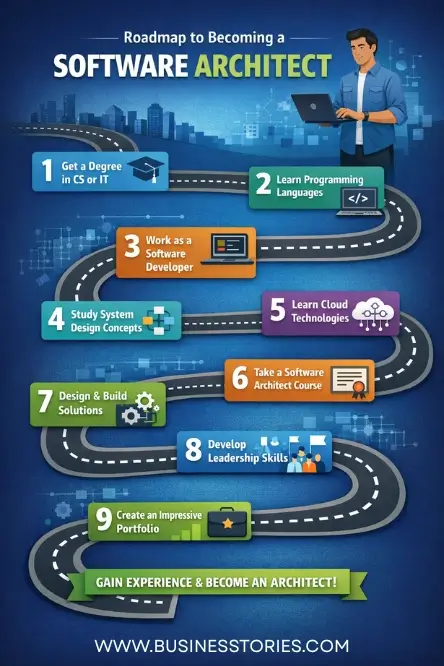
1. Build a Strong Educational Background
Start with the fundamentals. A degree in computer science, IT, or software engineering builds fundamentals. The theory you learn about data structures, algorithms, and operating systems actually matters when you’re designing systems at scale. But even self-taught architects learned everything online. The key is to not skip the fundamentals; however, you learn them.
2. Learn Programming Deeply
Write a lot of code. You should master at least one major language. Real projects that you build from scratch, break, fix, and improve. The more you build, the better you understand how systems behave in real-world situations. Each project teaches you something—what patterns work, what falls apart under pressure, and how different components interact.
3. Start Working as a Software Developer
Start your career as a developer. It helps you understand real-world challenges, teamwork, and project structure. Every bug you fix, every feature you ship, every late-night deployment—that’s all training for architecture work.
There isn’t one fixed timeline for how to become a software architect, but here’s a realistic roadmap:
Stage 1: Strong Developer (0–3 Years)
Focus on:
- Clean coding practices
- Debugging complex systems
- Understanding APIs and databases
- Writing maintainable code
Master one primary language deeply.
Stage 2: Senior Developer (3–6 Years)
Now you should:
- Lead small features
- Design modules
- Review code
- Understand performance optimization
- Work with DevOps teams
Start learning system design fundamentals.
Stage 3: Technical Leadership (5–8 Years)
This is where architectural thinking begins.
You should:
- Lead projects
- Design distributed systems
- Make tech stack decisions
- Understand cloud infrastructure
Explore cloud platforms like Amazon Web Services or Microsoft Azure through Microsoft Learn.
Stage 4: Transition to Architect
At this stage, you:
- Lead architecture discussions
- Design scalable systems
- Align tech with business needs
- Influence product strategy
You move from “How do I code this?” to: “How should this system evolve over 3 years?”
4. Study System Design Regularly
Obsess over system design. Read about micro services. Build a REST API. Try event-driven architecture. Work with different database types and layered architecture. These concepts will shape your architectural thinking and teach you how large-scale systems stay organized.
The more patterns you know, the better you’ll recognize which one fits each situation. It’s like a chef learning different cooking techniques—you need variety in your toolkit.
5. Learn Cloud Architecture
Get comfortable in the cloud. Most businesses look for architects familiar with cloud platforms, cost optimization, and working out deployment strategies. Systems built with cloud insight tend to grow easily and stay online across regions.
6. Take a Good Software Architect Course
Take a structured course when you’re ready. A structured course can help you learn system design, patterns, and cloud fundamentals faster. Real tasks show up along the way, shaped like actual architectural challenges.
7. Gain Experience in Designing Solutions
Work on bigger modules, plan architecture for small projects, and participate in design discussions. When your team is designing a new feature, offer your input. Ask if you can draft the technical design. Request to sit in on architecture reviews. This builds confidence and prepares you for high-level decision-making.
8. Strengthen Leadership and Mentorship Skills
Start mentoring junior developers. Write clear documentation. Lead by example in code reviews. When people start trusting your technical judgment, you’re already thinking like an architect even if that’s not your title yet. Strong leadership makes teams trust your architectural choices.
9. Create a Portfolio of Your Best Work
Create a portfolio that proves you can think architecturally. Include system diagrams, architecture decisions, and completed projects. A strong portfolio proves your skills and helps employers quickly understand your capabilities.
Career Growth Opportunities
The beautiful thing about starting as a software architect is that you’re not trapped. The role opens doors.
Some architects go deeper—becoming specialists in cloud architecture or security architecture. They become the go-to experts in specific domains. Others go broader—moving into technical leadership as engineering managers or CTOs. They use their architectural background to make better strategic decisions.
Some stay right where they are and love it. They become senior or principal architects, the people who design the most critical systems and mentor the next generation. The point is how to become a software architect. Once you develop this skill set, you have options. Real options, not just job titles.
Once you gain experience, you can move to roles like:
- Senior Software Architect
- Solutions Architect
- Cloud Architect
- Technical Lead
- Engineering Manager
- CTO
Each role brings higher responsibility, stronger leadership expectations, and greater influence in shaping the product and overall technology direction.
Avoid These Common Mistakes
To grow smoothly, avoid:
- Learning only coding and ignoring architecture: Developers who’ve written code for fifteen years and still think like someone with two years of experience. They never stepped back to learn system design, and now they’re stuck.
- Using outdated technologies: Stop learning every new JavaScript framework. Master fundamentals that last. A solid understanding of distributed systems is worth more than knowing the hot framework of the month.
- Avoiding documentation: Your brilliant design means nothing if nobody can understand or maintain it. Write it down. Draw diagrams. Make it clear.
- Not practicing design interview questions: You may be the smartest architect in the world, but if you cannot persuade your team to adopt your design, what value does it have? Communication isn’t optional.
- Poor communication during team discussions: Sometimes you need to push back on unrealistic timelines. Sometimes you need to say, “No, that approach will create technical debt we can’t afford.” Learn to have these conversations with empathy, but also with backbone.
Final Thoughts
Becoming a software architect isn’t easy. It takes years of work, countless mistakes, and honest self-reflection about your weaknesses. But if you love technology, if you enjoy seeing how pieces fit together, if you want to create systems that millions of people rely on—this career is incredibly rewarding.
You’re not just coding anymore and architecting solutions to real problems. You’re preventing disasters before they happen and enabling teams to move faster because you built them a solid foundation. One day, you’ll be the person sketching designs on the whiteboard while everyone leans in to listen. And you’ll remember how you got there—one deliberate step at a time.
Start today. Your future systems are waiting to be designed.
If you’re serious about learning how to become a software architect, remember this:
- It’s not a promotion. It’s a transformation. You move from solving small problems…
- To designing systems that support thousands—or millions—of users.
- Architecture isn’t about knowing everything. It’s about seeing the big picture.
- And that mindset—not just experience—is what turns developers into architects.
FAQs About How to Become a Software Architect
Are Software Architects in Demand?
Yes. Every company needs software. Complex software needs architects. As long as we’re building digital products, this role matters. The demand isn’t going anywhere—it’s growing.
Is Software Architecture a Good Career?
Absolutely. It offers strong salaries, leadership opportunities, and long-term career stability.
How long does it take to be a Software Architect?
Most people need six to ten years of solid experience. Some do it faster if they’re intentional about their learning and get the right opportunities. But don’t rush it—premature architects make expensive mistakes.
Will AI replace software architects?
No. AI might help us design better systems, but it won’t replace the human judgment needed for architecture decisions. These aren’t algorithmic problems with right answers. They’re messy, context-dependent choices that require experience, intuition, and understanding of people as much as technology.

Tabassum Shaik is an Author, Researcher, and SEO Specialist with over 8 years of experience creating informative content on business, startups, entrepreneurship, marketing, technology, and digital trends. She specializes in researching industry trends and transforming complex topics into practical, easy-to-understand insights. Her goal is to help readers stay informed, learn new ideas, and make better business decisions.