
From solar-powered cold chains to AI-driven crop advisory, a new generation of Indian agri startups is quietly rewriting the rules of Indian farming, one algorithm, one acre, and one farmer at a time. Indian agriculture feeds over a billion people. Yet for much of its history, the farming that makes such growth possible has operated without reliable data, accessible credit, or efficient supply chains. That is finally changing.
Agriculture contributes roughly 18% of India’s GDP and employs nearly half its workforce. Yet it remains one of the most underserved sectors in terms of technology adoption. Post-harvest losses alone account for an estimated 15–20% of all produce, a staggering inefficiency in a country where food security is both a political imperative and an economic necessity.
Into this gap, a vibrant ecosystem of Indian agri startups has stepped in. They are armed with artificial intelligence, satellite imaging, IoT sensors, and mobile-first platforms. These companies are tackling everything from soil health to supply-chain transparency. With India’s agritech market projected to touch $24 billion in 2026, the year stands out as one of consolidation, maturation, and genuine impact at scale.
This article profiles the most compelling Indian agri startups operating today. Unpacks the technology trends reshaping the sector and offers actionable perspectives for farmers, investors, and policymakers trying to navigate a rapidly evolving landscape.
Why 2026 is a Turning Point for Indian Agri Startups?
After the funding frenzy of 2021–22, the Indian agritech space went through a sobering correction. Several well-funded farm-to-fork Indian agri startups, including Otipy, Fraazo, and Deep Rooted, struggled to build sustainable unit economics and failed to raise follow-on capital. The investor enthusiasm has cooled, deal counts have dropped, and the agriculture sector has been forced to mature.
But maturation is not the same as stagnation. A new cohort of startups that survived the downturn did so because they had built real value for real farmers, not just attractive GMV numbers. Companies like Ecozen, Arya.ag, and DeHaat emerged from this period with stronger fundamentals, clearer paths to profitability, and renewed investor confidence. In 2025, a total of $80 million raised by Arya.ag and $30 million by AgroStar signaled a revival of selective, quality-focused funding activity.
“By 2026, over 70% of Indian agritech firms are harnessing AI for data-driven farming decisions, a tipping point that was unimaginable just five years ago.”
Top Indian Agri Startups in 2026
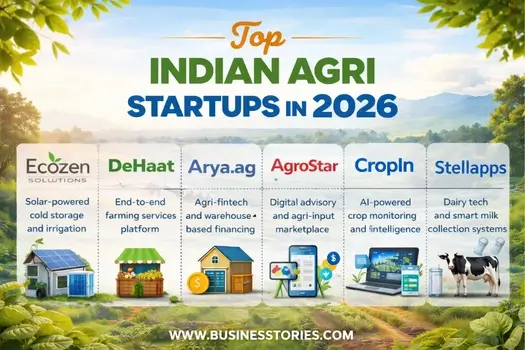
Here are some of the top Indian agri startups transforming the agriculture sector in 2026:
- Ecozen Solutions – Solar-powered cold storage and irrigation
- DeHaat – End-to-end farming services platform
- Arya.ag – Agri-fintech and warehouse-based financing
- AgroStar – Digital advisory and agri-input marketplace
- CropIn – AI-powered crop monitoring and farm intelligence
- Stellapps – Dairy tech and smart milk collection systems
1. Ecozen Solutions
Ecozen Solutions is an Indian climate-tech and agri-tech startup. It focused on building sustainable, solar-powered solutions for agriculture and rural infrastructure.
It was founded in 2010 by IIT Kharagpur alumni Devendra Gupta, Prateek Singhal, and Vivek Pandey. The company is headquartered in Pune. It was created with a mission to improve how agricultural produce is grown, stored, and transported using clean energy technologies.
It has built an end-to-end climate-smart technology platform covering solar-powered irrigation (Ecotron), portable cold storage (Ecofrost), and a marketplace connecting perishable produce farmers with organized buyers (Eco-Connect).
Use Case: How to use Solar-Powered Cold Storage for Reducing Post-Harvest Losses?
In many parts of India, farmers growing fruits and vegetables face a major challenge: a lack of cold storage facilities. Without proper storage, perishable produce often spoils within 1–2 days, forcing farmers to sell at low prices or incur heavy losses.
Ecozen Solutions addresses this problem through its solar-powered cold storage system, Ecofrost. These units operate without relying on grid electricity. It can be installed directly at farms or village collection centers.
With Ecofrost, farmers can store their produce safely for longer periods, allowing them to wait for better market prices instead of selling immediately after harvest.
Impact:
- Reduces post-harvest losses by up to 30–40%.
- Increases farmer income by enabling better price realization.
- Minimizes dependence on diesel or unreliable electricity.
- Supports sustainable and climate-friendly agriculture.
Key differentiator: A hardware-first approach that combines solar energy, thermal storage, and IoT to address the cold-chain gap rather than just digitizing around it.
2. DeHaat
DeHaat is one of the leading Indian agri startups. It was founded in 2012 by Shashank Kumar, along with co-founders Manish Kumar, Shashank Kumar Singh, and Saurabh Kumar.
Today, DeHaat operates across multiple Indian states and serves over 1.5 million farmers, making it one of the fastest-growing agri-tech startups in the country.
DeHaat reported the highest gross revenue among Indian agritech startups in FY25 at ₹3,010 crore, cementing its position as the sector’s revenue leader. With strong backing from investors and an expanding footprint across Bihar, Uttar Pradesh, and beyond, DeHaat is positioning itself as the default operating system for the Indian smallholder farmer.
Use Case: How Does DeHaat Provide End-to-End Farming Support for Small Farmers?
In India, small farmers often struggle with fragmented access to essential services like quality seeds, expert guidance, and reliable market connections. This leads to poor crop yields and lower income.
DeHaat solves this problem by offering a one-stop digital platform where farmers can access everything they need, from buying inputs to selling their produce.
Through its network of local service centers and digital tools, farmers receive:
- Personalized crop advisory.
- Access to high-quality seeds and fertilizers.
- Direct connections to buyers for better pricing.
Impact:
- Improves crop productivity through expert guidance.
- Reduces dependency on middlemen.
- Increases farmer income with better market access.
Key differentiator: Full lifecycle coverage, the only major platform addressing inputs, advisory, financing, and market linkage under one roof.
3. Arya.ag
Arya.ag is one of the leading Indian agri startups, transforming the agricultural value chain through technology, storage, and finance. Founded in 2013 and headquartered in Noida, the company was established by Prasanna Rao, Anand Chandra, and Chattanathan Devarajan, who brought deep expertise from banking, finance, and rural markets.
In FY25, Arya.ag reported a profit of ₹34 crore, making it one of the few genuinely profitable agritech companies in India at scale.
Use Case: How is Arya.ag Helping Farmers Avoid Distress Selling?
One of the problems in Indian agriculture is distress selling. Farmers are forced to sell crops immediately after harvest due to a lack of storage and urgent financial needs. This leads to lower income and unstable livelihoods.
Arya.ag addresses this issue through its integrated agriculture storage and financing platform. Farmers can store their crops in certified warehouses and access instant credit against stored produce, a key feature of modern agri-fintech startups in India.
This enables farmers to delay selling and wait for better market prices, improving their earnings and financial stability.
Impact:
- Increases farmer income through better price realization.
- Reduces post-harvest losses in agriculture.
- Provides quick access to agriculture loans and credit.
- Strengthens decision-making in agri market linkages.
Key differentiator: One of the only profitable, large-scale agritech companies in India—with a model that financially empowers farmers without asking them to change how they farm.
4. AgroStar
AgroStar has built a reputation as one of the fastest-growing Indian agri startups. It’s offering farmers regionally customized agronomic advice alongside doorstep delivery of quality seeds, crop nutrients, and plant protection products.
AgroStar was founded by Shardul Sheth, Sitanshu Sheth, and Ashish Bagrecha. AgroStar was built with a mission to digitize agriculture and improve farmer productivity and income.
Its mobile-first approach has scaled access to best-in-class inputs and expert guidance across rural India. A $30 million fundraiser in 2025 renewed confidence in the company’s trajectory.
Today, AgroStar stands out among agri-tech companies in India, driving innovation in digital agriculture, farm advisory, and rural e-commerce.
Use Case: How is AgroStar Improving Crop Yield Through Smart Advisory?
Many farmers struggle with selecting the right seeds, fertilizers, and crop protection methods due to a lack of expert guidance. This often leads to reduced crop yield and increased costs.
AgroStar solves this problem by offering a digital advisory platform combined with an agri-input marketplace. Farmers can access expert recommendations through the app and purchase the exact products needed for their crops.
How It Works:
- Farmers receive crop-specific recommendations based on location and season.
- They can order verified agricultural products directly through the platform.
- Advisory support is available in local languages for better accessibility.
Impact:
- Increases crop yield and productivity.
- Reduces incorrect input usage and farming costs.
- Improves farmer confidence and decision-making.
- Strengthens direct farmer-to-brand supply chain.
Key differentiator: Tight integration between data-driven advisory and product sales, creating a feedback loop that improves recommendations while driving revenue.
5. CropIn
CropIn is one of the leading agri-tech startups in India that is transforming agriculture through data-driven solutions and digital farming platforms. Founded by Krishna Kumar and Kunal Prasad in 2010.
Its platform has digitized over 16 million acres of farmland and impacted more than 7 million farmers across multiple countries. CropIn’s B2B SaaS model, selling farm intelligence to large agri-enterprises rather than individual smallholders, gives it a more scalable, defensible revenue base than consumer-facing platforms.
Today, CropIn works with global clients across multiple countries, making it a key player in the digital agriculture ecosystem. By combining technology with agriculture, CropIn is driving the future of smart farming in India and beyond.
Use Case: CropIn AI-Powered Crop Monitoring for Better Yield?
One of the most impactful use cases of CropIn is its AI-powered crop monitoring system, which helps farmers and agribusinesses track crop health in real time.
Traditionally, farmers rely on manual observation to detect crop issues, which often leads to delayed action and reduced yield. CropIn solves this problem by using satellite data, weather insights, and AI algorithms to continuously monitor crop conditions.
With CropIn’s platform, farmers and companies can:
- Detect pest infestations early.
- Monitor soil moisture and crop growth.
- Receive data-driven advisory for better decision-making.
Impact:
- Improves crop yield and quality.
- Reduces input costs, such as fertilizers and water.
- Enables proactive farm management.
- Strengthens supply chain efficiency.
Key differentiator: Global-scale precision agriculture SaaS with a focus on enterprise and institutional clients—insulated from the volatility of individual farmer acquisition.
6. Stellapps
Stellapps is one of the leading dairy tech startups in India, transforming the traditional dairy ecosystem through data, IoT, and artificial intelligence. Founded by Ranjith Mukundan in 2011, Stellapps focuses on digitizing milk production, procurement, and distribution to improve efficiency and transparency across the value chain.
As a fast-growing agri-tech and dairy tech startup, Stellapps provides smart solutions like automated milk collection systems, cold chain monitoring, and livestock management platforms. These technologies help dairy farmers and cooperatives improve milk quality, reduce wastage, and increase profitability.
Use Case: How Does Stellapps Do Smart Milk Collection & Quality Monitoring?
One of the most impactful applications of Stellapps is its smart milk collection and quality monitoring system.
In traditional dairy systems, milk quality testing is often manual and inconsistent, leading to inaccuracies, wastage, and unfair pricing for farmers. Stellapps solves this problem by introducing automated milk collection units integrated with IoT and data analytics.
These systems instantly measure key parameters like fat content, SNF (solids-not-fat), and quantity at the collection point. The data is recorded digitally and shared in real time with farmers and dairy operators.
Impact:
- Ensures transparent and accurate milk pricing.
- Reduces manual errors and fraud.
- Improves milk quality across the supply chain.
- Builds trust between farmers and dairy companies.
Key differentiator: Deep vertical focus on dairy, a $100B+ sector that most agritech startups have ignored in favor of crop farming.
Challenges Still Holding the Agriculture Sector Back
Despite the momentum, honest observers of Indian agritech will note that significant structural challenges remain. Understanding them is essential for any stakeholder investor, policymaker, or entrepreneur trying to build in this space.
- Digital Literacy Gaps
Many Indian small landowners, particularly those above 50 or in remote areas, lack the technical literacy to operate even well-designed mobile platforms. Voice-based interfaces and regional language support have helped, but the gap persists.
- Fragmented Landholdings
With the average Indian farm covering less than 1.1 hectares, the unit economics of many agritech solutions become strained. Aggregation and collective models help, but building them at scale is slow and expensive.
- Rural Internet Connectivity
Although India’s mobile internet penetration has grown dramatically, connectivity remains patchy in remote agricultural areas. Low-bandwidth and offline-first design are necessities, not afterthoughts.
- Unit Economics Under Pressure
Fresh produce supply chains operate on razor-thin margins. Several well-funded startups in this space, including Otipy and Fraazo, were unable to make the economics work at scale, eventually shutting down or pivoting.
- Farmer Trust and Adoption
Building trust with India’s farmers, who have often been exploited by middlemen and misled by input sellers, takes years of consistent, high-quality service. Many agritech companies underestimate this cultural dimension.
What Investors Should Know in 2026?
The agritech funding landscape in India has undergone a significant reset since the 2021–22 peak. Total funding touched $1.2 billion in 2021 but has contracted sharply since, with only selective rounds going to companies with proven fundamentals. This is not necessarily bad news; it has forced a quality filter that benefits the sector’s long-term health.
The companies that attracted investment in 2025, Arya.ag ($80M), AgroStar ($30M), and Ecozen (ongoing debt rounds) share a common thread: they have moved beyond GMV-driven metrics to demonstrate real profitability or a credible path toward it.
Investors in 2026 are backing fundamentals, not future stories. Most of the Indian agri startups have been founded by alumni of IIT Bombay, IIT Kharagpur, and BITS Pilani. This is a signal of technical depth, but domain expertise in agriculture itself remains rare and valuable.
Conclusion: The Road Ahead for Indian Agri Startups
The story of Indian agri startups in 2026 is not one of explosive hypergrowth; it is one of earned credibility. The companies that have survived the funding winter, proven their unit economics, and built genuine farmer trust are now positioned to define what modern Indian agriculture looks like for the next decade.
For farmers, the practical upshot is significant: better seeds, smarter irrigation, fair prices, and access to formal credit are increasingly within reach. It is not just for large commercial farmers but also for smallholders growing on two hectares in rural Bihar or Andhra Pradesh.
For investors and entrepreneurs looking to enter the space, the lesson from the past three years is clear: technology is necessary, but not sufficient. The companies that will define this decade are those that combine technical innovation with deep rural distribution, local language interfaces, farmer-centric trust-building, and sustainable business models. Shortcuts on any of these dimensions have proven fatal.
India’s agricultural revolution is underway. It is slower, messier, and more complicated than the breathless 2021 narratives suggested. But it is also more real, and in 2026, the Indian agri startups driving it are more capable and more resilient than at any previous point in the agriculture sector’s history.

Tabassum Shaik is an Author, Researcher, and SEO Specialist with over 8 years of experience creating informative content on business, startups, entrepreneurship, marketing, technology, and digital trends. She specializes in researching industry trends and transforming complex topics into practical, easy-to-understand insights. Her goal is to help readers stay informed, learn new ideas, and make better business decisions.