Introduction
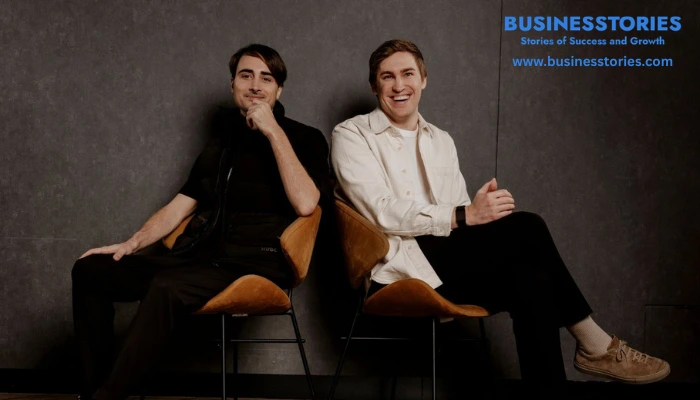
Every outstanding company begins with a simple frustration. For ElevenLabs, that frustration started in a Polish living room. Two school friends, Mati Staniszewski and Piotr Dąbkowski, grew up watching American movies. However, those movies were poorly dubbed into Polish.
A single, flat voice read over every character. As a result, the emotion vanished. The actors faded behind a monotone. Years later, both men became successful. Mati worked as a deployment strategist at Palantir.
Meanwhile, Piotr built machine learning systems at Google. Yet that childhood annoyance never left them. They kept asking the same question. Why can’t a machine speak with real feeling? Why does every AI voice sound robotic?
In 2022, they made a significant decision. First, they pooled their savings. Then, they quit their jobs and founded ElevenLabs. Their goal was bold yet simple. They wanted to give artificial intelligence a human voice.
Today, that tiny startup from Poland is worth more than $11 billion. Therefore, it stands as proof that one small, personal problem can grow into a world-changing technology.
The Founding Story of ElevenLabs
The story of ElevenLabs is, at its heart, a tale of friendship. Mati and Piotr met as teenagers in Warsaw. Both attended the same high school. Furthermore, both loved technology and problem-solving. However, their career paths diverged.
First, Mati studied mathematics at Imperial College London. Thereafter, he joined Palantir. There, he helped governments and large companies deploy complex technology. Piotr took a more academic path.
He studied at Oxford and Cambridge, where he focused on machine learning and speech. Later, he worked at Google as a machine learning engineer. In fact, his master’s work already touched on speech synthesis. That field would later define his future.
Despite the distance, the friends kept experimenting together. They created a tiny accent-detection application, for instance. They also built a recommendation engine. Yet they kept returning to a shared frustration.
Text-to-speech tools sounded cold and lifeless. Existing voices lacked the natural pauses, excitement, and warmth that make human speech real. Therefore, they wanted to fix that.
The turning point
Then came the turning point. While working at Palantir, Mati teamed up with Piotr. Together, they explored whether AI could solve the dubbing problem from their childhood. They imagined actors finally speaking their language.
Best of all, the emotion would stay intact. That vision became their mission. In April 2022, they founded the company. A month later, in May 2022, they quit their jobs and went all in.
The name itself carries meaning. “Eleven” honors November 11, Poland’s Independence Day. Meanwhile, “Labs” signals the company’s deep research focus. Together, the name became a quiet declaration. It showed pride in their roots and ambition for the future.
Here is a unique insight worth remembering. ElevenLabs did not chase the hottest trend of 2022. Most AI startups rushed to build chat interfaces on top of large language models. Instead, these two founders spent a full year in stealth mode.
Quietly, they perfected the sound of a single voice. They focused on quality before hype. As a result, that patience became their greatest advantage.
How ElevenLabs Works: The Technology Behind the Voice
Most people only hear the result. They press a button, type some text, and a warm, lively voice reads it back. But beneath that simple experience lies serious research. ElevenLabs builds what experts call natural-sounding speech synthesis using deep learning.
Traditional text-to-speech tools stitch together recorded sounds. That approach often sounds choppy and flat. However, ElevenLabs took a different route. Its models learn the patterns of human speech from vast amounts of data.
Because of this approach, they capture tiny details like breathing, laughter, and emotional tone. The result is audio that can sound cheerful, sad, or excited. It does not just sound neutral.
Breakthrough model
The breakthrough model arrived in January 2023. At that time, users could type any text and hear it read aloud in any voice. They could even use a cloned version of their voice.
The leap in quality stunned early adopters. Clearly, it was far more natural than the robotic voices of older assistants. People briefly described the AI voices as capable of joy and even laughter.
Over time, the platform expanded far beyond basic speech. Today, ElevenLabs offers a full suite of audio tools. Its text-to-speech engine remains the core. Furthermore, its voice cloning feature lets users create a digital copy of a real voice with proper consent.
Its dubbing tool translates spoken content while preserving the original speaker’s tone. In addition, its speech-to-text and voice agent products push the company into new territory.
Here is a perspective many articles miss. ElevenLabs deliberately pairs research with product. Instead of separating scientists from builders, the company brings them together.
Small, autonomous teams ship models and watch how real customers use them. Then, engineers feed those lessons straight back into research. This loop is why the company improves so fast.
That structure also explains the exceptional speech quality. When research and product live in the same place, breakthroughs reach users quickly. Therefore, for readers, the takeaway is clear.
EleLabs wins not by having just one excellent model. Instead, it wins by building a system that learns and ships continuously.
ElevenLabs’ Remarkable Growth and Milestones
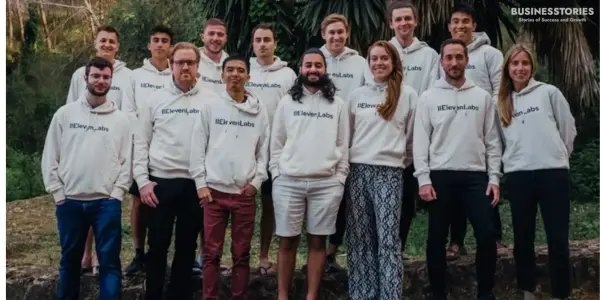
The rise of ElevenLabs has been nothing short of meteoric. From a two-person project, it grew into one of Europe’s most valuable startups in just a few years. The numbers tell a dramatic story.
First, the company began with a modest $2 million pre-seed round in early 2023. That money let the founders refine their first model. Then came the public beta launch in January 2023.
As a result, the response surprised even the founders. Within roughly five months, well over one million users signed up. Clearly, the demand was real and global.
Series A round
Investors took notice fast. For instance, in June 2023, ElevenLabs raised a $19 million Series A round. Andreessen Horowitz, one of Silicon Valley’s most respected firms, led that round.
Furthermore, former GitHub CEO Nat Friedman and entrepreneur Daniel Gross joined in. High-profile backers like Instagram co-founder Mike Krieger added weight to the story.
Thereafter, growth only accelerated.
- In January 2024, a Series B round of $80 million pushed the valuation to $1.1 billion. That made ElevenLabs a genuine unicorn. A year later, a $180 million Series C round lifted the valuation to $3.3 billion.
- Then, in October 2025, the company reached a stunning $6.6 billion valuation.
- By early 2026, reports pointed to an $11 billion valuation with a potential IPO on the horizon.
The revenue picture matters too. ElevenLabs has pointed to strong trailing twelve-month revenue. Roughly half of it comes from corporate customers like Cisco, Twilio, and Adecco.
Meanwhile, the other half comes from YouTubers, podcasters, and authors. The company is profitable, which is noteworthy. That is a rare achievement among AI startups.
Here is an insight competitors rarely highlight. ElevenLabs built a genuine fan base before it built a big sales team. Creators independently discovered the tool, loved it, and shared it with others. Consequently, this organic trust facilitated access to enterprise deals.
Growth followed demand rather than hunting for it. Therefore, for founders reading this story, the lesson is powerful. A clear problem, a patient year of research, and a product people enjoy can carry a company far. In fact, they can carry it further than any advertising budget.
Ethical Challenges and How ElevenLabs Responds
Powerful technology brings powerful questions. This is especially true for a tool that can copy a human voice. From its earliest days, ElevenLabs faced a difficult reality. The same software that helps people can also cause harm.
The risks are indeed significant. For example, a voice clone could impersonate someone without permission. Furthermore, malicious actors could create audio of a public figure saying things they never said.
Deepfake scams have become a growing concern worldwide. Naturally, critics worried that a company built on voice cloning might make these problems worse.
However, ElevenLabs has responded with a mix of tools and rules. First, its voice cloning feature requires consent and verification. Users can only clone voices they own or have permission to use.
In addition, the company built safeguards to detect synthetic audio. On top of that, a content moderation system works to catch harmful material before it spreads.
The platform powers translation and dubbing
At the same time, the company tries to highlight the positive side. Its voice library and marketplace let people license their voices and share in the earnings.
Furthermore, the platform powers translation and dubbing that help creators reach new audiences. In fact, the founders frequently describe a simple vision. They want to use AI to break down language barriers and amplify human potential.
Here is a perspective many articles skip. ElevenLabs treats ethics as an ongoing design problem, not a press release. Because it builds both research and product, it can embed safeguards directly into the models.
Detection, consent, and moderation become features rather than afterthoughts. That integration is technically challenging. However, it is also the most honest way to build responsibly. Still, no system is perfect.
As the technology improves, the arms race between misuse and protection continues. Therefore, for readers, the takeaway is to approach AI voice tools thoughtfully. Verify what you hear, respect consent, and demand transparency from the platforms you use.
The Human Impact: Restoring Voices and Breaking Barriers
Beyond the valuations and the hype, ElevenLabs does something deeply personal. It helps people speak again. This is where the company’s mission feels most real. Consider someone who has lost their voice to ALS, cancer, or another serious condition.
Traditional options are limited and often robotic. However, ElevenLabs offers a different path. A person can first record their voice. Then, they can rely on technology to speak with that same voice later. Best of all, the tone and warmth stay intact.
In fact, the company is turning this work into a major public effort. Its “1 Million Voices” initiative commits what it values at $1 billion in free voice restoration technology. This will help one million people living with permanent voice loss. The program began quietly in 2023.
Now, it is expanding in a very public way. For countless families, this technology is less about convenience. Instead, it is more about dignity.
Automated dubbing
The impact also stretches across language. For example, automated dubbing lets a blogger record in English and publish in Spanish. The voice stays their own, with emotion preserved.
Furthermore, audiobook creators use the platform to produce titles faster. Podcasters translate episodes for global listeners. Everywhere, the same theme appears. Voice AI lowers the barriers between people.
Here is an insight worth carrying with you. ElevenLabs succeeded because it turned an annoyance into empathy. The founders hated awful dubbing. So, they built something that respects both the speaker and the listener. In fact, the best technologies often grow from a personal ache, not a market report.
The financial success is impressive. But the human stories are the true measure of the mission. The person who speaks again, the creator who reaches a new continent. These moments show what matters. Therefore, that is what keeps ElevenLabs from being just another AI company.
Conclusion
The story of ElevenLabs is, above all, a reminder that small frustrations can change the world. Two Polish friends hated the soulless dubbing of their childhood. They carried that annoyance for years. Then, they turned it into one of the most valuable AI startups in history.
Their journey demonstrates three key lessons.
- First, patience wins. ElevenLabs spent a quiet year perfecting its voice models while rivals chased trends.
- Second, focus matters. By combining research and product under one roof, the company shipped breakthroughs faster than almost anyone else.
- Third, purpose endures. From restoring lost voices to breaking language barriers, the mission is about people, not just algorithms.
Today, ElevenLabs stands at the center of a fast-moving industry. It competes with giants like Google, OpenAI, and Microsoft. Yet, it keeps the friendly, builder-driven spirit of its founders. That balance is rare and worth watching.
FAQs
1. How did the founders of ElevenLabs come up with the idea?
They grew up in Poland frustrated by flat movie dubbing. Later, as Palantir and Google engineers, they decided to build a text-to-speech AI with real emotion and natural pauses.
2. What does ElevenLabs actually do for its users?
ElevenLabs turns text into realistic speech. Furthermore, users can clone voices, dub videos into other languages, and generate AI voices for podcasts, audiobooks, and apps.
3. Is voice cloning on ElevenLabs safe and consent-based?
Yes. First, voice cloning requires verification and proper consent. In addition, the company adds detection tools and moderation to reduce deepfake risks and prevent misuse.
4. How much funding has ElevenLabs raised so far?
ElevenLabs has raised more than $300 million in total. As a result, its valuation climbed from about $100 million in 2023 to over $11 billion by early 2026.
5. What is the ElevenLabs 1 Million Voices initiative?
It is a program offering free voice restoration technology to one million people with permanent voice loss, helping those affected by ALS, cancer, and similar conditions speak again.

Tabassum Shaik is an Author, Researcher, and SEO Specialist with over 8 years of experience creating informative content on business, startups, entrepreneurship, marketing, technology, and digital trends. She specializes in researching industry trends and transforming complex topics into practical, easy-to-understand insights. Her goal is to help readers stay informed, learn new ideas, and make better business decisions.