Most AI tools help one person at a time. You ask a question, and you get an answer. But work rarely happens alone. What if your AI could talk to your teammate’s AI and do the work for you? That simple idea turned Town AI into a unicorn.
In fact, the San Francisco startup reached a $1 billion valuation just 138 days after its public launch. On October 19, 2026, it raised $108 million in a Series B round. Forerunner Ventures and Menlo Ventures led the deal.
In this founder story, you will learn who built Town, how its AI bots work as a team, and how it grew so fast. Plus, you will get clear lessons you can use in your own business. Let’s dive in.
The Founders Behind Town AI: From Plaid to a Failed Tax App
Every startup story starts with people. And Town’s story starts with two builders who had chased the same dream for years.
Jean-Denis Greze: The Engineer Who Scaled Plaid
Jean-Denis Greze is Town’s co-founder and CEO. Before Town AI, he was the CTO of Plaid, the fintech company that links bank accounts to apps. At Plaid, he led engineering, product, and design. During his time there, revenue grew from about $10 million to more than $300 million a year.
So Greze knew how to grow a product.
Tony Vincent: Chasing the AI Teammate
Tony Vincent is the co-founder and chief product officer. He was a director of applied AI products at Google. Earlier, he co-founded two startups. One was bought by Google, and the other was bought by Dropbox.
In fact, Vincent had tried to build an AI teammate before. At Google, his team presented one of these projects at Google I/O in 2023. However, the tech was not ready yet. Now, he says, it is.
The $1M Business They Walked Away From
Here is the part most articles skip. Town did not start as an AI assistant. Instead, it began as an AI tax tool for small businesses.
And it worked. The tax product earned close to $1 million in its first year. Greze even expected $2.5 million to $3 million the next year. Still, he shut it down.
Why? Big tax firms could add AI to their tools and sell it to millions of current users. A tiny startup could not compete. On top of that, tax software sells once a year. So the team had only about a month to change course.
Our take: This story is the real lesson of Town’s origin. Killing a successful business can be braver than starting one. Greze judged the market, not the revenue. As a result, he moved his team toward a much bigger prize before the window closed.
The founders started Town in 2024. Then, in March 2025, it raised an $18 million seed round led by First Round Capital. The pivot had begun.
What Town AI Actually Does: Meet the Townies
So what does Town sell? In short, it gives every worker a personal AI work assistant called a “Townie.”
An Assistant That Learns How You Work
A Townie connects to your email, calendar, documents, and work apps. Then it learns about your people, your projects, and even your writing voice. Thereafter, it starts taking work off your plate.
For example, a Townie can:
- Sort your inbox and flag what matters most.
- Draft replies that sound like you
- Book meetings by checking open times on your calendar
- Prep you for calls with notes on who you are meeting
- Track your to-dos so nothing slips
Each Townie also has a fun cartoon look. For instance, Greze’s assistant is a silver fox named Ivy who carries a little bag.
Draft First, Send Later
Here is a smart design choice. By default, a Townie writes drafts but does not hit send. Instead, drafts wait in your outbox until you approve them.
Why does this matter? Greze believes the worst AI failure is not a wrong answer. Rather, it is making the user look foolish in front of a client. A poor draft is a small annoyance. In contrast, a poorly written email sent to your boss is a real problem.
Next, Town AI earns freedom over time. After you approve the same task ten times, it asks if it can do it on its own. You must click to say yes. So the AI can never give itself new powers.
Our take: Most AI tools compete on what they can do. Town competes on what it won’t do without you. That restraint is a feature. In fact, it may explain why trust grew so fast.
The results back these claims up. According to Fortune, Town had about 10,000 users soon after launch. Better still, users who built at least one automation stayed at a 99% rate after two months.
Town also offers simple plans. There is a free tier. Then Starter costs $15 per user each month. Finally, Pro costs $49 per user each month, billed yearly.
How Town AI Bots Work Together as a Team
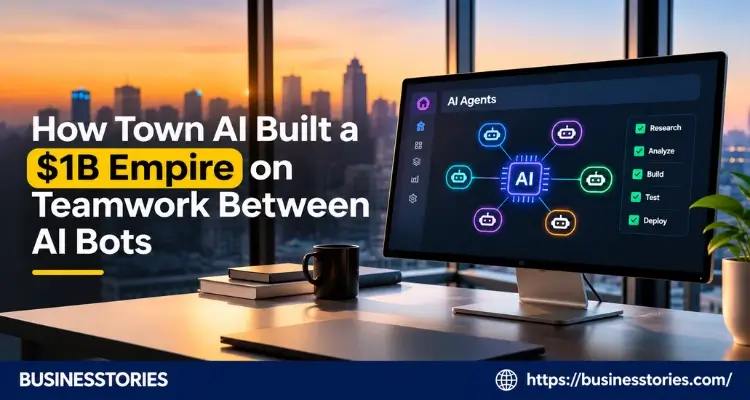
Now we arrive at the main concept that justifies the $1 billion valuation. With its Series B, Town moved from personal AI assistants to AI bots that collaborate across a whole team.
As Greze said on launch day, “Most AI assistants are built for one person. Work doesn’t happen alone. I think the moat is multiplayer.”
Townies That Talk to Other Townies
For the first time, Townies can work directly with each other. They can:
- Ask each other questions, like “When is the client call?”
- Share context across a team, so no one starts from zero.
- Hand off work from one person’s assistant to another’s
- Reach people outside the company, such as customers and job candidates, over email and text.
But each Townie still guards its owner’s data. In other words, a Townie shares only the information that its owner would choose to share. When a Townie faces a choice, it first asks for guidance and then brings the decision back to its human owner.
Shared Workflows That Update Once
Next comes shared workflows. Let’s say a business team adds new details to its notes on competitors. They update the call-prep process just once. From then on, every sales rep’s Townie prep calls with the new details built in.
This removes a hidden chore. With Town, one change flows to everyone.
Why Teamwork Matters So Much
Menlo Ventures notes that knowledge workers spend more than 13 hours a week on email, chat, and text. Now Townies can answer many of those questions for each other.
Greze also has a bold idea for privacy. Companies keep data in silos for good reasons. So he suggests an AI inside each silo that decides what is safe to share. For instance, it could show who knows a sales lead without showing any private emails.
Our take: Here is the insight competitors often miss. A solo AI assistant is easy to replace. In contrast, a team of linked Townies gets smarter with each new user. Every new Townie adds context that helps all the others.
As a result, leaving Town means breaking a web, not just closing an app. That is the real moat behind the multi-agent model.
The Road to $1 Billion in 138 Days
The town’s funding moved at record speed.
| Date | Round | Amount | Lead Investors |
| March 2025 | Seed | $18M | First Round Capital |
| June 3, 2026 | Series A | $55M | Andreessen Horowitz (a16z) |
| October 19, 2026 | Series B | $108M | Forerunner Ventures, Menlo Ventures |
In total, TechCrunch reports that Town AI has raised at least $160 million. Furthermore, its Series B came less than five months after its Series A. That gap is rare, even in today’s hot AI market.
Investors Who Used the Product First
What drove the deal? Most importantly, the investors were first-time users of the product. For example, First Round partner Todd Jackson said 93% of First Round used Town with no top-down order. Likewise, Menlo said its whole team began using Town in June.
Soon after, Menlo’s partners wrote that their Townies had become their hardest-working team members.
Fast Growth With a Lean Team
The growth numbers are strong. Town says it reached seven figures in yearly recurring revenue within weeks of launch. Since July, paying customers grew four times, and paying teams grew nine times.
Yet the company stays small. Its careers page listed fewer than 40 employees in September 2026. Town says its team roughly doubled over five months if you count Townies, which cost less than $100 a month.
Its marketing is lean too. Town leans on ads and newsletters, not cold sales calls.
A Word of Caution
Still, a valuation is a price, not a profit. “Seven figures” could mean $1 million or close to $10 million. At $49 a seat, $1 million a year takes about 1,700 paying seats.
Our take: Town’s real advantage was not hype. Instead, it was proof inside the investors’ own offices. When your buyers are also your users, the pitch writes itself.
Lessons Founders Can Copy From Town AI’s Rise
You may not raise $108 million this year. However, you can still copy the habits that made Town grow. Here are five practical steps.
Step 1: Judge the Market, Not Just the Revenue
Greze shut down a business that was making money. Why? He saw that big rivals would win the race. So ask yourself: Can a larger player copy my product and sell it to their users tomorrow? If so, rethink your plan early, while you still have time.
Step 2: Build Trust Before You Add Power
Town AI starts with drafts and asks before it acts. Do the same with your product.
- First, launch with safe, low-risk features.
- Then, add more freedom as users show they trust you.
Step 3: Get Your First Users to Spread the Word
Town AI spreads through group chats before any sales push.
- To achieve this goal, first find a small group that feels your problem deeply.
- Next, offer them a product worth sharing.
- Finally, make sharing easy with invites or team plans.
Step 4: Design for Teams, Not Just Users
A single user can leave in a minute. A whole team rarely does. So look for ways your product can connect people. For example, shared files, shared settings, or shared workflows all raise the cost of leaving.
Step 5: Turn Customer Wins Into Content
Town AI turns customer routines into web pages. You can, too. Each month, collect three real stories of how people use your product. Then turn them into short guides or case studies.
Our take: The biggest lesson is not about AI at all. It is about timing and trust. Town AI waited until the tech was ready, then moved faster than anyone. Meanwhile, it never asked users to trust it more than it had earned.
Conclusion: What Town AI Teaches Us About the Future of Work
The rise of Town AI shows where AI at work is heading. In summary, the startup excelled in three key areas.
- First, the founders made a difficult decision. They shut down a working tax business because they saw a bigger shift coming.
- Second, they built Townies with trust at the core. Drafts come first, and Townies earn new powers over time.
- Third, they bet on teamwork. Townies now talk to each other, share context, and hand off work across a whole team.
Together, these moves pushed Town from launch to a $1 billion valuation in just 138 days.
Still, the story is not finished. A high price is not the same as lasting success. Town must now prove that AI teamwork saves real time and money at scale. Furthermore, giant rivals like Google and Microsoft have their assistants with deep data access.
Even so, the main message is clear. The next wave of AI will not just speed up one person. Instead, it will speed up whole teams together.
So, what should you do next? Look at your team today. Find one task that bounces between people, like call prep or status updates. Then test an AI assistant to handle it for a week. Track the hours you save. That small test will show you how AI teamwork could change your business.
Frequently Asked Questions About Town AI
1. Who founded Town AI, and what did both founders do before starting?
Jean-Denis Greze and Tony Vincent founded Town AI in 2024. Greze was the CTO of Plaid, a fintech company. Vincent led applied AI product work at Google and co-founded two startups that were later acquired.
2. How did the Town AI startup reach a $1 billion valuation so fast?
Town AI hit a $1 billion valuation 138 days after launch. Fast revenue growth, strong user retention, and investors who used the product daily drove its $108 million Series B round in October 2026.
3. What is a Townie, and how does this AI work assistant help you daily?
A Townie is a personal AI work assistant. It connects to your email, calendar, and apps. Then it learns your voice to draft replies, book meetings, prep calls, and track tasks for you.
4. How do Town AI assistants work together as a team inside a company?
Town AI assistants can ask each other questions, share context, and hand off work. Each Townie shares only what its owner allows. Shared workflows also update every teammate’s assistant with one simple change.
5. Is Town AI safe to use with your private business emails and data?
Town AI is SOC 2 Type 2 compliant. By default, it does not train models on customer data. Its assistants also write drafts first and need your approval before sending emails or taking new actions.

Tabassum Shaik is an Author, Researcher, and SEO Specialist with over 8 years of experience creating informative content on business, startups, entrepreneurship, marketing, technology, and digital trends. She specializes in researching industry trends and transforming complex topics into practical, easy-to-understand insights. Her goal is to help readers stay informed, learn new ideas, and make better business decisions.