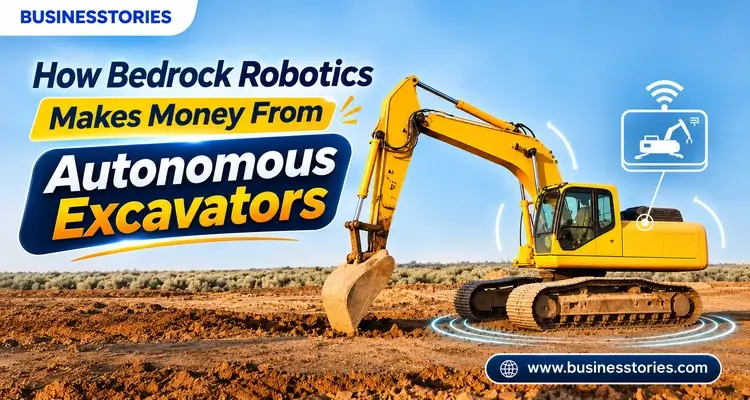
Last August, an excavator started digging at a water treatment facility in Nevada with nobody in the cab. A contractor was paying for that work. That’s the moment Bedrock Robotics stopped being a science project and became a business.
So how does Bedrock Robotics make money? In short, it sells contractors a retrofit kit that makes the excavators they already own run on their own. It then charges for that autonomy as an ongoing service.
Analysts think it uses a two-part model. There’s a one-time install fee, plus a monthly fee for software and remote oversight. Bedrock hasn’t published its prices.
In this guide, you’ll see what’s confirmed, what’s still an educated guess, and the math that makes the model work.
Key Takeaways
- Bedrock Robotics sells autonomy, not machines. Its kit lets a contractor’s own excavator dig by itself.
- Analysts say revenue comes from install fees plus a monthly subscription. Bedrock hasn’t confirmed its prices.
- Paid, operator-free work began in mid-August 2026. By then, Bedrock had 15 contractor partners across 23 states.
- The company has raised close to $1 billion. Its latest round valued it at $4.1 billion.
- The big unknowns are uptime, intervention rates, and cost per cubic yard.
What Does Bedrock Robotics Actually Sell?
Bedrock Robotics sells a bolt-on kit that lets heavy machines drive themselves. It doesn’t build excavators. Instead, it upgrades the ones contractors already run. Bedrock calls the product the Bedrock Operator. It adds sensors, cameras, and a small computer to a normal excavator.
According to Construction Metrics’ October 2026 report, a crew can install it in about one day. A site manager then sets the dig plan, and the machine does the rest. The machine stops if a person or an unauthorized object comes too close.
The computer side comes from a familiar name. SiliconANGLE reported in October 2026 that the system runs on a chip from Nvidia, which is also a Bedrock investor.
Why start with excavators? Bedrock says they often make up about 25% of a contractor’s fleet. Dump trucks, dozers, and loaders are on the roadmap. This indicates potential future revenue, as each new machine type represents an opportunity to sell a new kit to the same customer.
Here’s what most profiles miss. The retrofit choice is a sales decision as much as a technical one. A large excavator can cost around $600,000. Asking a contractor to replace a fleet is a tough pitch. Asking them to add a kit to machines they’ve already paid for is much easier.
The team helps too. Former Waymo engineers started Bedrock in 2024, with Boris Sofman as CEO. Investors say they’re backing a team that has already made self-driving systems work. Read more AI startup profiles.
How Bedrock Robotics Makes Money: The Revenue Model
Bedrock Robotics earns money when contractors pay to run its autonomy on real jobs. The exact pricing is private, but the outline of the model is clear.
Start with what’s confirmed. Bedrock’s machines have done paid work on live commercial sites since mid-August 2026. That’s from the company’s own announcement. Bedrock hasn’t shared revenue, prices, or machine counts.
Now the analyst view. Research firm Sacra describes a two-part pricing model. First, there’s a one-time fee for the kit and installation. Then there’s a monthly fee for software and remote oversight.
Sacra also notes that customers often start with one or two machines and then expand. Treat this as an informed outside estimate. Bedrock hasn’t confirmed it.
There’s a useful precedent too. Rival Built Robotics publicly priced its retrofit kit. TechCrunch reported in 2022 that Built charged $3,000 per machine per month, plus hourly usage fees. That figure is more than two years old and isn’t Bedrock’s price.
Still, it shows how buyers in this market typically pay.
| Revenue stream | What we know | Status |
| Paid autonomous work | Running on live commercial sites since August 2026 | Confirmed by Bedrock |
| One-time install/hardware fee | Covers the retrofit kit and setup | Analyst estimate (Sacra) |
| Monthly software + supervision subscription | Recurring fee per machine | Analyst estimate (Sacra) |
| Expansion to more machines per customer | Customers start small, then grow fleets. | Analyst estimate (Sacra) |
| New machine types (dozers, loaders, trucks) | On the roadmap | Company plan |
Investors are also bullish on margins. Laurent Hautefeuille, whose firm Xora backed the Series B, wrote on LinkedIn that Bedrock is on track to reach $1B in revenue. That’s an investor’s claim, not an audited number.
Our take: the subscription layer matters most. Hardware fees bring in cash once. But it’s the monthly fees that back up a $4.1 billion price tag.
Who Pays Bedrock Robotics? Customers and Job Sites
Bedrock Robotics’ buyers are general contractors and earthwork firms with big digging jobs. Its first paying sites were in Nevada and Texas.
The August 2026 launch named three partners. In addition, the October funding news added new contracts across the Midwest and South Atlantic.
| Contractor | Location | Work described | Announced |
| Sundt Construction | Nevada | Water treatment facility excavation | Aug 2026 |
| Champion Site Prep | Texas | Multi-million-cubic-yard earthwork | Aug 2026 |
| Zachry Construction | Not stated | 1.2 million cubic yard civil site work project | Aug 2026 |
| Haydon | Texas | Autonomous earthwork on a remote site | Oct 2026 |
| Wagner, Smith Trucking, B&S, Native Excavating, Clarkson, C.W. Matthews | MN, FL, VA, CO, MO, GA | New customer contracts | Oct 2026 |
Source: Construction Metrics, October 2026
One detail is easy to misread. The 1.2 million cubic yards is the size of Zachry’s project. It isn’t the volume Bedrock’s machine dug.
Bedrock also says its total customer volume has more than doubled since 2025. However, it gave that as a ratio, not a customer count. In August, it reported 15 general contractor partners across 23 states.
The sales motion is simple: land, prove, expand. A contractor tests one machine on one site. If production holds up, it adds more. That’s why the named sites matter so much. Each one is a reference customer for the next sale.
Data centers are a big driver here. Bedrock’s customers dig for data centers, hospitals, and big civil jobs. These jobs are large and urgent. They’re also short on operators. See how AI data centers are changing construction.
The Unit Economics: Why Contractors Would Pay
Contractors will pay if a self-driving excavator moves more dirt per dollar than a human-run one. High wages and a lack of workers make that case stronger each year.
Start with wages. The U.S. Bureau of Labor Statistics put the median pay for construction equipment operators at $58,320 a year in May 2024. That’s about $28 an hour, before benefits and overtime.
Next, the shortage. A trade group, Associated Builders and Contractors, said in January 2026 that U.S. builders need 349,000 net new workers in 2026 and 456,000 in 2027. Much of that demand comes from retirements.
Now, a simple illustration. These are our numbers, not Bedrock’s prices:
- One excavator running two 8-hour shifts needs two operators.
- At the BLS median, that’s about $116,600 a year in base wages alone.
- Add benefits, overtime, and hiring costs, and the real figure climbs higher.
- An autonomous machine still needs people nearby. Bedrock hasn’t said how many machines one supervisor can watch.
So the pitch isn’t “fire your operator.” It’s “run more shifts with the crew you can actually hire.” That’s a key difference. When contractors can’t find operators, the real value is extra capacity. Savings come second.
There’s a trade-off most guides skip. Self-driving machines move costs from wages to software, field staff, and remote checks. If a machine stalls often and needs help, the savings shrink fast. That’s why intervention rates matter so much. Bedrock hasn’t published them yet, so watch for them.
Bedrock told Fox News in September 2026 that its machines are “near human-level productivity.” If that holds at scale, a machine that works longer hours could beat a single-shift human crew on output.
How Nearly $1 Billion in Funding Fits the Model
Bedrock Robotics’ funding pays for the costly part of the model: field crews, support, and getting machines onto more sites. The kit itself is the easy bit.
| Round | Date | Amount | Valuation | Lead investors |
| Seed + Series A | July 2025 | $80M | Not disclosed | Eclipse, 8VC |
| Series B | February 2026 | $270M | $1.75B | CapitalG, Valor Atreides AI Fund |
| Series C | October 2026 | $600M | $4.1B | CapitalG, Emergence Capital |
Sources: Robotics 24/7, February 2026; Construction Metrics, October 2026
That’s a valuation more than doubling in about eight months. New Series C investors included Bessemer Venture Partners and Temasek. Nvidia and 8VC returned.
Where does the money go? According to SiliconANGLE, Bedrock plans to sign more users and build the field teams it needs to reach more sites. It also hired a VP of operations from Amazon, Nuro, and Uber. That hire tells you a lot. The next job is running sites well, not inventing new tech.
Here’s the contrarian point: investors call the model “capital-light,” but the early years won’t look light. Each new region needs techs, spare parts, and remote staff. The capital-light part only shows up later, once each new machine adds subscription revenue without much added cost.
CEO Boris Sofman summed up the milestone in The Robot Report: “We have proven that fully autonomous excavators can perform real work of value.” The new funding is a wager that Bedrock can replicate its success across numerous locations. See how startups use big funding rounds.
What Could Break the Bedrock Robotics Business Model?
The largest risks are untested costs at scale, rising rivals, and the hidden cost of keeping machines running in the field.
1. Pricing is a black box. No one outside Bedrock knows the install fee, the monthly rate, or the contract length. As a result, investors and customers can’t yet compare cost per cubic yard against human crews.
2. The competition is intensifying. Swiss rival Gravis Robotics raised $200 million from SoftBank in August 2026, according to Tech.eu. It’s also retrofitting excavator fleets, starting in the UK. Built Robotics has years of field data too. Meanwhile, the big machine makers could build their own self-driving tech into new models.
3. Field support costs. Each job site needs installers, technicians, and remote monitors. If those costs grow as fast as revenue, margins stay thin.
4. Key metrics are missing. Uptime, intervention rates, and production rates aren’t public. These numbers will decide whether contractors expand from one machine to ten.
5. Concentration risk. Bedrock Robotics is making a significant investment in U.S. digging work. If data center or road spending slows, demand could drop fast.
| Risk | Why it matters | What to watch |
| Hidden pricing | Can’t verify unit economics | First public case study with costs |
| Competition | Could pressure prices | Gravis and Built contract wins |
| Field costs | Could squeeze margins | Ratio of support staff to machines |
| Missing metrics | Decides fleet expansion | Published uptime or intervention data |
A quick warning for researchers: some sites list the wrong headquarters, investors, or valuation for Bedrock. Always check facts against the company’s own news posts.
Conclusion
Bedrock’s business is easy to describe and hard to pull off. It makes a contractor’s own excavators dig by themselves. Then it charges for that work over time. Analysts expect a mix of installation fees and recurring subscriptions, though the real prices are still private.
The demand side looks strong. Contractors face a shortage of hundreds of thousands of workers, and operators earn close to $60,000 a year before benefits. Paid jobs in Nevada and Texas show that customers will pay for the work.
The open question is cost. Field support, remote checks, and how often humans must step in will decide the outcome. Bedrock Robotics could become a high-margin software firm. Or it could stay a service company with costly hardware.
Your next step: if you’re a founder or investor tracking physical AI, watch for Bedrock’s first published cost-per-cubic-yard data. That one number will tell you more than any funding headline.
FAQs
1. How much does Bedrock Robotics cost?
Bedrock Robotics doesn’t publish its pricing. Analysts at Sacra think it charges a one-time install fee. Then it adds a monthly fee for software and remote oversight. For context, rival Built Robotics charged $3,000 per machine per month in 2022, plus hourly usage fees.
2. Who founded Bedrock Robotics?
Former Waymo engineers started Bedrock Robotics in 2024. Boris Sofman is co-founder and CEO. His co-founders are Kevin Peterson, Ajay Gummalla, and Tom Eliaz. The firm runs out of San Francisco and builds self-driving kits for construction machines.
3. How much funding has Bedrock Robotics raised?
Bedrock Robotics has raised close to $1 billion in total. That includes $80 million in 2025, a $270 million Series B in February 2026, and a $600 million Series C in October 2026 at a $4.1 billion valuation.
4. Is Bedrock Robotics a public company?
No. Bedrock Robotics is a private startup backed by venture funds. Its shares don’t trade on any stock exchange, so you can’t buy them directly. Its backers include CapitalG, Emergence Capital, Nvidia, 8VC, Eclipse, Bessemer Venture Partners, and Temasek.
5. Who are Bedrock Robotics’ main competitors?
Bedrock Robotics’ main rivals include Built Robotics, which sells a retrofit kit called the Exosystem. Swiss startup Gravis Robotics is another. It raised $200 million from SoftBank in 2026. Big equipment makers could also build autonomy into new machines.

Tabassum Shaik is an Author, Researcher, and SEO Specialist with over 8 years of experience creating informative content on business, startups, entrepreneurship, marketing, technology, and digital trends. She specializes in researching industry trends and transforming complex topics into practical, easy-to-understand insights. Her goal is to help readers stay informed, learn new ideas, and make better business decisions.