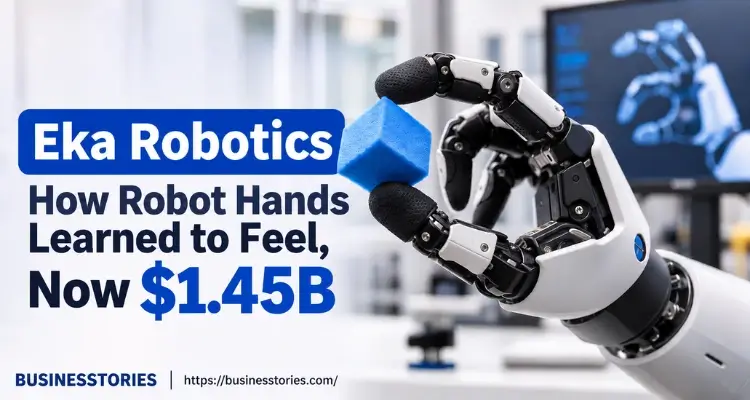
When a veteran roboticist from a frontier AI lab met Eka’s robot, they handed it a raspberry. Soft fruit is a classic test because robot grippers tend to crush it. This one didn’t. Eka Robotics builds robot grippers that sense force, plus an AI model that combines sight with touch.
In October 2026, it raised a $150 million Series A at a $1.45 billion valuation, led by a16z and F-Prime. Its founders are MIT professor Pulkit Agrawal and ex-DeepMind researcher Tuomas Haarnoja.
In this profile, you’ll get the founders’ backstory and a plain-English look at the tech. You’ll also see how its price compares with rivals, the risks ahead, and the lessons early-stage founders can borrow.
Key Takeaways
- Eka Robotics hit a $1.45B valuation about 17 months after an $11M seed round.
- Its robots grip by feel, using force sensors plus vision, not vision alone.
- It trains robots in a physics simulator instead of on costly human videos.
- Eka claims about 1,500 picks an hour, versus roughly 600 for a person.
- The big test is still ahead: running nonstop on real factory lines.
What Is Eka Robotics?
Eka Robotics is a physical AI startup that builds robot hands and the software that runs them. Its pitch is simple. Robots should grip by feel, not just by sight.
Most robot arms do well at fixed jobs. They weld the same seam or move the same box all day. But hand them a new thing, and they fail. That’s the gap Eka targets.
Eka was founded in 2025 and is based in Cambridge, Massachusetts, per PitchBook. So far, it has picked two kinds of work. The first is picking up items and setting them down.
The second is handling wires. TechCrunch reported in October 2026 that Eka runs pilots with a few unnamed factory clients in both.
Why those two jobs? Both jobs are common in plants and still require human hands. Wires bend and tangle. Mixed parts come in odd shapes. A camera shows a robot roughly where things are. But it can’t tell the robot when a grip starts to slip.
Here’s how Eka’s claimed results stack up, using its figures as told to TechCrunch (2026):
| Metric | Eka robot | Typical human |
| Unfamiliar objects picked per hour | ~1,500 | ~600 |
| Max object weight | 1 kg | — |
| Reported pick success rate | 95%+ | — |
| Gripper hardware cost | Under $1,000 | — |
What most news skips: these are Eka’s own numbers from the lab. The Next Web says it hasn’t verified them. So treat them as strong early signs, not real-world proof.
Who Are the Eka Robotics Founders?
The Eka Robotics founders are Pulkit Agrawal, an MIT professor, and Tuomas Haarnoja, a former Google DeepMind researcher. They met as grad students at UC Berkeley. Both are known for teaching robots through trial and error, a method called reinforcement learning.
Pulkit Agrawal
Agrawal is a professor in MIT’s computer science and EE department. He also directs the Improbable AI Lab at MIT CSAIL. His lab’s goal is to build machines that move and grasp things as well as people do.
He earned his bachelor’s degree at IIT Kanpur in 2011 and his PhD at UC Berkeley. He’s not new to startups, either. Before joining Eka, he co-founded SafelyYou, a company that develops technology to prevent falls among individuals with dementia.
In 2024, he also won an IEEE early career award in robotics.
Tuomas Haarnoja
Haarnoja is best known for co-creating Soft Actor-Critic, or SAC. It’s a learning method from 2018 that’s now used widely in robot research. In fact, the SAC paper showed it could teach a four-legged robot to walk and a robot hand to turn a valve.
Later, at DeepMind, he co-led research that trained small humanoid robots to play one-on-one soccer. The robots learned in simulation first. Then the skills moved straight onto real hardware. That sim-first idea is now Eka’s core bet.
Why this pairing works
Many robotics startups pair a researcher with a business-minded CEO. Eka paired two people who’ve spent years on one narrow problem: making learned skills work on real machines. That depth is rare. It’s also a big reason investors paid up early.
How Eka Robotics Teaches Robot Hands to Feel
Eka’s system has three parts built to work together. There’s a hand that senses force, an AI model that blends sight with force, and training is mostly done in a simulator. The core idea is that touch, not sight, closes the last gap in a grip.
Vision-force-action, not vision-language-action
Many robot AI models today are vision-language-action (VLA) models. They link what a robot sees and the orders it gets to what it does. Eka calls its model vision-force-action (VFA). It adds data from force sensors in the hand. As a result, the robot can feel a grip slip and fix it mid-move.
Agrawal told The Next Web that vision isn’t the main way to solve this “last millimeter problem.” Meanwhile, a16z’s investment note says Eka builds the model, sensors, controls, and hardware as one system.
That way, touch itself becomes useful data. The goal is a robot that keeps working when parts change. No engineer should have to retune it each time.
Practice in a simulator, not from human videos
Most of the field trains robots on clips of people doing tasks. That data is slow and costly to gather. Eka takes a new route. It models the forces a robot meets while grasping inside a physics simulator.
Then it lets the robot learn by trial and error at a giant scale. Eka says it can create thousands of hours of robot practice in minutes.
There’s another upside. A robot trained solely on human demonstrations typically reaches the same skill level as a human. Kris Hauser, a professor at the University of Illinois Urbana-Champaign, told TechCrunch that Eka’s method lets robots go past the demos they’re given.
Cheap, tough hardware
Eka’s custom hand has more force sensors than a standard gripper. Even so, it costs under $1,000. It’s rated for 5 million duty cycles, and the target is 20 million, the norm for industrial arms.
Here’s our contrarian take. The AI model gets the headlines, but the hand’s price may matter more. A factory can replace a sub-$1,000 hand without a budget meeting.
The $1.45B Round: Who Invested and Why
On October 20, 2026, Eka Robotics announced a $150 million Series A at a $1.45 billion post-money valuation. Andreessen Horowitz (a16z) and F-Prime co-led the round. F-Prime is tied to FMR, the parent company of Fidelity.
Other backers are Obvious Ventures, E14 Fund, MFV Partners, Bison Ventures, Glasswing Ventures, and Samsung Next. In total, investors have now put about $161 million into Eka, SiliconANGLE reported in 2026.
| Date | Round | Amount | Key investors |
| May 2025 | Seed | $11M | Obvious Ventures, E14 Fund, MFV Partners |
| Oct 2026 | Series A | $150M | a16z, F-Prime (co-leads) |
That’s unicorn status about 17 months after the seed. Notably, both seed leads came back for the Series A. When early backers double down, they’ve often seen data others haven’t.
Eka plans to use the cash to train its model on more tasks and ship to more clients faster. Raghu Raghuram, the a16z partner who co-led the deal, called VFA the first method he’d seen that truly solves robot grasping.
How Eka’s price compares with rivals
Here’s the surprise. In a year of huge robot deals, Eka’s price is modest.
| Company | Reported valuation | Timing |
| [Skild AI](INTERNAL: Skild AI startup profile) | $14B+ | Jan 2026 |
| Physical Intelligence | ~$11B | 2026 (reported) |
| Generalist | ~$3B | Aug 2026 |
| Eka Robotics | $1.45B | Oct 2026 |
Tech Funding News notes Eka is priced at about 13% of Physical Intelligence’s reported value. For context, robotics startups raised $9.9 billion in Q3 2026 alone, more than double Q3 2025, according to Crunchbase data. So Eka won a big round without a sky-high price.
The Hard Part Still Ahead
Eka’s demos impress experts, but a lab isn’t a factory floor. The real test is whether its robots run for months without breaking. And they’ll need to do it in plants Eka doesn’t control.
Hauser named the biggest hurdle himself. He told TechCrunch that a plant would need the system to run for about a year without failing. He also mentioned to The Next Web that the challenging phase begins when Eka collaborates with external companies on actual assembly lines.
There are three open questions worth watching:
- Does it generalize? Pick-and-place and wires are a beneficial starting point. But Hauser doubts the same methods carry over to other high-value factory tasks.
- Does the simulator match reality? Skills learned in a simulator don’t always carry over cleanly. a16z says the gap is shrinking for Eka, yet it’s still a known risk.
- Where’s the revenue? Eka hasn’t shared sales or named clients. Its pilots remain private.
Rivals are also moving fast. Zurich’s Enact raised $30 million in October 2026 to give robots a sense of touch. Meanwhile, Chinese hand-maker Linkerbot was reportedly seeking a $6 billion valuation in May, per The Next Web.
You can see a similar race in humanoids in our look at Figure AI.
Our view: Eka’s focus is a strength here. It isn’t trying to build a robot that does everything. Instead, it’s trying to beat humans at two dull, valuable jobs. That’s a far easier promise to keep.
What Early-Stage Founders Can Learn from Eka Robotics
You don’t need to build robots to borrow from this playbook. Eka’s path from seed to unicorn comes down to a few choices you can repeat.
- Bet against the crowd, with proof: Many labs built robot models around language. Eka bet on force and touch. Robot pioneer Rodney Brooks has long said robots will fail without a sense of touch. Eka’s results suggest he has a point.
- Start with a narrow market: Eka began with two use cases, not ten. A tight wedge makes pilots quicker to win and results simpler to track.
- Make your data cheaper than your rivals’ data: Its simulator lets Eka make in minutes what others pay people to record. So ask yourself: what’s your costliest input, and can you make it nearly free?
- Adoption price: A gripper under $1,000 lowers the buyer’s risk. When a product is cheap to try, deals close faster.
- Keep early backers close: Both seed leads reinvested. That signal helped Eka raise a large round on strong terms. Our [guide to raising a Series A](INTERNAL: startup fundraising guide) covers how to build that trust.
What most guides miss: Eka’s lower price may be a smart move. It leaves room for an up-round later, even if plans slip. In contrast, founders who chase the top number today can box themselves in tomorrow.
The Bottom Line on Eka Robotics
A robot that holds a raspberry gently sounds like a party trick. But for factories, it’s the difference between a robot that handles one part and one that handles any part.
Eka Robotics has a sharp thesis: touch beats vision for the final millimeter of a grip. Two founders with extensive experience support it with lab results that impressed veteran robot builders. Plus, investors priced it at a fraction of its peers. This provides the company with the opportunity to increase its value.
Still, the scorecard isn’t in. Lab speed isn’t factory uptime, and pilots aren’t contracts. The next 12 to 18 months of real-world use will reveal whether these hands can genuinely navigate the economy.
Your next step: if you’re building in advanced tech, name your own “last millimeter problem,” the gap your rivals ignore. Then test whether a cheaper data source could solve it.
Is touch the missing piece of robotics? Share your take, or explore more robotics startup stories on Businesstories.
Frequently Asked Questions
1. What does Eka Robotics do?
Eka Robotics builds robot hands that sense force, plus an AI model that mixes sight and touch. Together, they let robot arms grip new objects by feel. The Cambridge startup is testing its system on pick-and-place and wire work with unnamed factory clients.
2. How much is Eka Robotics worth?
Eka Robotics is valued at $1.45 billion post-money after its $150 million Series A in October 2026. a16z and F-Prime co-led the round. Total funding is about $161 million, including an $11 million seed round in May 2025.
3. Who founded Eka Robotics?
MIT professor Pulkit Agrawal and ex-Google DeepMind researcher Tuomas Haarnoja founded Eka Robotics in 2025. They met as grad students at UC Berkeley. Agrawal leads MIT’s Improbable AI Lab, and Haarnoja co-created the Soft Actor-Critic algorithm.
4. What is a vision-force-action model in robotics?
A vision-force-action (VFA) model is a robot AI system that pairs camera input with force data from the robot’s hand. Unlike VLA models, it uses touch to sense slips and adjust a grip as it happens.
5. Is Eka Robotics hiring?
Yes. As of late 2026, Eka Robotics lists open roles on the a16z portfolio jobs board, including field robotics and mechanical and hardware test engineers. Most roles are on-site near Boston, on a team of about 11 to 50 people.

Author & Researcher with 8 years of experience across IT and non-IT industries, delivering insightful and data-driven content.