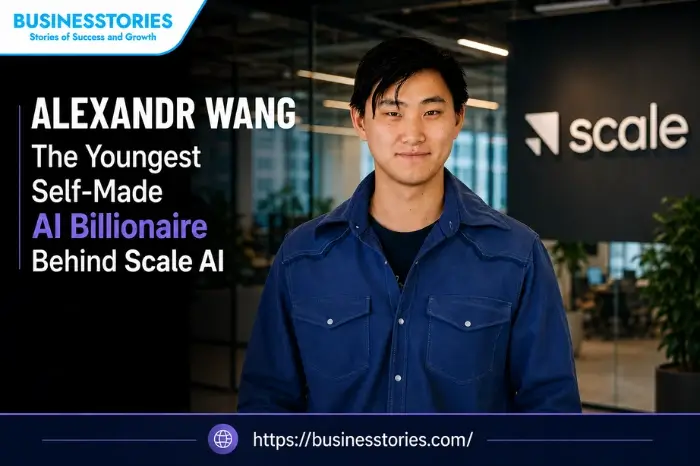
What does it take to become the world’s youngest self-made billionaire at 24? For Alexandr Wang, the answer was clear. The key is to solve a problem that nobody else wants to touch. Wang saw that AI companies had smart algorithms but terrible data. So he built a company to fix that gap.
Today, Scale AI powers the world’s top AI systems. And Alexandr Wang stands at the center of the global AI race. His story is one every entrepreneur should know.
Wang went from a small town in New Mexico to the heart of Silicon Valley. He dropped out of MIT at 19. Then he built a $29 billion business. Along the way, he shaped US AI policy and met with world leaders. Not too shabby for someone who just wanted to catch a food thief in a college dorm.
Early Life: Born into Science
Alexandr Wang was born in January 1997 in Los Alamos, New Mexico. His parents were Chinese immigrants. They worked as physicists at the Los Alamos National Laboratory. That is the same place where the atomic bomb was first built. Growing up there shaped Wang deeply. He learned early that technology can change the world. He also saw that complex problems need bold solutions.
Wang showed a gift for math and science from a very young age. He entered national math and physics olympiads while still in school. By age 17, he was already coding full-time for Quora. Quora is a popular question-and-answer platform. He worked alongside senior engineers and impressed them quickly. Furthermore, he was learning skills that most adults his age did not yet have.
Then, at 18, he enrolled at MIT to study machine learning and computer science. However, his time there would be brief. His childhood had given him something beyond technical skills. His parents worked at a national lab with real stakes. So Wang understood early that breakthrough technologies are relevant for national security.
That belief later guided many of his choices at Scale AI. In short, Wang arrived at MIT already shaped by a unique view of the world.
Dropping Out of MIT: The Founding of Scale AI
Wang spent just one year at MIT before making a bold move. In the summer of 2016, at age 19, he dropped out to start Scale AI. He co-founded the company with Lucy Guo, a fellow student. Together, they joined Y Combinator’s summer 2016 batch. Y Combinator had already helped launch Airbnb and Dropbox. Therefore, their acceptance into the program was a significant endorsement for the young team.
The concept for Scale AI originated from an unexpected source. Wang wanted to catch the roommate who kept stealing his food from the shared fridge. So he set up a camera and tried to build an AI to review the footage. But he hit a wall fast. There was too much video data, and the AI could not make sense of it. He never caught the thief. However, he did discover a massive gap in the AI industry.
Training AI models needs large amounts of clean, labeled data. At that time, finding clean, labeled data was very difficult. Wang immediately recognized the opportunity. As he later said in a TED Talk, “To power AI, you need powerful data.” That single insight became the foundation of Scale AI.
Think of it this way. If an AI model is a student, then labeled data is the textbook. Even the most intelligent student cannot learn effectively without quality textbooks. Scale AI set out to write those textbooks for the entire AI industry.
How Alexandr Wang Built Scale AI into an Industry Giant
The Core Business: Data Annotation
Scale AI sits at the heart of the modern AI world. Its core service is data annotation. This means labeling raw data so that AI models can understand it. For example, a self-driving car must recognize stop signs, pedestrians, and road markings. Human workers must first label thousands of images.
Scale AI manages this process at a massive scale. The company uses both software and human workers. Over 100,000 contract workers around the world help with this effort.
Scale also operates two main platforms: Remotasks and Outlier AI. These recruit contractors in countries like the Philippines, Kenya, and Venezuela. They handle tasks from image labeling for autonomous cars to annotating text for large language models like ChatGPT.
Smart Pivots and Revenue Growth
Scale AI’s first big customers were self-driving car startups. Companies like Lyft, General Motors’ Cruise, and Voyage relied on Scale to label their sensor and camera data. This helped Scale pass $100 million in annual revenue by 2020. Then, as generative AI exploded in 2022 and 2023, Wang made a rapid pivot.
He shifted Scale’s focus toward helping large language model companies train better AI. The key method was reinforcement learning from human feedback, known as RLHF. That timely shift was a brilliant move.
Today, Scale AI works with Meta, Microsoft, OpenAI, the US Army, and the US Air Force. Revenue grew from $290 million in 2022 to $870 million in 2024. By 2025, Scale reached an estimated $2 billion in revenue. Furthermore, its client list makes it one of the most critical AI infrastructure companies in the world.
From Startup to Billionaire: Alexandr Wang’s Rise

Alexandr Wang became the world’s youngest self-made billionaire in 2021. He was just 24 years old. That year, Scale AI raised a $325 million Series E round. The funding valued Scale at $7.3 billion. So Wang’s roughly 15% stake made him a billionaire almost overnight. Forbes confirmed the milestone, and the news traveled fast across the tech world.
But Wang did not stop there. He kept building and expanding Scale AI further. In May 2024, Scale raised another $1 billion in a Series F round led by Accel. New investors, including Amazon, Meta, Nvidia, and Intel Capital, joined in. This is a valued scale at $13.8 billion. Then, in June 2025, Meta made a landmark move.
The tech giant invested $14.3 billion in Scale AI, acquiring a 49% stake. This pushed Scale’s valuation to $29 billion. It also triggered a big career change for Wang.
As part of the deal, Wang stepped down as CEO of Scale AI. He then joined Meta as its first-ever chief AI officer. Now he leads Meta’s superintelligence team. “Opportunities of this magnitude often come with trade-offs,” Wang wrote to employees. “In this instance, that cost is my departure.” It was a bittersweet moment. Still, Wang was clearly ready for his next big challenge.
Alexandr Wang’s Role in AI Policy and National Security
One thing that sets Alexandr Wang apart from most tech founders is his profound involvement in US government policy. While many Silicon Valley leaders avoid politics, Wang actively engages with Washington. His views on AI and national security have made him a respected voice among US lawmakers.
Wang grew up understanding that technology shapes global power. His parents worked at a lab that helped build nuclear weapons. That background gave him a strong sense of how tech connects to national security. After visiting China in 2018, Wang became very vocal about the threat from China’s AI rise.
He testified before the Senate Select Committee on the Chinese Communist Party. He also briefed US lawmakers behind closed doors. One congressman called him “very insightful,” which is a real compliment in Washington.
Scale AI also built strong government ties. Its clients include the US Army, the US Air Force, and the Pentagon. In January 2025, Wang wrote directly to President Trump. He declared that “America must win the AI war.” Later that month, he spoke at the World Economic Forum in Davos about the AI race between the US and China.
Then, in February 2025, he met with world leaders, including UK Prime Minister Keir Starmer, French President Emmanuel Macron, and Indian Prime Minister Narendra Modi. Clearly, Wang is not a typical startup CEO. He is also a key voice in the global AI conversation.
Key Lessons From Alexandr Wang’s Entrepreneurial Journey
Wang’s story holds clear lessons for founders and builders everywhere.
First, solve a real problem. Wang did not set out to be a billionaire. Instead of pursuing a path to billionaire status, he recognized the lack of quality data in AI companies and devised a solution. The market rewarded him because his answer addressed a genuine need.
Second, timing matters. When the self-driving car boom slowed in 2022, Wang did not panic. Instead, he pivoted Scale AI toward generative AI and LLM training. This shift positioned Scale perfectly for the ChatGPT era.
Third, naivete can be an asset. Wang has said openly that there is “a significant premium to naivete.” Because he entered the AI world without preconceptions, he saw problems that experts had missed. Sometimes, ignorance of impossibilities is the best way to do something new.
Fourth, relationships build everything. Wang personally closed Scale AI’s first 50 customers. He built trust with both engineers and executives. Those early relationships led to the powerful connections that drove Scale’s growth for years. Furthermore, his network across Silicon Valley and Washington, DC, became one of Scale AI’s biggest assets.
Finally, think beyond profit. Wang’s belief in the connection between AI and national security provided Scale AI with a purpose beyond profit. That sense of mission helped attract top talent and win large government contracts. It also gave Wang a platform that very few founders his age ever reach.
Conclusion: What Alexandr Wang’s Story Means for the Future of AI
Alexandr Wang’s journey is one of the most compelling in modern business. He grew up in a small New Mexico town as the son of immigrant physicists. He then dropped out of MIT at 19. Thereafter, he built Scale AI into a $29 billion company that powers the world’s most advanced AI systems.
Along the way, he became the youngest self-made billionaire on the planet. He also shaped US AI policy at the highest levels. And he earned the trust of tech giants like Meta, Microsoft, and OpenAI.
Yet perhaps the most inspiring part of Wang’s story is his mindset. He stayed curious. He acted boldly. And he never stopped learning. He saw a simple problem in a college fridge and turned it into a billion-dollar insight. He saw the risk of America losing the AI race and turned it into a national conversation.
So if you are building something today, Wang’s example is worth studying closely. Start by solving a real problem. Build with a clear purpose. Do not be afraid of what you do not yet know. That is precisely how Alexandr Wang changed the world of AI. And this is how the next generation of founders can do the same.
Follow Scale AI‘s journey and Wang’s next chapter at Meta to stay ahead of the biggest shifts in global AI development.
FAQs About Alexandr Wang and Scale AI
Q1: How did Alexandr Wang become the youngest self-made billionaire?
Wang co-founded Scale AI in 2016 at age 19. By 2021, Scale reached a $7.3 billion valuation. So Wang became a billionaire at just 24. Forbes then recognized him as the world’s youngest self-made billionaire.
Q2: What does Scale AI actually do?
Scale AI provides data labeling and annotation services. It helps AI companies train their machine learning models by supplying high-quality labeled data. Its clients include OpenAI, Meta, Microsoft, and several US government agencies.
Q3: Why did Alexandr Wang leave Scale AI?
In June 2025, Meta invested $14.3 billion in Scale AI for a 49% stake. Wang left Scale AI as part of the deal. He then became Meta’s Chief AI Officer and now leads its superintelligence team.
Q4: Where did Alexandr Wang grow up?
Wang was born in Los Alamos, New Mexico, in January 1997. His parents were Chinese immigrant physicists who worked at the Los Alamos National Laboratory.
Q5: What is Alexandr Wang’s net worth?
As of April 2025, Forbes estimated Wang’s net worth at $3.6 billion. He owns approximately 15% of Scale AI.

Tabassum Shaik is an Author, Researcher, and SEO Specialist with over 8 years of experience creating informative content on business, startups, entrepreneurship, marketing, technology, and digital trends. She specializes in researching industry trends and transforming complex topics into practical, easy-to-understand insights. Her goal is to help readers stay informed, learn new ideas, and make better business decisions.