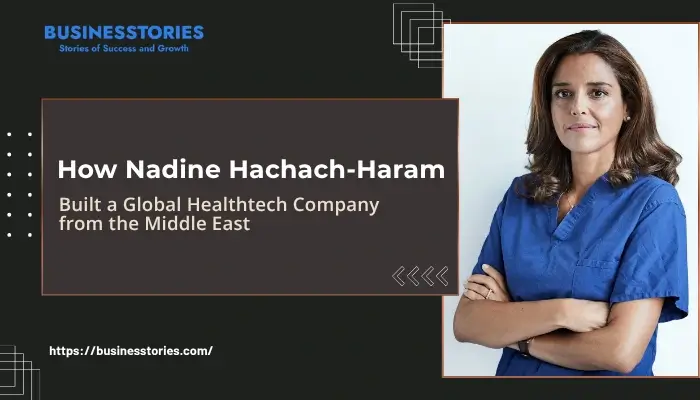
Nadine Hachach-Haram is one of the most inspiring names in Middle East healthtech. She did not just build a company. She built a new way for doctors to work together across borders. For that reason, her story matters to founders, health leaders, and anyone who wants to build a global business in the region. Moreover, it shows how a strong idea, a clear problem, and steady effort can create real change.
Nadine Hachach-Haram and the problem she set out to solve
To understand Nadine Hachach-Haram’s journey, it helps to start with the problem. Surgery is often highly skilled, yet it can still feel isolated. A surgeon may need advice from a specialist in another city or country. However, many teams cannot simply share live guidance. That gap can slow care and limit access to expertise.
Nadine saw the issue clearly. She worked in surgery and understood the pressures of the operating room. So, instead of accepting the old system, she asked a better question: how can clinicians collaborate in real time, no matter where they are? That question became the basis for her healthtech mission.
Her idea was not only about technology. It was also about access, trust, and speed. When a doctor can connect with another expert during a procedure, the result can be better decisions and better outcomes. Therefore, her work sits at the point where medicine meets digital innovation.
A unique part of Nadine Hachach-Haram’s story is that she built from both empathy and technical insight. Many founders start with a market gap. She also began her journey by focusing on a human need. As a result, her company grew around a real need, not a trend. That is often what makes a health tech company last.
How Proximie turned a local idea into a global healthtech platform
Nadine Hachach-Haram founded Proximie to help medical teams connect in real time. The platform lets clinicians share live procedures, guide one another, and support care across distances. In simple terms, it brings expert help closer to the patient. And that matters in both routine and complex cases.
The company grew because it solved a clear problem. Hospitals needed better ways to transfer knowledge. Meanwhile, specialists needed tools that were secure, easy to use, and built for clinical work. Proximie met those needs by focusing on live collaboration instead of abstract digital promises.
This area is where many healthtech startups struggle. They build software first and ask the market to adapt. Nadine Hachach-Haram did the opposite. She began with the user’s pain point. Then she shaped the product around clinical workflows. Therefore, the platform felt practical, not forced.
Proximie also gained attention for its scalable design. A strong healthcare tool must work in many places, with different systems and teams. That is challenging. Still, the company showed that a Middle East founder can design for the world from day one. This is a powerful lesson for regional startups.
Another useful insight is that global growth often begins with local proof. Once a product works in one setting, it can move to others. Proximie’s rise shows how a founder can use the Middle East as a base, then expand outward with confidence.
Why Nadine Hachach-Haram’s leadership style stands out
Nadine Hachach-Haram stands out because she leads with clarity. She articulates the issue in straightforward language, which enhances the trustworthiness of her message. Moreover, she keeps the focus on patients and clinicians, not just on product features. That builds credibility.
Her leadership also shows how important domain knowledge can be. In healthtech, founders need more than ambition. They need a profound understanding of the field. Since Nadine worked close to surgery, she knew the real limits of the system. Consequently, she could build for practical use.
She also shows the value of persistence. Healthtech is not a fast lane. It involves trust, regulation, and long sales cycles. Yet Nadine kept moving. She built step by step. For that reason, her company became more than a concept. It became a serious platform used in real clinical settings.
The power of timing plus preparation is a less discussed part of her story. The world became more open to remote collaboration and digital care. However, Proximie was ready because it had already shaped the core idea. The company didn’t rush when the market shifted. It responded.
For founders, that is an important lesson. You do not need every trend to line up at once. Instead, you need a strong problem, a useful product, and patience. Nadine Hachach-Haram proved that steady leadership can create global reach.
What founders can learn from building healthtech in the Middle East
Nadine Hachach-Haram’s journey gives founders a clear roadmap.
First, start with a real problem. In healthtech, the timeline is even more important because users cannot waste time. They need tools that fit into daily work. So, listen closely before you build.
Second, design for trust. Healthcare users care about accuracy, privacy, and safety. Therefore, the product must feel reliable from the beginning. Good branding helps, but clear workflows and strong evidence matter more.
Third, think beyond your home market. The Middle East is a strong launchpad, not a limit. In fact, founders here can build products that solve regional issues and still appeal to global buyers. Proximie shows how a company can start with a local view and grow into a global one.
Fourth, speak the language of your users. Healthtech teams are busy. Doctors, nurses, and hospital leaders do not want jargon. They want simple tools and clear value. Therefore, founders should explain benefits in plain words and show how the product saves time or improves care.
Finally, keep the mission visible. People support companies that stand for something real. Nadine Hachach-Haram built around collaboration in healthcare. That mission helped the story travel. It also helped the brand feel human, which is often the edge that lasts.
The wider impact of Nadine Hachach-Haram on health innovation
The impact of Nadine Hachach-Haram goes beyond one company. She is part of a wider shift in Middle East entrepreneurship. More founders now build for global markets from the region, and healthtech is one of the strongest areas for that growth.
Her work also helps change how people see founders from the Middle East. Too often, people view the region only as a place to consume technology. However, stories like Nadine’s show something different. They show that the region can create original products, strong teams, and world-class innovation.
This is relevant for the next generation. When young founders see someone like Nadine Hachach-Haram succeed, they can imagine a bigger future for themselves. That sense of possibility is powerful. It can shape careers, startup choices, and the confidence to build them.
There is also a broader lesson for the health sector. Digital tools work best when they improve human connection. Proximie does not remove the expert. Instead, it helps experts work together better. That is a useful model for future healthtech ideas as well.
Thus, Nadine’s influence is both practical and symbolic. She built a company with real use cases. At the same time, she showed that the Middle East can produce founders who compete on a global stage and lead with purpose.
Conclusion
Nadine Hachach-Haram’s story is strong because it combines vision, empathy, and execution. She identified a real problem in healthcare, then built a platform that helps teams collaborate across distance. As a result, Proximie grew from a regional idea into a global healthtech company.
More importantly, her journey proves that founders in the Middle East can build for the world while staying close to local needs. If you are a founder, a student, or a health leader, her path offers a simple lesson: start with the problem, stay close to the user, and keep building with purpose.
Nadine Hachach-Haram shows that meaningful innovation often begins with one clear question and one brave step forward.

Tabassum Shaik is an Author, Researcher, and SEO Specialist with over 8 years of experience creating informative content on business, startups, entrepreneurship, marketing, technology, and digital trends. She specializes in researching industry trends and transforming complex topics into practical, easy-to-understand insights. Her goal is to help readers stay informed, learn new ideas, and make better business decisions.