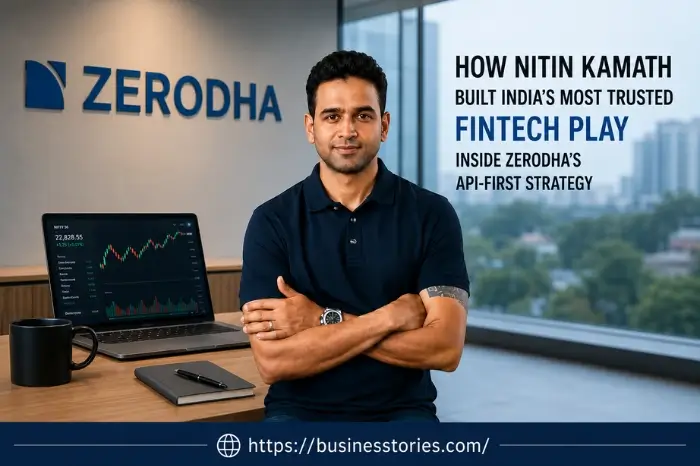
Most startups chase big funding first. Nitin Kamath did the opposite. In 2010, he and his brother Nikhil started Zerodha with their savings. Today, it is one of the biggest stock brokers in India. And yet, it has never raised a single rupee from outside investors.
So how did he pull it off? The answer is not a secret formula. Instead, it is a simple plan built on three ideas: charge less, teach more, and build your own tools.
In this founder story, you will learn how each step worked. You will also see real numbers, recent struggles, and lessons you can use in your own business.
Note: his official spelling is Nithin Kamath, but many readers search for “Nitin Kamath.”
Who Is Nitin Kamath? From Call Centre Nights to Trading Days
Before Zerodha, Nitin Kamath was just a young man who loved the stock market. He grew up in a neighborhood full of business families. As a result, he picked up an interest in trading very early. In fact, it was as a teenager that he began trading.
Two Market Crashes, Two Challenging Lessons
But his early years were rough. He lost about ₹5 lakh when markets crashed in 2001 and 2002. Still, he did not quit. Instead, he took a night job at a call center. Then he traded stocks during the day to rebuild his money.
He later said he learned most of his life skills in those call center years. For example, he learned how to talk to strangers and how to sell. That skill matters more than you might think. After all, a broker’s whole job is to earn trust from people who don’t know you yet.
The Franchise Years
Next, in 2006, he became a sub-broker for Reliance Money. He finally learned more about the brokerage business from an insider’s perspective. And what he saw bothered him.
Brokers charged high fees. On top of that, they often pushed clients to trade more, since more trades meant more fees.
Then the 2008 crash hit. Even so, he had saved enough to start something of his own. In 2010, right in the middle of a slow market, he launched Zerodha with his brother Nikhil.
The name captures this ideal. It mixes “zero” with rodha, a Sanskrit word for barriers. So the goal was zero barriers for ordinary traders.
The Unique Insight Here
Most articles skip the call center part. However, it may be the most important clue. Nitin Kamath didn’t start as a tech founder or a finance expert. He started as a trader who had lost money and a salesman who had to earn trust one call at a time.
In other words, his plan was shaped by pain, not theory. That is why every later choice puts the customer’s wallet first.
Step One of the Simple Plan: Charge Less and Show Every Rupee
Nitin Kamath’s first big move was price. At the time, most Indian brokers charged a percentage of every trade. So the more you traded, the more you paid. Zerodha, on the other hand, charged a flat fee per trade.
Why a Flat Fee Changed the Game
This idea came from the US, where discount brokers had used flat fees since the 1990s. But in India, it was new. Because of this change, active traders saved a lot of money right away. Furthermore, the pricing was easy to understand. There were no hidden charges and no confusing slabs.
Still, growth was slow at first. In fact, Zerodha had only about 70,000 customers in 2016. So what changed?
The 2015 Tipping Point
In December 2015, Zerodha began offering zero brokerage on equity delivery trades. In simple terms, if you bought shares to hold, you paid no brokerage at all. This decision welcomed long-term investors, not just day traders.
As a result, sign-ups exploded. By 2022, Zerodha had about 10 million customers. That is giant growth in just six years, and it happened without big ad campaigns.
What You Can Learn From This
Here is the key point. Low prices alone don’t build trust. However, clear prices do. Nitin Kamath made sure customers always knew what they were paying. So if you run a business, try these steps:
- Show your full pricing on a single page.
- Remove hidden fees, even if they earn you money today.
- Cut prices where it helps customers most, not where it looks appealing in ads.
A Fresh Perspective
Many people think Zerodha won because it was cheap. But rivals copied its prices within a few years. So price was not the lasting edge. Instead, the real edge was the honesty behind the price.
Once customers saw Zerodha didn’t try to trick them, they stayed. And that kind of trust is far harder to copy than a fee chart.
Step Two: Teach People Instead of Selling to Them
The second part of the plan is maybe the smartest. Rather than spending on ads, Zerodha spent on free education.
Varsity: A Free School for Investors
In 2014, Zerodha launched Varsity, a free library of stock market lessons. It covers everything from basic investing to options trading. Better yet, it has no sign-up, no paywall, and no ads.
So why give away so much for free? Because people who understand markets trade more wisely. And then they tell friends. Over time, Varsity became one of India’s biggest free finance learning sites. It quietly attracted millions of new users as a result.
Word of mouth was the primary driver of growth.
Nitin Kamath has said it plainly. When Zerodha started, it had no money for ads. So the only growth tool was word of mouth. Until 2024, close to 30% of new accounts came through referrals. That program paused due to exchange rules, but the habit of sharing stayed.
The statistics support this assertion. In FY25, Zerodha spent roughly ₹47 crore on ads against ₹8,847 crore in revenue. That is about half a percent. For comparison, many fintech rivals spend far more just to win a single customer.
How to Apply This to Your Business
You don’t need Zerodha’s size to use this low-cost customer acquisition strategy. Instead, try this approach:
- Find the biggest question your customers ask.
- Answer it fully and for free in a blog, video, or guide.
- Skip the hard sell. Let the help do the talking.
- Make sharing effortless so happy users can pass it on.
The Insight Most People Miss
Here’s a deeper reason why this strategy works. When a company pays a lot to win a customer, it must earn that money back. So it may push that customer to trade more, even when it hurts them.
Nitin Kamath has pointed this issue out himself. Because Zerodha spent almost nothing on ads, it had no pressure to push risky trades. In short, no ad budget meant cleaner incentives. And cleaner incentives built deeper trust.
Step Three: Build the Tech In-House and Open It Up
The third step was technology. Early on, Zerodha used software from outside vendors. But Nitin Kamath soon saw a problem. If you rent your tools, you can’t shape the experience.
Kite: Owning the Platform
So in 2013, tech lead Kailash Nadh joined the team. Then, in 2015, Zerodha released Kite, its trading platform. It was fast, clean, and simple. Furthermore, because Zerodha owned it, the team could fix bugs and add features quickly.
Building in-house wasn’t easy, though. For instance, Nitin Kamath once shared that a new backend took almost two years because of the significant amount of data involved. Still, the effort was worthwhile. Soon, Kite became the core of the entire business.
Kite Connect: The API-First Bet
Here is where the plan got clever. Alongside Kite, Zerodha built Kite Connect, a set of APIs. In simple terms, APIs let other developers build apps on top of Zerodha’s system.
This meant that coders could create their own trading tools. Startups could also build full products that used Zerodha behind the scenes.
Rainmatter: Backing the Builders
Then Zerodha went further. In 2015, it started Rainmatter, a fund that invests in startups. Many of these startups used Kite Connect. For example, Streak lets users run algo trades without writing any code.
So each new startup brought fresh users back to Zerodha. Today, Nitin Kamath says Rainmatter has put over ₹1,500 crore into more than 160 startups.
Steps to Try in Your Own Business
- Own your core product, even if it takes longer to do so.
- Open parts of it to others through APIs or partnerships.
- Support the people who build on you, because their growth becomes yours.
A Unique Angle
Most companies see outside developers as a threat. Nitin Kamath, however, saw them as free distribution. Every app built on Kite Connect was, in effect, a new door into Zerodha. So instead of fighting the fintech wave, Zerodha became the ground it was built on.
How Nitin Kamath Kept Zerodha Bootstrapped and Profitable
Now, let’s examine the financial aspect. Zerodha has stayed bootstrapped since day one. In other words, no venture capital and no outside investors.
The Numbers Behind the Plan
At its peak in FY24, Zerodha earned about ₹9,993 crore in revenue and ₹5,496 crore in profit. Those margins are rare for any company, especially a startup without a funding history.
But the story isn’t all smooth. In FY25, new market rules had a significant impact. For example, exchanges ended certain rebates that brokers used to earn. As a result, revenue fell to about ₹8,847 crore, and profit dropped to ₹4,237 crore. Then in FY26, profit stayed almost flat at around ₹4,283 crore.
Losing the Top Spot on Users
Meanwhile, rivals grew fast. By July 2026, Groww had about 1.31 crore active clients, while Zerodha had around 67.62 lakh. So, in terms of user count, Zerodha is no longer number one.
Even so, it still earns far more profit than most rivals. And Zerodha has called these user rankings a mere “distraction.”
Why the Plan Survives Bad Years
Here is the unique lesson. Because Zerodha never took VC money, no investor demands rapid growth. Furthermore, low ad spend means low fixed costs. So when revenue drops, the company stays calm.
In fact, it held a cash reserve of about ₹22,679 crore in FY25. That cushion gives it freedom to wait out tough markets.
Giving Back
Finally, Nitin Kamath has tied success to purpose. Through the Rainmatter Foundation, Zerodha first set aside $100 million for climate work. Later, it added more. So profit isn’t the only goal. Instead, it funds causes like forests, water, and green jobs.
Your Takeaway
If you’re building a business, consider this approach. Fast growth is exciting. However, a business that can survive a challenging year is worth more. So keep costs low, stay profitable, and save cash. That way, you stay in control, not your investors.
Conclusion: The Simple Plan Anyone Can Learn From Nitin Kamath
So what is the big lesson from Nitin Kamath? It’s that a simple plan, done well for years, can beat a flashy plan with lots of money.
Let’s recap.
- First, he charged less and showed every rupee clearly.
- Then, he taught people for free through Varsity, which turned users into fans.
- He then developed Zerodha’s technology and made it available through APIs, allowing other startups to contribute to its growth.
- And through it all, he stayed bootstrapped and profitable.
Of course, Zerodha faces real challenges today. Rules are tighter, and rivals like Groww now have more users. Still, the company keeps making strong profits and has a big cash cushion. That shows the plan was built to last, not just to grow quickly.
The best part is that you don’t need to run a broker to use these ideas. Whether you run a shop, a SaaS tool, or a media brand, the same rules apply. Be honest about pricing. Teach before you sell. Own your core product. And spend less than you earn.
FAQs About Nitin Kamath and Zerodha
1. Who is Nitin Kamath, and how did he first start Zerodha back in 2010?
Nitin Kamath is the founder and CEO of Zerodha. After years as a trader and sub-broker, he started Zerodha in 2010 with his brother Nikhil, using their savings instead of venture capital funding.
2. How did Zerodha grow so fast without spending big money on TV ads?
Zerodha grew mainly through word of mouth and free education. Its Varsity platform taught investing for free, and close to 30% of accounts once came through referrals, keeping its customer acquisition cost very low.
3. What does the name Zerodha mean, and why did Nitin Kamath pick it?
The name Zerodha joins “zero” with “rodha,” a Sanskrit word for barriers. Nitin Kamath chose it because the company’s goal was to remove the cost and trust barriers that kept ordinary Indians from trading.
4. Is Zerodha still bootstrapped, or has it ever raised outside funding?
Yes, Zerodha is still fully bootstrapped. It has never raised outside investor money. Instead, the company has funded its growth from its profits, which reached about ₹4,283 crore in FY26 despite a tougher market.
5. What simple business lessons can founders learn from Nitin Kamath?
Founders can learn to price honestly, teach customers for free, and own their core technology. Nitin Kamath also shows that staying profitable and avoiding heavy ad spend builds a business that survives challenging years.

Author & Researcher with 8 years of experience across IT and non-IT industries, delivering insightful and data-driven content.