Introduction
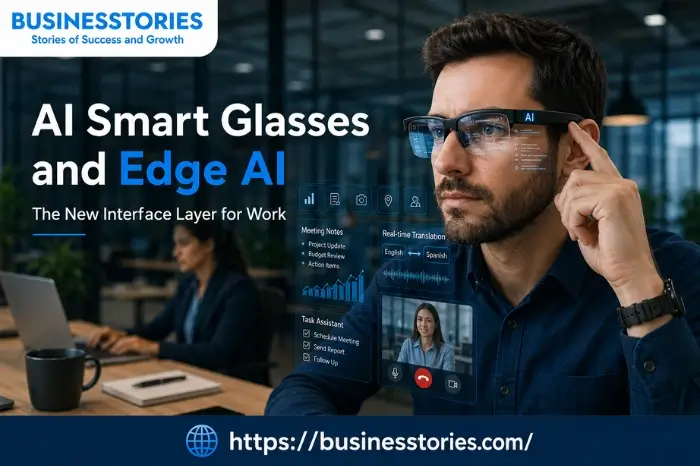
Think about how often you check your phone at work. You pick it up to read a message. Then you lose your focus. Then you have to find your place again. It happens dozens of times a day. Now, there is a better way. AI smart glasses display the right information directly in front of your eyes. You do not have to stop what you are doing. You do not have to pick up the phone. Just see what you need and keep going. This is not science fiction. Today, AI-powered smart glasses are light, stylish, and built for real work. They connect to large language models (LLMs) and edge AI to give you hands-free help in real time. So instead of looking down at a screen, you look up and stay in the moment. This shift is big. It creates a whole new way to use technology at work. And if you lead a team or run a business, you should take notice.What Are AI Smart Glasses? A Simple Breakdown
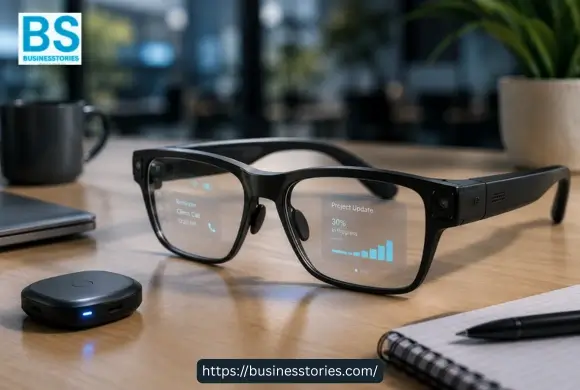
- Audio and camera models (e.g., Amazon Echo Frames Gen 3)—great for voice calls and voice AI.
- Multimodal AI models (e.g., Meta Ray-Ban)—handle voice, vision, and live translation.
- In-lens display models (e.g., Even Realities G1, Halliday)—show floating text or data overlays in your view.
AI Smart Glasses—Comparison Table
Three Main Types of AI Glasses: Features, Use Cases & Workplace Fit.| Feature / Criteria | Audio + Camera Models | Multimodal AI Models | In-Lens Display Models |
| Example Devices | Amazon Echo Frames Gen 3 | Meta Ray-Ban Display | Even Realities G1, Halliday |
| Primary Function | Hands-free calls & voice AI | Voice, vision & translation | Floating text/data overlays |
| AI Type | Voice AI (Alexa, GPT) | Multimodal LLM (GPT-4o, Gemini) | On-device LLM (Perplexity AI) |
| Display / Visual Output | None—audio only | LED indicator only | In-lens AR text overlay |
| Camera | Yes—photo & video | Yes—live scene analysis | Optional/limited |
| Edge AI Processing | Partial (smartphone-linked) | Hybrid (on-device + cloud) | Strong on-device processing |
| Response Latency | 1–3 seconds (cloud-reliant) | < 1 s simple / < 3 s complex | < 1 second (on-device) |
| Internet Required? | Yes, always online. | Hybrid, offline basics | No, it works fully offline. |
| Real-Time Translation | Audio translation only | Full audio + visual translation | Text subtitle overlay in lens |
| Best Workplace Use Cases | Hands-free calls Voice commands Meeting transcription | Field assistance Live translation Remote expert guidance | Warehouse picking Surgery support Step-by-step instructions |
| Privacy & Data Security | Cloud-dependent—lower | Hybrid—moderate security | On-device—highest privacy |
| Battery Life | 14–16 hours | 4–6 hours (AI-active) | Up to 12 hours |
| Weight | ~31–38 g | ~49 g | ~38–45 g |
| Prescription Lens Support | Yes. | Limited / coming soon | Yes. |
| Enterprise Integration | Basic (Alexa for Business) | Growing (Teams, Zoom) | Emerging (custom APIs) |
| Price Range (approx.) | $249 – $299 | $299 – $399 | $349 – $599 |
| Overall AI Depth | ★★☆☆☆ | ★★★★★ | ★★★★☆ |
| Ease of Adoption | ★★★★★ (simplest) | ★★★★☆ | ★★★☆☆ (most specialized) |
| Best For | Non-technical teams, remote workers | Sales, field service, global teams | Healthcare, logistics, and engineering |
How Edge AI Powers Smart Glasses for Real-Time Work
Here is something important to know. Not all AI in smart glasses comes from the cloud. Much of it runs right on the device itself. Experts call this approach edge AI. Edge AI means the glasses think locally. They process data immediately, without transmitting it to a distant server. For workers who need fast answers, this capability makes a huge difference.Speed: Get Answers in Milliseconds
Cloud AI can take 100 to 500 milliseconds to respond. But edge AI reduces that to just 5-10 milliseconds. That is nearly instant. So for a factory worker or a field technician, there is no waiting around. For instance, Meta’s Ray-Ban glasses start to process what you say before you even finish speaking. Simple tasks respond in under one second. Even more complex cloud-linked queries finish in under three seconds. As a result, the experience feels smooth and natural, almost invisible.Privacy: Your Data Stays on Your Device
Data privacy is a real concern with AI wearables. Edge AI helps solve this problem. Because processing happens on the device, your data never goes to an outside server. So your information stays private. This matters a lot for hospitals, banks, and law firms. These sectors handle sensitive data every day. With edge AI smart glasses, that data stays right where it belongs, on the device.Hybrid AI: The Best of Both Worlds
Most top AI glasses use a mix of both approaches. Simple, quick tasks, like voice commands or image scans, run on the device. But for harder questions, the glasses connect to a cloud LLM like ChatGPT or Gemini. This hybrid setup gives you speed and privacy for everyday tasks, plus deep AI power when you need it.AI Smart Glasses at Work: Real-World Use Cases
So what does all of this technology look like in practice? Here are four ways AI smart glasses are already changing real workplaces.Hands-Free Access to Key Information
Consider a logistics worker who picks items in a warehouse. Instead of carrying a scanner, they simply look at a shelf and get the data they need. The glasses show the bin location, the item count, and the next step, all in the lens. In the same way, a surgeon can see step-by-step notes without turning from the table. An engineer on a factory floor can view repair steps overlaid on a broken machine. In each case, the worker stays focused and keeps both hands free. As a result, errors go down, and speed goes up.Real-Time Language Translation
Language gaps still slow down global teams. However, AI smart glasses can resolve these issues on the spot. They can show live subtitles of what someone is saying, right in your lens. They can also translate spoken words during a live conversation. So instead of waiting for an interpreter, you get the message in real time. This makes working with international clients far easier.Remote Help from an Expert
Field technicians can share their exact view with a remote expert. The expert sees what the technician sees. Then the expert can draw on that view and give step-by-step directions. This means fewer costly site visits and faster fixes. Companies like Varjo and Google have already built tools around this idea.Faster Training and Onboarding
New team members can learn a process while doing it. The glasses show them what to do at each step, right in their field of view. They do not need a trainer standing next to them. As a result, new workers get up to speed much faster.The Market Is Moving Fast—Here Is the Data
This is not a slow trend. The numbers show a clear trend. AI smart glasses are moving into the mainstream right now. Citi Research projects that smart glasses will grow at a 105% compound annual growth rate (CAGR) from 2024 to 2030. By 2030, shipments could reach 112 million units per year. And market revenue could hit $40 billion, growing at a 112% CAGR. The edge AI market is growing just as fast. It was worth around $9 to $12 billion in 2025. By 2030, it could reach $49 to $56 billion. The main drivers are the need for faster responses, stronger privacy, and less reliance on cloud servers. Big names are all in. Meta, Google, Samsung, Apple, and Qualcomm are not just testing ideas. They are building full platforms. Meta’s Ray-Ban Display is already on the shelves. Samsung’s Galaxy XR and Apple’s Vision Air are on the way. Moreover, enterprise vendors now bundle glasses with software and analytics in one subscription. This makes it much easier for businesses to start using them right away.What This Means for the Future of Work Interfaces
For decades, screens have been the gateway to digital work. We went from desktop computers to laptops, then to smartphones. Each step made things faster and more mobile. But each screen also pulled our eyes away from the real world. AI smart glasses take a different path. Instead of asking you to look at a screen, they bring the data to your world. So the room you are in becomes the interface. Your view becomes the dashboard. This change does more than save time. It also protects your focus. One of the biggest drains on work today is the constant pull of screens and alerts. AI glasses reduce that drag. They show you what matters and stay quiet the rest of the time. Furthermore, AI smart glasses do not replace your phone. Instead, they work beside it. The glasses handle quick, in-the-moment tasks. The phone handles the deeper work. Together, they form a smarter setup than either one alone. Here is the key insight most people miss. AI smart glasses do not just change how we work. They change where our attention lives during work. That is a deeper shift than any app has managed in the past ten years.Challenges to Know Before You Adopt
No technology is perfect. So before you roll out AI smart glasses in your business, here are four things to watch for.- Battery life is still a limit. Most glasses last 5 to 10 hours on one charge. That covers a full workday, but you need to plan for regular charging, especially for shift workers.
- Display quality is improving, but not perfect yet. Text overlays and simple guides look fantastic. However, the size of the lenses and the power of the chip still limit full augmented reality with rich 3D images.
- Privacy in shared spaces is a real issue. Glasses with cameras can record people without clear signs. This raises legal and ethical questions. Therefore, you need clear workplace policies before you hand out devices.
- Tool integration is key for business use. The positive news is that Teams, Zoom, and Webex all work with smart glasses. Still, your IT team should check for compatibility before any wide rollout.
Conclusion
We are at the start of a new era in how people work with technology. AI smart glasses, powered by edge AI and large language models, are creating a brand-new interface layer. Instead of looking at screens, workers look at the world—and the right data meets them there. The technology is ready. The market is growing fast. And the businesses that start now will be the ones with an edge later. This is not about replacing your phone. It is about adding smarter, faster, lighter help, right in your field of view. Whether you run a warehouse, lead a team, or work in healthcare, AI smart glasses offer a real and useful advantage. So start small. Pick one process in your business where hands-free data would help. Try it for 30 days. See what changes. The next interface layer for work is here. The only question is, will you use it?Frequently Asked Questions on AI Smart Glasses and Edge AI
1. What do AI smart glasses do at work?
AI smart glasses give workers hands-free access to data, guides, live translation, and expert support. They help teams in logistics, healthcare, and manufacturing stay focused and get more done.
2. How does edge AI keep smart glasses data safe?
Edge AI processes data right on the device. So your data never goes to an outside server. This makes smart glasses much safer for regulated industries like banking and healthcare.
3. Can AI smart glasses work without the internet?
Yes. Edge AI handles simple, fast tasks offline. For complex questions, the glasses connect to a cloud LLM, such as ChatGPT. This hybrid setup works well even with limited connectivity.
4. How long does the battery last on AI smart glasses?
Most AI smart glasses last 5 to 10 hours on one charge. That covers a normal workday. However, teams working long shifts should plan regular charging into their routine.
5. Do AI smart glasses work with Teams or Zoom?
Yes, many do. Enterprise smart glasses now support platforms like Microsoft Teams, Zoom, and Webex. However, IT teams should check for specific compatibility before a full rollout.

Author & Researcher with 8 years of experience across IT and non-IT industries, delivering insightful and data-driven content.