A forklift and a worker cross paths at the same aisle junction four times in one month. Nobody files a report. Nobody gets hurt yet. In most warehouses, that pattern stays invisible until the day it ends in an injury. Protex AI exists to catch that pattern early.
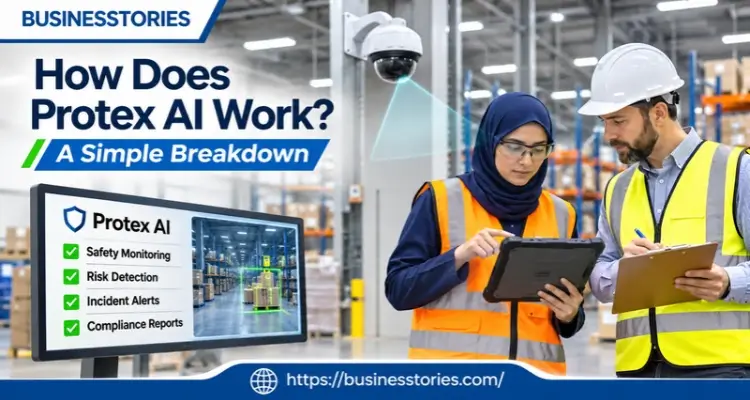
So what is Protex AI? It’s an industrial safety platform that plugs into a site’s existing CCTV cameras. A small device on site then scans the video for risks. Think forklift near misses, missing PPE, and people in no-go zones, all in real time. Finally, it turns those events into alerts, trends, and reports for safety teams.
In this guide, you’ll see how the system works step by step. You’ll also learn what it detects and how it guards privacy. Plus, we look at what its results prove and how it stacks up against Voxel and Intenseye.
Key Takeaways
- The platform runs on cameras a site already owns, so most customers don’t need new hardware.
- Video is analyzed on a local edge device. Only short, optionally blurred clips and metadata reach the cloud.
- Safety teams build their own rules by choosing cameras, zones, event types, and thresholds.
- Published results look strong. But they come from Protex and its clients, not outside audits.
- Pricing isn’t public. Expect an enterprise sales process, either direct or through AWS Marketplace.
What Is Protex AI? The Company in Brief
Protex AI is an Irish firm that turns plain security cameras into safety sensors. Most of its customers run factories, logistics hubs, or warehouses.
According to the company’s own overview, it serves seven fields. These include factories, logistics, warehouses, ports, food and drink, car making, and building sites. It has its headquarters in Dublin and a US office in Boston.
The founders are Dan Hobbs (CEO) and Ciarán O’Mara, now Chief Product and Technology Officer. The pair started in Limerick. By August 2022, the team had grown from two people to 22 in about a year, as the Irish Times reported at the time. (That’s older data, but it shows how fast the early team scaled.)
One small detail trips up many profiles. Protex lists its founding year as 2019. Yet databases such as Seedtable and CB Insights say 2021. The gap likely reflects when the idea began versus when the firm was formed. Either way, it’s a young business.
Here’s how the money has flowed so far:
| Round | Date | Amount (USD) | Lead / notable investors |
| Pre-seed | Aug 2021 | ~$130K | Early backers |
| Series A | Aug 2022 | $18M | Notion Capital, Playfair, Elkstone, Flexport, SCOR Ventures |
| Series B | Feb 2025 | $36M | Hedosophia, Salesforce Ventures |
| Series B extension | Jul 2025 | Undisclosed | W23 Global (grocery retail fund) |
That adds up to roughly $54M, based on Seedtable’s tally. In April 2026, Verdantix also named Protex a vendor with market-leading functionality in its video analytics for safety reports. For a company this size, that’s a meaningful outside signal.
Explore more founder journeys like Protex’s in our AI startup profiles.
How Does Protex AI Work? The 5-Step Process
Protex AI reads live CCTV on a local device and checks it against rules you set. Only flagged events go to the cloud. The whole loop takes seconds.
Here’s the flow, based on Protex’s privacy guide:
- Connect the cameras. The system links to fixed-position CCTV cameras over RTSP, a standard video streaming protocol. Protex says it works with about 90% of cameras from leading CCTV makers. There’s no minimum camera count.
- Process on site. A small edge device sits on the local camera network. It analyses the live feed in real time. The raw stream is never stored; it’s read and discarded.
- Apply your rules. Next, computer vision models look for the risks you’ve defined. In the rule builder, you pick cameras, draw zones, choose event types, and set thresholds. For vehicles, you can tune distance, speed, direction, and count.
- Capture the event. When a rule fires, the device records metadata and a 10-second clip. Metadata covers the timestamp, event type, and source camera. The clip can be blurred first, then it’s encrypted and sent to the cloud.
- Analyze and act. Finally, the safety team reviews events on dashboards, heat maps, and trend reports. They can also assign corrective actions and push data into other tools through an open API.
Protex Intelligence
On top of this sits Protex Intelligence, launched in November 2025. It’s a plain-language AI assistant. You type a question like, “Where did forklift near-misses rise on the night shift?” and get a dashboard or report back. According to the launch announcement, one customer cut reporting time by 90%.
What most guides miss is the 10-second clip. It sounds minor, but it changes how safety meetings run. Instead of arguing over a written report, a supervisor can show the team exactly what happened.
Bendix’s safety director has called those short snippets the most valuable part of the product.
What Protex AI Detects: The Main Safety Rules
It detects five broad groups of risk: vehicle-pedestrian conflicts, PPE gaps, restricted areas, unsafe behaviors, and ergonomic strain. Each group is a set of configurable rules rather than one fixed model.
| Detection group | Examples | Typical setting |
| Vehicle control | Forklift near-misses, wrong-way driving, speeding | Warehouses, docks |
| PPE compliance | Missing hard hats, hi-vis vests, goggles | Factories, ports |
| Area control | Restricted zone entry, line crossing, door misuse | Machinery cells |
| Behavioural safety | Phone use, running, skipping handrails, crowding | Indoor floors |
| Ergonomics | Poor lifting posture, awkward reach | Picking, packing |
Vehicle risk is the headline use case, and for good reason. DHL’s team piloted the system and noted that forklift accidents injure as many as 20,000 US workers each year.
Rules can also trigger a physical response. With the Protex Signal add-on, a detection can sound a site speaker, flash a warning beacon, or even stop a machine when someone steps into its zone.
There’s also an operations side. The same cameras can measure flow, congestion, and asset use. Bendix, for example, used the system to count how often parts dropped in an automated cell. That’s a quality problem, not a safety one.
Our perspective is that this dual use represents the true business case. Safety budgets are tight. So a tool that also finds wasted time is much easier to sell to a finance chief.
If you’re comparing workplace tools more broadly, our guide to business automation tools covers the wider stack.
How Protex AI Handles Privacy
The platform is built to detect actions and objects, not people. It doesn’t use facial recognition, and it can blur or ghost workers before any footage leaves the site.
The privacy controls are more detailed than most buyers expect:
- Blurring options. Sites can blur faces, blur whole bodies, or use “ghosting.” There’s also a videoless mode that keeps no clips at all, only metadata.
- No biometrics. The models can’t tell who anyone is. Training data focuses on objects, PPE, and actions.
- Encryption. Data is protected with TLS 1.2+ in transit and AES-256 at rest.
- Access control. Role-based access, multi-factor login, and audit logs track who views footage.
- Retention. Each site sets its retention rules, and old clips are deleted automatically.
- Certifications. Protex holds ISO 27001 certification and says it is aligned with GDPR, the UK Data Protection Act, and CCPA.
Note the wording on that last point. “Aligned with” GDPR is a claim, not a certificate. Buyers in the UK and EU still need their own assessment of data protection impacts. Helpfully, Protex provides buyers with a partially filled DPIA form and a guide for briefing staff.
Here’s the common mistake we see. Firms treat privacy as a legal box to tick. In practice, the bigger risk is worker trust. When staff see the cameras as a way to discipline them, near-miss reporting can drop.
Bendix framed the rollout around coaching, not blame. That framing mattered as much as the blurring settings.
Does Protex AI Actually Reduce Risk? Results and Limits
Yes, according to published case studies, though every headline figure comes from Protex or its customers. No outside study has tested the platform yet.
Here are the most cited results:
| Customer | Result | Timeframe | Source date |
| Bendix CVS (US auto supplier) | 84% fewer targeted behaviors | 60 days | 2026 |
| Major UK packaging maker | 62% fewer safety events; £750K grant funding kept | Not stated | Undated |
| Fortune 500 clients incl. DHL | 64% average risk reduction | 3 months | Feb 2025 |
| Marks & Spencer DC | 80% fewer incidents | 10 weeks | 2022 (older) |
These numbers are impressive. However, read them with care. A cut in “detected events” isn’t the same as a cut in injuries. When workers know a camera rule exists, behavior often improves fast, partly because people feel watched.
The real test is whether recordable injury rates fall over a year or more. Night shifts show why steady coverage matters. Bendix found that safe habits slipped when leaders weren’t on the floor. Cameras that watch every shift close that gap.
Context helps here too. US private employers reported 2.5 million nonfatal injuries and illnesses in 2024, according to the Bureau of Labor Statistics. Warehousing and storage ran at 4.6 injuries per 100 full-time workers, double the private-sector average of about 2.2. That gap is precisely where tools like Protex aim.
Our view: the case studies are credible enough to justify a pilot. They’re not strong enough to skip one. Ask for a 60–90 day trial on your highest-risk zone. Agree on your baseline before the cameras go live.
Protex AI vs Voxel vs Intenseye: How It Compares
All three companies add computer vision to existing cameras. The main differences are funding, home market, and how each frames privacy.
| Feature | Protex AI | Voxel | Intenseye |
| Base | Dublin and Boston | San Francisco | Not covered here |
| Latest major round | $36M Series B (2025) | $44M Series B (2025) | $64M Series B (2024) |
| Runs on existing cameras | Yes | Yes | Yes |
| Headline claim | 64% average risk cut in 3 months | Injury rates are down by up to 91%. | Never analyzes faces |
| Privacy approach | Edge processing, blurring, videoless mode | Not detailed publicly | Video destroyed on the fly |
Voxel announced its $44M Series B in June 2025 and claims Fortune 500 adoption. Intenseye raised $64M in early 2024. So Protex isn’t the best-funded player. Still, it ranks well in analyst rankings.
Where does Protex stand out? Two things.
- First, its privacy tooling is unusually granular, which suits strict UK and EU buyers.
- It also connects directly to safety software like SafetyCulture, EcoOnline, and Alcumus.
Protex also sells through AWS Marketplace. That can speed up buying for firms that already spend there, which matters when procurement can stall a pilot for months.
The trade-off is reach. Voxel is US-born and works with the insurance industry. Protex, by contrast, is a European firm still growing its US base. For a wider view of the sector, see our coverage of computer vision startups.
The Bottom Line on Protex AI
The platform takes cameras you’ve already paid for and makes them watch for risk. A local device reads the footage. Your rules decide what counts. Then short, blurred clips reach the safety team in seconds.
Three points matter most.
- First, setup is light because the hardware is mostly in place.
- Second, it takes privacy seriously. It blurs people, offers a no-video mode, and never tracks faces.
- Third, the results look strong, but they’re self-reported, so you should verify them on your floor.
If you run a warehouse, plant, or distribution center, begin with a small pilot. Pick one zone with a known near-miss problem. Then measure it for a month before and after a pilot. That’s the fastest way to learn whether Protex AI fits your site.
Have you trialed AI safety cameras at work? Tell us what changed. You can also read our guide to workplace AI tools for more options.
Frequently Asked Questions About Protex AI
1. Is Protex AI facial recognition software?
No. The platform does not scan faces or use any biometric ID. Its models detect objects, PPE, and actions, not individuals. Sites can also blur faces or full bodies or run in a video-less mode that keeps only event metadata.
2. How much does Protex AI cost?
Protex AI pricing isn’t published. It’s sold through enterprise contracts and the AWS Marketplace, so costs depend on camera count, number of sites, and features. Expect a custom quote after a demo, and ask about a paid pilot first.
3. Does Protex AI need new cameras?
Usually not. The system connects to existing fixed CCTV cameras over RTSP. Protex says it supports about 90% of cameras from major brands. You’ll need its on-site edge device, but most sites can keep their current camera estate.
4. Who are Protex AI’s main competitors?
Its closest rivals are Voxel and Intenseye. Both also add AI to the cameras a site already has. CB Insights also lists Surveyily, Buddywise, CompScience, and Stroma as other options.
5. Is Protex AI GDPR compliant?
The company holds ISO 27001 certification. It also says it is aligned with GDPR, the UK Data Protection Act, and CCPA. Alignment isn’t a certificate, though. Each employer still needs its own DPIA and clear worker communication.

Tabassum Shaik is an Author, Researcher, and SEO Specialist with over 8 years of experience creating informative content on business, startups, entrepreneurship, marketing, technology, and digital trends. She specializes in researching industry trends and transforming complex topics into practical, easy-to-understand insights. Her goal is to help readers stay informed, learn new ideas, and make better business decisions.