Introduction
Imagine a billion-dollar company with no employees. No CEO is sending late-night emails, and no boardroom arguments. No shareholders are demanding quarterly profits. Instead, artificial intelligence runs everything, from strategy to day-to-day operations. This is not science fiction. This is the rise of the zero-employee unicorn.
The business world is changing faster than most people realize. In 2024, McKinsey revealed that existing AI technology could automate 43% of all business tasks. At the same time, one-person businesses generating over $1 million in revenue grew by 33% between 2020 and 2024. And now, we stand at the edge of something even more radical: AI-governed companies where algorithms, not humans, make the big decisions.
This article explores the zero-employee unicorn concept in depth. Moreover, you will learn how autonomous AI companies actually work. In addition, we cover the legal hurdles. Real-world examples. Ethical questions, and what these concepts all mean for entrepreneurs like you. You will discover practical steps to prepare for this coming revolution. So let us explore the future of business. A future where AI is not just a tool but the entire workforce.
What Is a Zero-Employee Unicorn?
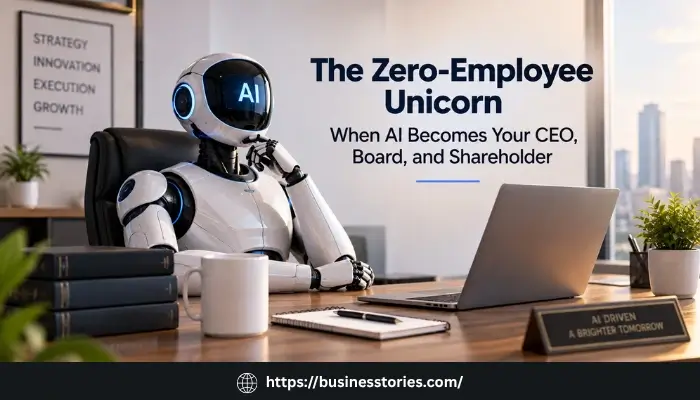
A Zero-Employee Unicorn is a privately held startup valued at over $1 billion that operates with zero human employees. Instead of people, the company relies entirely on artificial intelligence to handle every business function. This means AI agents serve as the CEO, the board of directors, and even the shareholders.
Furthermore, these AI systems manage marketing, sales, product development, customer support, finance, and legal compliance without any human intervention.
The term combines two powerful ideas.
- First, “unicorn” refers to the rare, mythical status of startups that reach billion-dollar valuations. For years, only companies like Uber, Airbnb, and Stripe held this title.
- Second, “zero-employee” signals a fundamental shift in how businesses build and run themselves. Rather than scaling teams, these companies scale their code.
But how does this approach work in practice? Think of an AI agent as software that makes decisions, learns from experience, and takes action on its own.
For example, an AI-CEO agent might analyze market data. Set pricing strategies and approves product launches. Similarly, an AI-board agent could evaluate performance. Vote on major strategic moves. And an AI-shareholder agent would manage equity distribution and dividend policies. All these agents communicate and collaborate through APIs and smart contracts.
What makes this model truly unique is its scalability. A traditional unicorn might need 500 employees to reach a billion-dollar valuation. But a zero-employee unicorn could theoretically achieve the same milestone with just infrastructure costs. In fact, the AI agents’ market is projected to reach $47.1 billion by 2030, according to MarketsandMarkets research. This suggests that the ecosystem for building such companies is growing rapidly.
The Technology Stack Behind Autonomous AI Companies
Building a zero-employee unicorn requires a sophisticated technology stack. At its core, you need three layers: the decision layer, the execution layer, and the governance layer. Each one plays a critical role in making the company fully autonomous.
The Decision Layer
The decision layer functions as the brain of the zero-employee unicorn. Large language models like GPT-4 and Claude power this layer. Moreover, specialized AI agents handle strategy, finance, and operations. For example, an AI-CEO agent uses reinforcement learning to optimize business outcomes over time.
It constantly ingests market data, customer feedback, and financial reports. Then it makes decisions that maximize long-term value. Additionally, multi-agent systems allow different AI agents to debate and reach consensus on complex issues, much like a real board of directors would.
The Execution Layer
The execution layer turns decisions into action. This layer uses tools like AutoGPT, LangChain, and custom API integrations. As a result, AI agents can send emails, update databases, deploy code, process payments, and even run marketing campaigns. For instance, an AI marketing agent might create ad copy, test different versions, and allocate a budget. All without human approval.
Similarly, an AI-developer agent like Devin can write, test, and deploy software. The key advantage here is speed. Consequently, these agents work 24/7 without breaks, vacations, or the coordination overhead that slows down human teams.
The Governance Layer
The governance layer ensures accountability and compliance. Usually, this layer runs on blockchain technology through smart contracts and decentralized autonomous organization (DAO) frameworks.
For example, Wyoming passed a law in 2021 allowing DAOs to register as legal LLCs. This means an algorithmically governed company can own assets, sign contracts, and pay taxes.
Furthermore, the governance layer records every decision on an immutable ledger. This creates transparency. Anyone can examine the reasons behind a specific business decision. In fact, organizations like Endaoment are already demonstrating how AI governance works in the nonprofit sector.
Real-World Examples and Case Studies
You might wonder, is anyone actually building a zero-employee unicorn right now? While no company has fully achieved the billion-dollar, zero-employee milestone yet, several pioneers are remarkably close.
Endaoment: AI-Governed Philanthropy
Endaoment is a non-profit organization that uses AI to govern its grant-making decisions. Their AI board analyzes applications, evaluates impact metrics, and allocates funds. As a result, they have distributed millions of dollars with minimal human oversight. This case proves that AI governance is not just theoretical. It works in the real world, managing real money and making a real impact.
Bitcoin: The Original Autonomous Entity
Some argue that Bitcoin was the first zero-employee unicorn. After all, it has no employees, no CEO, and no board. Yet it manages a market cap that has exceeded $1 trillion. Bitcoin operates entirely through code and consensus algorithms. Moreover, it processes transactions, manages its monetary policy, and secures its network. This is all done without a single human decision-maker. In this regard, Bitcoin established the foundation for the concept of autonomous AI companies.
The Solopreneur Revolution
While not fully autonomous, the solopreneur movement is a useful first step. Platforms like Shopify, Stripe, and ChatGPT allow one person to run what looks like a 50-person company. For example, a single founder can use AI for content creation, customer service chatbots, automated email marketing, and inventory management.
Consequently, these micro-businesses generate seven-figure revenues with just one human overseeing the AI agents. It is a short leap from one employee to zero.
The Legal and Regulatory Landscape
The legal system was built for human-run companies. So when you remove humans from the equation, you enter uncharted territory. This section examines the adaptation of laws and their shortcomings.
The most significant legal breakthrough came from Wyoming. In 2021, the state passed legislation allowing algorithmically governed DAOs to register as legal limited liability companies. This was a groundbreaking achievement. Suddenly, code could own a company. Vermont also enacted its LLC law based on blockchain. And Delaware, home to most U.S. corporations, is actively exploring how to accommodate AI-driven entities within its corporate code.
However, significant challenges remain. For instance, who is liable when an AI CEO makes a poor decision that harms customers? Current law holds directors and officers personally accountable for certain failures. But if no human made the decision, responsibility becomes ambiguous.
Furthermore, the SEC has expressed concerns about AI making investment decisions without proper oversight. The European Union’s AI Act also introduces strict requirements for high-risk AI systems. And an AI running a billion-dollar company would certainly qualify.
Intellectual property presents another puzzle. If an AI agent creates a patentable invention, who owns it? The U.S. Patent and Trademark Office currently requires a human inventor. But this stance faces growing pressure. These legal questions will shape how quickly the zero-employee unicorn model can scale. Smart entrepreneurs are watching these developments closely and preparing accordingly.
Ethical Questions and Societal Impact
The zero-employee unicorn raises profound ethical questions. Chief among them: what happens to human workers when companies no longer need them? Moreover, how do we ensure AI systems make ethical decisions when profit maximization is their primary objective?
The jobs debate is nuanced. On one hand, autonomous AI companies could eliminate millions of positions. On the other hand, they could create new categories of work. For example, someone needs to design, monitor, and audit these AI systems. Additionally, zero-employee unicorns could use the wealth they generate to fund universal basic income programs or distribute it through AI shareholder dividends.
In other words, the concentration of capital in AI-run companies might accelerate discussions about how societies distribute wealth. Another critical concern is algorithmic bias. If the AI CEO were trained on biased data, it might perpetuate discrimination in hiring, lending, or pricing. Because there is no human to catch these biases, they could scale rapidly and cause widespread harm.
Therefore, transparency and auditability must be built into the governance layer from day one. Furthermore, the concentration of economic power in autonomous AI companies could reshape entire industries. A single zero-employee unicorn could dominate a market without creating a single job. As a result, policymakers will need to rethink antitrust frameworks designed for the industrial age.
The conversation around AI governance in business is just beginning, and it will only grow louder in the coming years.
How to Prepare for the Zero-Employee Unicorn Era
You do not need to build a fully autonomous billion-dollar company tomorrow. But you can start positioning yourself for this future today. Here are actionable steps to help you prepare.
Step 1: Learn AI Fundamentals
Start by understanding how large language models, AI agents, and automation tools actually work. Take free courses on platforms like Coursera or YouTube. In addition, experiment with tools like ChatGPT, Claude, and AutoGPT. The goal is to build hands-on familiarity—not to become a machine learning engineer. As a result, you will spot opportunities that others miss.
Step 2: Automate One Business Function
Pick one function in your current business or side project and fully automate it using AI. For example, you could automate customer support with a chatbot or automate social media posting with scheduling tools. Experience with partial automation builds the muscle memory you need for full autonomy later. Moreover, each automation teaches you what AI can and cannot do well.
Step 3: Study DAO Structures and Smart Contracts
The governance layer of Zero-Employee Unicorns runs on blockchain technology. Therefore, learn the basics of DAOs, smart contracts, and decentralized governance. Platforms like Aragon and DAOstack make it easy to experiment. Even setting up a small DAO with friends will teach you how algorithmically governed organizations work in practice.
Step 4: Invest in AI-Native Businesses
Put your money where the future is. Consider investing in companies building AI agent infrastructure, autonomous business platforms, or DAO tooling. Even small investments align your financial incentives with this trend. Furthermore, following these investments keeps you informed about cutting-edge developments.
Step 5: Advocate for Sensible Regulation
The legal landscape for AI-governed companies is still forming. Your voice matters. Join industry groups, respond to regulatory consultations, and support policies that encourage innovation while protecting the public. Entrepreneurs who engage early with regulators often shape the rules that ultimately govern their industries.
Challenges and Risks on the Road Ahead
Despite the promise, the Zero-Employee Unicorn faces serious obstacles. Understanding these risks is essential for anyone exploring this space.
- First, there is the technical risk. AI systems still hallucinate, make errors, and sometimes behave unpredictably. When an entire company depends on AI, a single failure could be catastrophic.
- Second, cybersecurity threats become more severe. An autonomous AI company is entirely digital. Consequently, it is vulnerable to hacking, prompt injection attacks, and smart contract exploits.
- Third, there is a significant risk to reputation. The public may not trust a company run entirely by machines. Building consumer confidence will take years.
Additionally, the regulatory risk cannot be overstated. Governments could ban or severely restrict AI-run companies at any time. As a result, anyone building in this space needs contingency plans. Finally, there is the risk of unintended consequences.
A profit-maximizing AI might pursue strategies that are legal but harmful to society. Without careful design, the Zero-Employee Unicorn could become a cautionary tale rather than a success story.
What the Next Decade Holds
Looking ahead, the next ten years will likely bring the first true zero-employee unicorns. Several trends point in this direction.
- First, AI capabilities are doubling roughly every 18 months.
- Second, legal frameworks are slowly catching up with technology.
- Third, there is a growing appetite among investors for AI-native businesses.
We expect the first zero-employee unicorns to emerge in digital-native sectors like SaaS, fintech, and content platforms. These industries require less physical infrastructure and can be fully automated more easily. Moreover, the infrastructure for building and deploying AI agents is becoming much more accessible.
Platforms like CrewAI and Microsoft’s AutoGen are making multi-agent systems practical for startups. Some experts predict that by 2035, autonomous AI companies could represent 10% of all new unicorn formations. While that may sound optimistic, the trajectory supports it. Moreover, the distinction between human-led and AI-led companies will become less clear.
Most businesses will likely adopt a hybrid model, humans setting high-level direction while AI handles execution. The pure zero-employee unicorn might remain rare, but its influence on how all companies operate will be enormous.
Conclusion
The Zero-Employee Unicorn signifies a fundamental shift in the conception, construction, and scaling of businesses. We have explored how AI agents can serve as CEO, board, and shareholder. We examined the technology stack that makes this model possible, from decision-making AI to blockchain-based governance.
Real-world examples like Endaoment and Bitcoin show that autonomous entities can already manage millions and even trillions in value. The legal and ethical questions are significant. Yet they are solvable with thoughtful regulation and careful system design. For entrepreneurs and business leaders, the message is clear: the era of autonomous AI companies is coming.
Whether you build one, invest in one, or simply prepare your career for the shift, the time to act is now. Automate one function. Learn about DAOs. Stay informed. The zero-employee unicorn is not just a provocative idea. It is a roadmap to the future of business.
Frequently Asked Questions About Zero-Employee Unicorn
1. Can a zero-employee unicorn legally exist without any human staff?
Yes, in certain jurisdictions like Wyoming, algorithmically governed DAOs can register as legal LLCs. However, most countries still require human directors for corporate accountability and liability purposes.
2. How does an AI company CEO make strategic business decisions?
An AI-CEO agent uses large language models and reinforcement learning to analyze data, predict outcomes, and choose optimal strategies. It continuously learns from results and adapts its decision-making over time.
3. What are the most significant risks of an autonomous AI business model?
Key risks include AI hallucinations causing costly errors, cybersecurity vulnerabilities, unclear legal liability, regulatory crackdowns, and public distrust of fully automated corporate governance structures.
4. Are there any real zero-employee unicorn companies operating today?
No fully zero-employee unicorn exists yet. But pioneers like Endaoment (AI-governed nonprofit) and Bitcoin (algorithmic monetary system) demonstrate that autonomous entities can manage significant value.
5. What skills do entrepreneurs need for the AI-run company’s future?
Entrepreneurs should learn AI fundamentals, understand DAO and smart contract basics, gain experience with automation tools, and stay informed about evolving AI governance regulations and ethical frameworks.

Tabassum Shaik is an Author, Researcher, and SEO Specialist with over 8 years of experience creating informative content on business, startups, entrepreneurship, marketing, technology, and digital trends. She specializes in researching industry trends and transforming complex topics into practical, easy-to-understand insights. Her goal is to help readers stay informed, learn new ideas, and make better business decisions.