Running a business today means doing more with less time. You need to write content, manage social media, send emails, track data, and still find time to talk to real customers. That is a lot for one team. This is where AI marketing tools step in to help.
In 2026, smart software can write blog posts, design graphics, predict the best time to send an email, and even talk to your website visitors. These tools do not replace your team. Instead, they give your team more hours back each week. As a result, small businesses can now compete with bigger brands without hiring a huge staff.
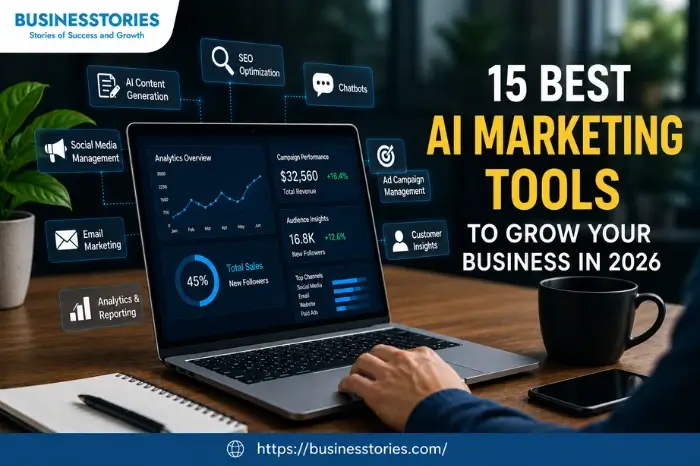
In this guide, we will walk through the 15 best AI marketing tools to grow your business in 2026. We picked each tool based on real value, ease of use, and how well it fits different budgets. So, whether you run a solo shop or lead a growing marketing team, you will find a tool that fits your needs.
What Are AI Marketing Tools?
AI marketing tools are software platforms that use machine learning and large language models to handle marketing tasks. They can write copy, sort customer data, plan content calendars, and even guess which leads are most likely to buy. In short, these tools turn raw data into clear, useful action.
The shift toward AI is not a passing trend. Recent research backs this up. Most marketers now use AI every day to automate and grow their business. Up to 93% of marketers now use AI in some way. That number alone tells you how fast this space is moving. If your competitors already use AI to write faster, target better, and report smarter, falling behind is a real risk.
So, what makes these tools different from older marketing software? Traditional tools follow fixed rules. You set them up once, and they repeat the same steps every time. AI tools work differently. They study patterns in your data and adjust on their own. For example, a normal email tool sends a campaign at a set time. An AI email tool works differently. It studies how each person engages. Then it picks the best send time and adjusts the content.
Why Do They Matter in 2026?
This matters a lot for business growth. First, AI saves time. Tasks that once took hours, like writing ten product descriptions, now take minutes. Second, AI improves accuracy. Instead of guessing which subject line works best, you get real predictions based on past behavior. Third, AI scales with you. A solo founder and a 50-person team can both use the same platform, just at different levels.
Here is a unique point many guides miss: the real value of AI marketing tools is not the output speed. It is the decision support they provide. A good AI tool does not just write a paragraph for you. It tells you which topic to write about, which channel to post on, and which customer segment to target first. That shift matters a lot. It moves AI from a writing helper to a true decision partner.
Before you pick any tool, ask yourself one question: does this tool save me time, or does it just create more work to review? That single filter will guide every choice on this list.
The 15 Best AI Marketing Tools for Businesses in 2026
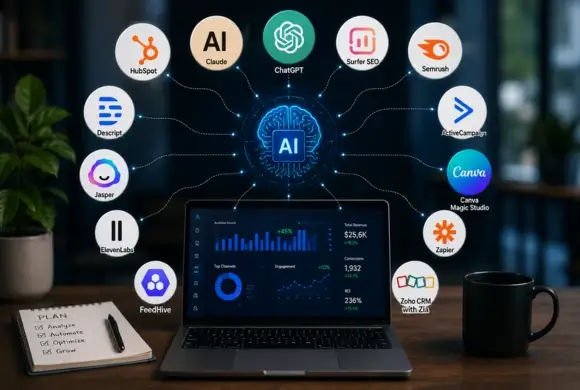
Below, you will find 15 tools grouped by use case. Each tool solves a different problem. Some help with writing. Others handle customer support or scheduling.
1. HubSpot (Best All-in-One AI Marketing Platform)
HubSpot combines CRM, email, and content tools in one dashboard. Its AI features, branded as “Breeze,” assist users by drafting emails and summarizing customer records to save time on administrative work. It is a strong pick for teams who want marketing, sales, and service data connected in one place.
2. Claude (Best for Long-Form Content and Strategy)
Claude, made by Anthropic, handles long blog posts, brand voice, and detailed research. Many marketers use it to edit drafts, summarize reports, and write long articles. It works best when a topic needs a careful, thoughtful tone. It works well for founders who write their own strategy documents.
3. ChatGPT (Best for Flexible, Everyday AI Tasks)
ChatGPT supports a wide range of marketing tasks. Marketers often use it to write blog outlines, email drafts, and social posts. It also helps with landing page copy and brainstorming. Its flexibility makes it a great starting point for beginners.
4. Surfer SEO (Best for AI-Powered SEO Content)
Surfer SEO helps you write pages that rank. It studies top-ranking pages. Then it finds content gaps. It also suggests better headings, keywords, and structure. If you already know your target keyword but need a stronger structure, this tool helps fast.
5. Semrush (Best for Competitor and Keyword Research)
Semrush has long been a favorite SEO toolkit. It now combines keyword tracking with AI-driven visibility insights, allowing teams to see their rankings not only on Google Search Console but also within AI-generated search results.
6. ActiveCampaign (Best for AI Email Marketing)
ActiveCampaign predicts the best time to email each subscriber. Once you send a campaign, ActiveCampaign saves the email. Then it resends it to each person at their best engagement time. It also tests subject lines and cleans up cold leads automatically.
7. Canva Magic Studio (Best for AI Design and Visuals)
Canva’s Magic Studio turns text prompts into social posts, ads, and presentations. It works well for small teams without a designer. It pulls your brand colors and logo into templates automatically.
8. Zapier (Best for Connecting AI Tools Together)
Zapier links your AI apps so they talk to each other. For example, you can have ChatGPT create an image and then tell it to upload the results to Google Drive or post them to Slack for review. This turns separate tools into one smooth workflow.
9. Jasper (Best for On-Brand Marketing Copy)
Jasper focuses on brand voice consistency across teams. It lets multiple writers follow the same tone guide, which is useful for agencies managing several client accounts at once.
10. Descript (Best for AI Video and Podcast Editing)
Descript edits video and audio by simply editing a text transcript. This makes podcast and video repurposing far faster, since you can cut filler words or change scripts without touching a timeline.
11. ElevenLabs (Best for AI Voiceovers)
ElevenLabs creates realistic voiceovers without expensive recording gear. Marketers can create voice content in many languages, fast and at low cost. This helps brands reach new regions sooner.
12. FeedHive (Best for AI Social Media Scheduling)
It predicts how well a social post will perform before you publish it. FeedHive makes this simple. It creates content, schedules posts, and reuses your top posts automatically.
13. Copy.ai (Best for Marketing Workflow Automation)
Copy.ai goes beyond writing single posts. Its real strength is automated workflows. Fast-growing companies love it because they can scale output without hiring more staff.
14. Hotjar (Best for AI-Powered User Behavior Insights)
Hotjar shows you why visitors leave your site instead of buying. The free plan allows you to watch session replays of site visitors, spotting where they get confused or encounter errors. This kind of feedback is gold. It helps you fix weak spots and boost sales.
15. Zoho CRM with Zia (Best Budget AI CRM Assistant)
Zoho’s AI assistant, Zia, supports small budgets well. Zia studies your sales data. It shows which leads are most likely to buy. Also reads customer messages to spot mood and tone. It is a smart, low-cost entry point for small teams new to AI-powered CRM.
How to Choose the Right AI Marketing Tools for Your Business
With so many options, picking the right stack can feel overwhelming. The good news is you do not need all 15 tools. You need the right two or three for your stage of growth.
Start by mapping your biggest time drain. If writing content eats your week, pick a content tool like Claude or Jasper first. If your inbox is a mess, an AI email tool such as ActiveCampaign will help more than a design tool ever could. This step alone, called workflow auditing, saves business owners from buying tools they never fully use.
Next, check for integration. No tool works alone. Check if the new tool connects with your email platform or accounting software. Disconnected tools trap your data in separate places. This adds manual work and defeats the whole point of automation. A connector tool like Zapier can bridge gaps if your stack does not naturally sync.
Budget also plays a role, but do not chase the cheapest plan blindly. Small businesses plan to grow, so the tools they use should grow and track performance with them. Look for software with tiered pricing models. Pick a tool that can scale as your team and data grow, instead of forcing a painful switch later.
Here is an actionable three-step process you can follow this week:
-
List your top three repetitive tasks: Write down what eats the most hours: content writing, email scheduling, or reporting.
-
Trial two tools for each task: Most platforms on this list, including Canva and Zoho, offer free plans or trials.
-
Track time saved over 30 days: If a tool does not save at least a few hours per week, drop it and try another.
A perspective many guides skip: the biggest ROI rarely comes from the flashiest AI feature. It often comes from boring automation, like auto-tagging leads or auto-scheduling social posts. These small, quiet wins add up to real hours saved every single month. Marketing teams that win in 2026 are not the ones with the most tools. They use AI agents to manage ads on Google and Meta. These agents also improve websites, all without adding new staff.
Finally, remember that AI supports your digital marketing strategy, but it does not replace it. AI can handle many marketing tasks. But it should not replace strategy, customer understanding, or final editorial judgment. Use these tools to move faster, while you and your team keep the final say on brand voice and big decisions.
Conclusion
Growing a business in 2026 no longer means working longer hours. It means working smarter with the right support. The AI marketing tools covered in this guide, from HubSpot and Claude to ActiveCampaign and Canva, each solve a real, specific problem. Some save you hours on content. Others help you understand your customers better or send emails at the perfect moment.
The key takeaway is simple: do not try to adopt every tool at once. Instead, find your biggest bottleneck, test one or two tools against it, and measure the time you save. Small, steady wins build into major growth over a few months.
If you are ready to build your own AI marketing stack, start small. Pick one tool from this list, try its free plan this week, and see how much time it gives back to your team. Your next big growth milestone might be one smart tool away.
AI Marketing Tools FAQs: Everything You Need to Know in 2026
What are the best free AI marketing tools for 2026?
Canva Magic Studio, Claude, Zapier, HubSpot, FeedHive, Descript, and ElevenLabs all offer free versions, making them great starting points for small budgets exploring AI marketing tools.
Do AI marketing tools replace human marketers?
No. AI is beneficial for boosting output. But human marketers still matter most for strategy, creativity, and final approval.
Which AI tool is best for small business email marketing?
ActiveCampaign ranks among the top AI email marketing platforms. It offers strong automation. It also personalizes messages. And it predicts the best send time for each contact.
How often should I update my AI marketing tool stack?
You should revisit your tool choices every six months to keep your team effective, rather than chasing the newest tool for its own sake.
Are AI marketing tools worth the cost for startups?
Yes, if they save real-time. AI marketing tools are worth it if they save measurable time, improve campaign quality, or help your team act on data faster than manual work.

Market Research Analyst with 20+ years of experience delivering data-driven insights and strategic market intelligence.