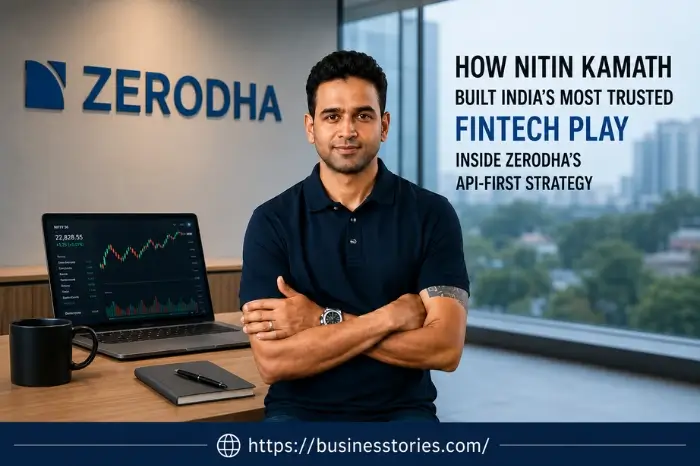
Nitin Kamath did not build Zerodha by chasing hype. Instead, he built it by solving a real problem with simple tools. That choice mattered. In a market full of loud ads and complex products, Zerodha stood out because it felt clear, quick, and honest.
Today, many people call Zerodha India’s most trusted fintech brand. That trust did not happen by chance. It came from years of careful decision-making. It came from a low-cost model, strong tech, and a strong belief in user trust.
Just as important, it came from an API-first mindset that gave the company room to grow beyond a normal brokerage app.
Why Nitin Kamath Chose Trust Over Noise
From the start, Nitin Kamath understood one key truth: money is personal. Because of that, people do not forgive broken promises in finance. So, instead of building a flashy brand, Zerodha focused on reliability, clear pricing, and a calm user experience. That was a smart move.
At the same time, many brokers in India leaned on heavy advertising and pushy sales. Zerodha went the other way. It kept the product simple and made the experience straightforward to understand. As a result, users felt more in control. And when users feel in control, trust grows faster.
This approach also helped Zerodha stay lean. Since it did not depend on large ad budgets or physical branches, it could invest more in product quality. That mattered because a better product often beats a louder campaign. In fintech, that lesson is still relevant.
How Zerodha’s API-First Model Changed the Game
Zerodha’s API-first strategy was not just a technical choice. It was a business choice. APIs allow software tools to connect and work together. When Zerodha opened access through Kite Connect, it invited developers, traders, and startups to build on its platform.
That created a bigger ecosystem. For example, algorithmic traders could automate strategies. Meanwhile, developers could create dashboards, alerts, and research tools. In turn, this made Zerodha more useful to advanced users. And when a platform becomes more useful, people stay longer.
This approach is one reason the “API-first fintech platform” fits Zerodha so well. The company did not treat APIs as an extra feature. Instead, it made them part of the core product story. That gave Zerodha a stronger edge than many traditional brokers.
There is also a more profound insight here. Many fintech brands try to win by serving only retail users. However, Zerodha saw value in builders too. By supporting developers, it expanded its reach without building every tool itself. That is efficient, and it is also scalable.
The Business Model Behind Zerodha’s Growth
Another major reason for Zerodha’s rise was its business model. Nitin Kamath kept the company focused on digital growth and low operational waste. Instead of spending on old-style distribution, the company encouraged self-service onboarding and simple digital flows.
Thus, users could begin faster, and the company could scale better. Zerodha also helped reshape Indian broking by making discount broking mainstream. Users became more aware of costs. Therefore, they started expecting fair pricing and better value.
Zerodha did not win only because it was cheaper. It won because it combined fair pricing with strong trust and useful technology. This balance is important. A low price alone can attract users once. However, a trusted product helps them last longer.
That is why Zerodha’s model worked so well. It gave people both value and confidence. And in financial services, that combination is powerful.
Another benefit of the lean model was speed. Because the company stayed focused, this focus allowed it to enhance the product without being slowed down by layers of processes. The product is delivered without getting lost in layers of processes.
As a result, the team could react to user needs more quickly. That is a strong advantage in a fast-moving market.
What Made the Brand Feel So Reliable
Trust is not built with one campaign. It is built through repeated proof. Zerodha earned that proof in several ways. First, it kept the interface clean. Second, it stayed transparent about costs. Third, it focused on performance during busy market hours. Each of these choices reduced user stress.
Furthermore, Zerodha supported education. Through content, tools, and market learning resources, it helped users make better choices. That matters because educated users often feel more confident. And confident users are more likely to stay loyal to a platform.
There is a useful lesson here for other founders. Do not try to look trustworthy. Be trustworthy. That means clear language, honest pricing, and stable systems. It also means building a product that works when you need it most. In finance, reliability is not optional.
Lessons Founders Can Learn from Nitin Kamath
Nitin Kamath’s story offers practical lessons for founders, product leaders, and marketers.
- First, solve a real pain point. Zerodha did just that by making trading easier and cheaper.
- Second, keep the product simple. Simple products are easier to trust, easier to use, and easier to improve.
- Third, think beyond the app. Zerodha’s API-first mindset shows how a company can become a platform. This is useful for any startup that wants long-term growth. When users, developers, and partners can build around your core product, your value grows over time.
- Fourth, build for the customer experience, not for vanity metrics. Many startups chase downloads, likes, or short-term buzz.
However, the companies that last usually focus on retention, trust, and usefulness. Zerodha is a strong example of that idea.
Finally, think about the power of calm branding. Zerodha did not shout the loudest. Yet, it became one of the most respected names in Indian fintech. That tells us something important: in crowded markets, clarity often wins over noise.
Why the Zerodha Story Still Matters in 2026
The Zerodha story still matters because fintech is changing fast. New products appear every year. AI tools are growing. Developer ecosystems are expanding. Even so, the basic rules have not changed. Users still want trust, speed, and value. Therefore, Zerodha’s playbook still feels fresh.
It also matters because many startups still make the same mistakes. They add too many features. They spend too much on hype. And they forget that finance is a high-trust category. Zerodha shows a better way. Start with the user. Then, build the systems that support that user for the long term.
In that sense, Zerodha is more than a brokerage story. It is a lesson in product discipline. It is also a lesson in ecosystem thinking. Most of all, it is a lesson in how a founder like Nitin Kamath can turn simple ideas into a lasting business moat.
Conclusion
Nitin Kamath built Zerodha into India’s most trusted fintech play by staying focused on what truly matters. He chose trust over hype. He chose clarity over complexity. And he chose an API-first path that helped the company grow into a wider platform, not just a trading app.
The result was a brand people could trust, a product developers could build on, and a business that stayed efficient as it scaled. That is the real lesson of Zerodha. In fintech, strong products and honest systems win over noise.
So, if you are building in this space, take a close look at this model. Start simple. Build trust. Then, scale with purpose.

Author & Researcher with 8 years of experience across IT and non-IT industries, delivering insightful and data-driven content.