
Introduction
You have a bold idea. You have the drive. But you also have one burning question: how to get funding for a startup when you have never done it before? You are not alone. Every first-time founder faces this same wall.
Here is the good news. Global startup funding reached $285 billion in 2025, according to Crunchbase data. And yet, more money is flowing into early-stage deals than ever before. So, the cash is out there. You just need a clear plan to go get it.
This guide is built for you to know how to get funding for a startup. It breaks down every funding option, from bootstrapping to venture capital. You will also learn how to build a pitch deck that wins. On top of that, you will get an 8-week roadmap to take you from zero to funded. Let us turn your idea into a funded business.
7 Smart Ways to Get Funding for Your Startup
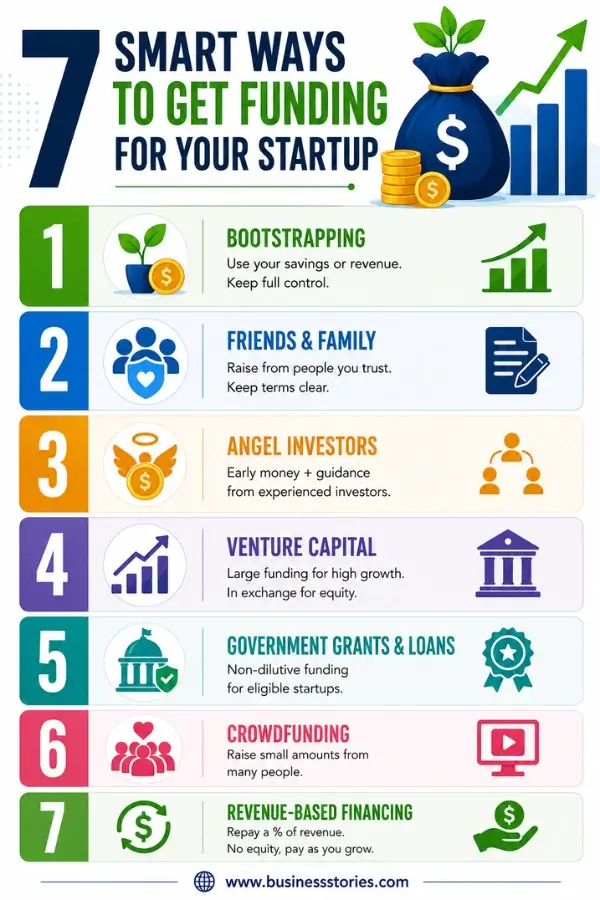
There is no single path to funding. In fact, the best route depends on your stage, your industry, and your goals. So, let us walk through seven options, from simple to complex.
1. Bootstrapping: Fund It Yourself First
Bootstrapping means you use your savings or revenue to grow your business. It is the most common path for new founders. Plus, it gives you full control. You do not owe anyone money or equity. Consequently, you retain complete control over every decision.
However, bootstrapping also means you move slower at first. You may need to work a day job while building on the side. But here is the upside. Investors love founders who put their skin in the game. According to Fundera, 94% of new businesses start with personal funds. So, if you can show traction on your own dime, you become far more attractive to outside investors later.
2. Friends and Family: Your First Believers
Before you pitch strangers, start with the people who already trust you. Friends and family rounds are quick and often come with flexible terms. Often, these are the easiest checks you will ever raise.
Still, be careful. Money can strain relationships fast. So, always put terms in writing. Use a simple loan note or a SAFE agreement. That way, everyone knows what to expect. Treat this round as professionally as you would treat a VC round.
3. Angel Investors: Early-Stage Fuel
Angel investors are high-net-worth people who back very early startups. They often write checks between $25,000 and $100,000. In addition to providing financial support, they offer mentorship and valuable connections. That can be even more valuable than the money itself.
To find angels, join platforms like AngelList or attend local pitch events. A warm introduction through a mutual contact is always the best approach. However, if you craft a brief, personalized message, cold outreach on LinkedIn can also be effective. Above all, show them why your idea has huge growth potential.
4. Venture Capital: Scaling at Speed
Venture capital (VC) is the path most people think of first. VC firms raise large funds and then invest in startups with high growth potential. In exchange, they take equity. Rounds range from $1 million (seed) to $100 million+ (Series C).
However, VC is not right for everyone. It works best for startups that can scale quickly and exit within five to ten years. On the other hand, if you want to run a profitable small business, VC may not be the right fit. Before you pitch, ask yourself: can your startup become a billion-dollar company? If the answer is yes, start building your pitch deck now.
5. Government Grants and Loans: Free Money, More Paperwork
Governments around the world offer grants and low-interest loans to boost innovation. In the U.S., the Small Business Administration provides loans up to $5 million. Similarly, the Small Business Innovation Research (SBIR) program awards grants for R&D projects. These funds do not dilute your equity, which is a huge plus.
That said, the application process can be slow and complex. You will need a detailed business plan and clear milestones. But here is a unique insight: winning a government grant acts as a quality signal. It tells future investors that experts have vetted your idea. Therefore, the effort often yields double benefits.
6. Crowdfunding: Raise from the Crowd
Crowdfunding lets you raise small amounts of money from a large number of people. Platforms like Kickstarter and Indiegogo are excellent for physical products. Meanwhile, Wefunder and StartEngine let you sell equity to the crowd. In short, you can validate your idea and raise funds at the same time.
A winning campaign needs three things: a compelling video, a clear reward structure, and a strong pre-launch email list. Most failed campaigns overlook the pre-launch phase. So, spend at least 4-6 weeks building buzz before you go live. When the big day comes, you will have momentum from the very first hour.
7. Revenue-Based Financing: Pay as You Grow
Revenue-based financing (RBF) is a newer option. Companies like Pipe and Clearco give you upfront cash in exchange for a small share of future revenue. You do not give up equity. And you only pay back when you make money. So, it aligns perfectly with your cash flow.
RBF works best for startups that already have steady monthly revenue. Even $5,000 per month can qualify you with some providers. As a result, this option has grown rapidly among SaaS and e-commerce founders who want to scale without dilution.
How to Build a Pitch Deck That Wins

Your pitch deck tells your story in just 10-12 slides. It must grab attention fast. More importantly, it must answer the one question every investor asks: “Why should I believe in you?” So, let us break down the must-have slides.
- Problem Slide: Show the pain point clearly. Use one sentence and one image. Investors invest in problems, not products.
- Solution Slide: Explain how you resolve that problem. Keep it simple. If your grandma cannot obtain it, please redo it.
- Market Size Slide: Use TAM, SAM, and SOM data. Cite a trusted source like Statista or Gartner.
- Traction Slide: Show real numbers. Revenue, users, or pilot results. This is your strongest slide.
- Team Slide: Highlight why you and your co-founders are the right people to win. Past wins matter here.
- Ask Slide: State clearly how much you are raising and how you will spend it. Be specific.
Here is a statistic to remember. Investors spend an average of 2 minutes and 30 seconds on a pitch deck, according to DocSend. So, every slide must earn its place. If a slide does not strengthen your case, cut it. Less is always more.
Prepare Before You Pitch: What First-Time Founders Overlook
Many new founders think the pitch is the hard part. But in truth, what happens before the pitch matters just as much. So, here is what you need to nail before you walk into any meeting.
Know Your Numbers Inside Out
Investors will test your knowledge of the business. So, you must know your customer acquisition cost, lifetime value, gross margin, and monthly burn rate by heart. If you stumble on these, you lose trust instantly. Furthermore, practice answering tough questions about your competition and risks. The more you prepare, the more confident you will sound.
Build a Data Room Early
A data room is a secure folder with your financials, cap table, legal docs, and team bios. When an investor asks for due diligence, you can share it in one click. That speed demonstrates your organization and seriousness. As a bonus, building it early forces you to spot and fix gaps before anyone else sees them.
Show Traction, Even Without Revenue
What if you have zero revenue? Do not panic. Traction can take many forms. For instance, you can show a waitlist with 500 signups, a pilot with three design partners, or a prototype with glowing user feedback. All of these prove that people want what you are building. In short, show forward motion. That is what investors really need to see.
Where to Find the Right Investors
Finding investors is not just about volume. In fact, spraying your deck to 500 random contacts rarely works. Instead, you need a targeted approach. So, here is how to do it right.
Warm Introductions Beat Cold Emails
A warm intro through a shared contact can boost your response rate by 10x or more. So, start by mapping your network. Who do you know that has raised money before? Which advisors, mentors, or founders can connect you? In the same way, attend startup events and join founder communities. Every relationship you build opens new doors.
Use Investor Databases Smartly
Platforms like Crunchbase, AngelList, and PitchBook let you filter investors by industry, stage, and location. Use these tools to build a focused list of 20-30 targets. Then research each one deeply. What deals have they done recently? What themes do they care about? When you contact them, make sure to mention their specific interests. That personal touch makes all the difference.
Post Content That Attracts Investors to You
Here is a unique strategy that most guides overlook. Share your founder journey on LinkedIn or Twitter. Post about your wins, your lessons, and your progress. Over time, investors will notice you. In fact, some investors may even initiate contact. Inbound interest from investors puts you in a much stronger position than outbound pitching ever will. So, start writing today.
Common Mistakes First-Time Founders Must Avoid
Even intelligent founders stumble over the same obstacles. Here are the major pitfalls to be aware of.
- Raising too much or too little: Ensure you have 18-24 months of runway. Less creates panic. More leads to wasteful spending.
- Ignoring investor due diligence: Check their past deals. Ask other founders about them. A bad investor is worse than no investor.
- Using jargon to sound smart: Clear language shows clear thinking. Jargon hides gaps. Speak plainly and win more trust.
- Overlooking legal basics: Get a qualified startup lawyer early. A poorly drafted SAFE or cap table error can kill deals months later.
Your 8-Week Roadmap to Getting Funded
Here is a simple, week-by-week plan to take you from idea to investor-ready. Tackle each week in order. Do not skip steps. Momentum builds on momentum.
| Week | Focus Area | Key Deliverable |
| 1 | Business plan and research | One-page business plan completed |
| 2 | Pitch deck and data room | 10-slide deck + Google Drive data room |
| 3 | Financial model | 3-year projections with assumptions |
| 4 | Investor target list | 20-30 investors researched and ranked |
| 5 | Warm outreach | 10 personalized intro requests sent |
| 6 | Pitch practice | 5 mock pitches with mentor feedback |
| 7 | Official pitches | Pitch to 5-10 investors |
| 8 | Follow up and negotiate | Term sheets reviewed with a lawyer |
Follow this roadmap, and you’ll progress more in eight weeks than most founders do in six months. The key is consistent action. Even small daily steps compound fast.
Conclusion
Learning how to get funding for a startup as a first-time founder is not simple. But here is the truth. Thousands before you have walked this same road and have succeeded. You can too. In this guide, we covered seven funding paths, from bootstrapping to venture capital. We broke down the pitch deck, the pre-pitch prep, and the common traps to avoid.
Above all, remember these principles. Investors bet on people, not just ideas. So, show up prepared. Show traction in any form you can. And never stop telling your story with clarity and passion. Your job is not to convince everyone. Your job is to find the few believers who see what you see.
How to Get Funding for a Startup FAQs
Q1: What is the easiest way to know how to get funding for a startup?
Bootstrapping with personal savings is easiest to start. Thereafter, friends and family rounds offer quick, flexible capital for new founders.
Q2: How much equity should a first-time founder give up?
In seed rounds, founders typically give up 10-20% of their equity. Always use a SAFE note to keep terms simple and protect your cap table.
Q3: Can I get startup funding with no revenue yet?
Yes. Angel investors and pre-seed VCs fund pre-revenue startups. Show traction through waitlists, pilots, or a strong prototype instead.
Q4: What documents do I need to raise startup capital?
You need a pitch deck, financial projections, and a data room with legal docs like incorporation papers and cap table records.
Q5: How long does it take to raise a seed round?
Most seed rounds take 3 to 6 months, from first outreach to money in the bank. An 8-week focused plan can speed this up significantly.

Author & Researcher with 8 years of experience across IT and non-IT industries, delivering insightful and data-driven content.