People always need food. That one fact makes agriculture stocks a great place to start investing. The world keeps adding more people. So, food demand keeps rising, too. Whether you are brand new to stocks or just want to branch out, the agricultural sector has a lot to offer. It gives you a steady income, solid growth, and real long-term value.
This guide will provide you with a step-by-step approach to getting started. First, we explain what agriculture stocks are. Then, we cover the main types, key risks, and how to pick the right ones. You now have a well-defined action plan that you can start right now.
What Are Agriculture Stocks and Why Do They Matter?
Agriculture stocks are shares in companies that work in farming and food. These firms do many things. Some grow and sell food products. Others make seeds, plant nutrients, or farm tools. Many run the supply chain, moving crops from farms all the way to store shelves.
So, why invest here? The reason is simple. Food demand will not stop growing. The world will likely hit 10 billion people by 2050. As a result, every part of the food and farming system must grow too.
Furthermore, many of these companies are called consumer staples. This means people buy their goods regardless of what the economy does. Because of this, these stocks tend to be more stable than tech or retail shares. They remain stable despite market fluctuations.
Moreover, food security is now a top concern for many countries. Governments are paying more to grow food locally. So, this trend creates strong demand for seeds, crop chemicals, and farming tools. Firms such as Corteva and Nutrien are at the forefront of this trend.
Furthermore, farming is changing fast. Drones, AI tools, and smart sensors are making farms more productive. So, you are not just buying into old-style farming. Instead, you are also getting a stake in cutting-edge tech growth.
Finally, many top agriculture companies pay strong dividend yields. So, you earn a regular income while your investment grows over time.
Types of Agriculture Stocks for Beginners
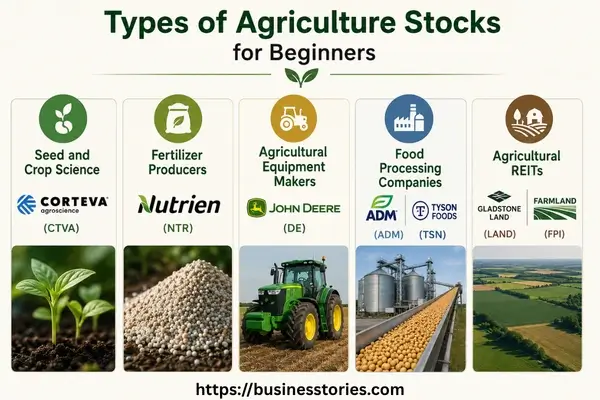
Before you buy your first share, it helps to know the main types of companies. Each type has a different risk level and growth rate. Let’s simplify these concepts.
Seed and Crop Science Companies
These companies make and sell seeds and crop protection products. For example, Corteva (CTVA) is a global leader in this space. It sells improved seeds and weed killers to farmers worldwide. Because these firms own patents and unique tech, they have strong pricing power. So, even when commodity prices fall, their profits hold up better than most.
Fertilizer Producers
Fertilizer companies sell the nutrients that help crops grow. Nutrien (NTR) is the world’s biggest maker of potash, nitrogen, and phosphate. These three items are vital for modern farming. However, their profits can rise and fall with global commodity prices. That said, food demand keeps fertilizer demand strong over time.
Agricultural Equipment Makers
Deere & Company (DE) is the top name here. It makes tractors, harvesters, and planting tools. It also leads the industry in smart farming tech. However, these stocks follow a cycle. Farmers buy more gear after successful harvests. Then, they reduce their purchases during lean years. So, timing matters more here than in other areas.
Food Processing Companies
Firms like Archer-Daniels-Midland (ADM) and Tyson Foods (TSN) turn raw crops into food products for millions of people. ADM processes soybeans and corn into items used across the global supply chain. Tyson, meanwhile, sells food brands like Jimmy Dean and Ball Park. Because they work at a huge scale, these firms enjoy strong cost advantages.
Agricultural REITs
If you want farmland exposure without buying land, REITs are a smart option. Gladstone Land (LAND) and Farmland Partners (FPI) own and lease farmland across the United States. They pay regular dividend yields from rent income. So, they work well for investors who want steady cash flow.
How to Evaluate Agriculture Stocks
Picking the right stock means looking past the price. Here are the key things every beginner should check first.
Market Cap and Business Size
Market cap tells you how big a company is. Larger firms, like Deere or ADM, tend to be more stable. Smaller firms can grow faster, but they also carry more risk. As a result, beginners often do better starting with large, well-known names. Many of the best choices also trade on the S&P 500. That signals strong financial health and wide investor interest.
Dividend Yields
Many agricultural companies share profits through dividends. For example, Nutrien has offered a dividend yield of around 4% recently. However, also check the payout ratio. If a firm pays out more than 80% of earnings as dividends, that pace may be difficult to keep during tough times.
Commodity Price Sensitivity
Agriculture stocks often move with commodity prices for wheat, corn, and soybeans. When prices rise, farmers earn more and spend more. So, companies across the sector do better. But when prices fall, margins shrink. Therefore, it is smart to choose firms with diverse products or strong brand power. These help protect profits from price swings.
Supply Chain Strength
A strong supply chain helps a company stay steady during disruptions. ADM, for instance, operates in over 170 countries. This extensive reach mitigates the impact of a drought in any one region. So, always look at how global a company’s work is before you buy.
Agriculture ETFs: The Easiest Way to Start
If picking single stocks feels like too much, agriculture ETFs are the perfect start. An ETF holds many stocks at once. So, you get instant spread with one purchase. This cuts risk without cutting your access to the sector.
Here are three solid choices for beginners:
VanEck Agribusiness ETF (MOO):
The fund is one of the most popular options. It holds shares in Deere, Tyson, Nutrien, and ADM. Its fee is around 0.52%. As a result, it gives you wide access to top agriculture company names worldwide.
iShares MSCI Global Agriculture Producers ETF (VEGI):
This fund tracks global farm producers. It offers a dividend yield of around 2.4%. So, it works well for investors who want both growth and income. Also, it goes beyond just US companies.
Invesco DB Agriculture Fund (DBA):
Unlike the others, DBA tracks commodity futures, like wheat, corn, and sugar. It is more volatile. However, it works well as a hedge against rising food prices. So, it is a useful tool if inflation is a key concern for you.
All things considered, ETFs are perfect for novices. They are simple to buy. They cost less to run. And they spread your risk across many firms at once.
Key Risks You Must Understand
Every investment carries risk. Agriculture stocks are no different. But if you know the risks, you can manage them better. So, let us go through the main ones clearly.
Commodity Price Swings
Commodity prices can shift fast. Wars, droughts, and trade disputes can all cause big moves. For example, the war in Ukraine hit global wheat and fertilizer supplies hard. As a result, many agricultural stocks moved sharply in a short time. So, make sure your risk tolerance can handle this kind of change before you invest.
Weather and Climate
Floods, droughts, and heat can destroy crops quickly. Furthermore, climate change is making these events more common. However, firms that work in many regions tend to cope better. So, spreading across different areas within the agriculture space helps cut this risk.
Trade and Policy Risk
Government rules can change fast and hurt profits. For instance, US farm exports to China dropped from $15.8 billion in 2017 to just $5.9 billion in 2018. Trade tensions caused that sharp fall. So, always check how much a firm relies on foreign trade before you buy.
Inventory and Seasonal Cycles
Input firms, those that sell seeds and plant nutrients, can face an “inventory trap.” When commodity prices fall, farmers delay their purchases. So, these firms build up large stocks. Later on, they have to sell those stocks at a discount. Checking a company’s inventory turnover rate is therefore crucial. A falling rate is a warning sign.
Step-by-Step Guide: How to Start Investing in Agriculture Stocks
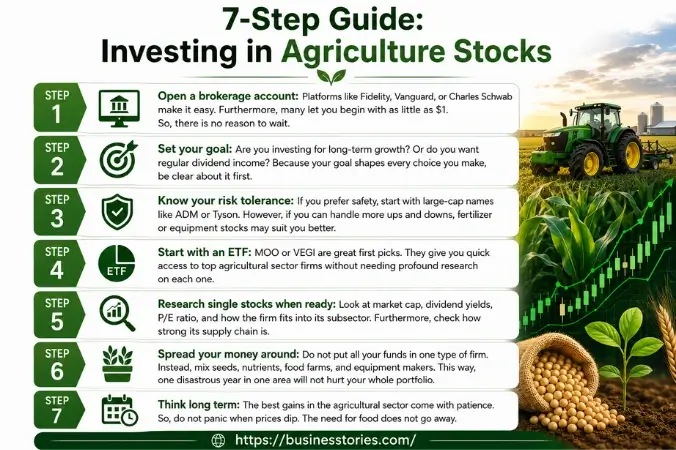
Starting does not have to be hard. Here is a simple plan you can follow right away.
- Step 1 — Open a brokerage account: Platforms like Fidelity, Vanguard, or Charles Schwab make it easy. Furthermore, many let you begin with as little as $1. So, there is no reason to wait.
- Step 2 — Set your goal: Are you investing for long-term growth? Or do you want regular dividend income? Because your goal shapes every choice you make, be clear about it first.
- Step 3 — Know your risk tolerance: If you prefer safety, start with large-cap names like ADM or Tyson. However, if you can handle more ups and downs, fertilizer or equipment stocks may suit you better.
- Step 4—Start with an ETF: MOO or VEGI are great first picks. They give you quick access to top agricultural sector firms without needing profound research on each one.
- Step 5 — Research single stocks when ready: Look at market cap, dividend yields, P/E ratio, and how the firm fits into its subsector. Furthermore, check how strong its supply chain is.
- Step 6 — Spread your money around: Do not put all your funds in one type of firm. Instead, mix seeds, nutrients, food farms, and equipment makers. This way, one disastrous year in one area will not hurt your whole portfolio.
- Step 7—Think long term: The best gains in the agricultural sector come with patience. So, do not panic when prices dip. The need for food does not go away.
Conclusion
Investing in agriculture stocks is a smart move for beginners. Food demand will continue growing for decades. So, companies in the agricultural sector are built on a base of real, lasting need. Whether you pick an ETF like MOO, a dividend payer like Nutrien, or a global giant like ADM, you invest in something the world truly cannot live without.
That said, always match your picks to your risk tolerance and goals. Start small if you need to. Spread across the top agricultural subsectors. And think long-term, not just the next quarter, but the next decade.
Your next step is simple. Open a brokerage account, pick one agriculture ETF or stock, and start today. The world’s need for food is not slowing down. So, neither should your investment journey.
FAQs About Agriculture Stocks
Q1. What is the best agriculture stock for beginners to buy first?
A: For beginners, start with the VanEck Agribusiness ETF (MOO) or a large-cap stock like Archer-Daniels-Midland (ADM). Both provide wide exposure to the agricultural sector. Furthermore, they have strong track records and pay solid dividends over the long term.
Q2. Are agriculture stocks a viable long-term investment?
A: Yes, they are. Because food demand grows with the global population, agricultural stocks tend to reward patient investors. Companies across the agriculture value chain, from seed makers to food processors, benefit from this steady demand.
Q3. How do commodity prices affect agriculture stocks?
A: Commodity prices directly impact profits across the sector. When crop prices rise, farmers earn more and spend more on inputs. So, fertilizer and equipment firms do better, too. However, when prices fall, margins shrink. Choosing firms with diverse products helps manage this risk well.
Q4. Can I invest in agriculture stocks through an ETF?
A: Yes, you can. ETFs like MOO, VEGI, and DBA let you invest in a basket of agriculture stocks or commodity futures at once. They are ideal for beginners. Furthermore, they cost less and carry lower risk than picking single stocks on your own.
Q5. What is the difference between agriculture REITs and agriculture stocks?
A: Agriculture REITs like Gladstone Land (LAND) own farmland and earn rent from farmers. Traditional agriculture stocks, however, give you a stake in firms that work in the sector, like seed makers or food firms. REITs tend to pay higher dividend yields. Meanwhile, stocks may offer stronger long-term capital growth.

Market Research Analyst with 20+ years of experience delivering data-driven insights and strategic market intelligence.