
Have you ever looked at a $40 shirt and thought it cost too much? Then, a few racks later, a $120 jacket made that shirt look like a steal. That shift in your mind is price anchoring at work. In short, the first price you see becomes a yardstick. After that, you judge every other price against it.
For business owners, the first price matters a lot. After all, buyers rarely know what a product should cost. So they look for clues. If you give them a fair, honest clue, your price makes sense. But if you leave them guessing, they will find their clue, and it may not help you.
In this listicle, you will learn how anchors work in the mind and which types you can use. You will also see real examples and a simple step-by-step plan. Finally, we will cover how to keep it honest, so buyers trust you and come back.
What Is Price Anchoring? The Psychology Behind It
So, what is price anchoring? Put simply, it is a pricing method where the first number a buyer sees shapes how they judge every price after it. That first number is the “anchor.” Once it drops, the mind stays tied to it, like a boat on a rope.
The idea comes from two psychologists, Amos Tversky and Daniel Kahneman. In 1974, they showed that people lean heavily on the first piece of data they receive. In fact, this phenomenon happens even when that data has nothing to do with the choice.
Why Our Brains Fall for Anchors
Here is the core of price anchoring psychology. Most of us cannot tell what a fair price is just by looking at a product. Instead, we compare. We ask, “Is this more or less than I expected?” As a result, the anchor quietly sets that expectation.
What’s more, even experts fall for it. In a 1987 study, Gregory Northcraft and Margaret Neale asked real estate agents to value the same house. The only change was the listing price. Agents who saw $119,900 valued the house at about $114,204.
In contrast, agents who saw $149,900 valued it at about $128,754. That is a gap of roughly $14,500, all from one number. Yet the agents said the list price did not sway them.
The Fairness Link Most Guides Miss
Many articles say anchors make prices feel cheap. However, this argument overlooks the larger issue. Anchors decide what feels fair. A Kleiner Perkins essay on pricing notes that our sense of fairness comes more from feeling than from logic.
So when your anchor is honest, it does more than push sales. It also tells buyers, “This price is reasonable, and here is why.” In other words, the anchor is not a trick. Rather, it is the context your buyer needs. Provide your buyers with clear context, and what initially seems like a high price will start to appear reasonable.
Price Anchoring Examples That Boosted Sales
Theory is useful, but stories stick. So let’s look at two famous price anchoring examples. Both teach the same lesson: you can lift sales without changing your price.
Williams-Sonoma and the Bread Maker
Back in the 1990s, bread machines were new. Williams-Sonoma sold one for about $279, but sales were slow. After all, shoppers had no idea what a bread maker should cost. So the store added a fancier model at $429.
Few people bought the $429 machine. Still, sales of the $279 model doubled. Why? Because the higher price gave buyers a point of comparison. Next to $429, the old price suddenly looked sensible.
The Economist and the Decoy Offer
Next, consider behavioral economist Dan Ariely. He once spotted three plans on The Economist’s website:
- Web only: $59
- Print only: $125
- Print and web: $125
At first, the print-only plan looked silly. Who would pay the same for less? But that was the point. Ariely tested it with 100 MIT students. With all three options, 84 students picked print and web. Then he removed the print-only plan. This time, 68 students chose web only, and just 32 picked the combo.
In money terms, the gap was significant. With the decoy, revenue came to about $11,444. Without it, revenue fell to about $8,012. So one plan that nobody bought lifted revenue by over 40%.
Your Best Seller May Never Sell
Here is the twist most people miss. In both cases, the anchor product barely sold. Yet it did the heavy lifting. Think of it as a silent salesperson. Its only job is to make your main offer easy to understand.
This is where decoy pricing shines. However, it only works when the decoy is real. The $429 bread maker was a real, better machine. Likewise, the print plan was a real product.
So if you add an anchor, make sure someone could buy it and get fair value. Otherwise, sharp buyers will notice, and your trust will suffer.
6 Types of Price Anchoring That Make Prices Feel Fair
Now that you know why anchors work, let’s look at your options. There are several types of price anchoring, and each fits a different kind of business. So pick the one that matches how your buyers shop.
1. The High Anchor
First, show your most premium option before the rest. For example, a store might place an $800 boot next to a $200 best seller. As a result, the $200 boot feels easy to say yes to.
2. The Was-Now Price
Next comes the classic sale tag. You cross out the old price and show the new one, such as $120 and $79. This makes the savings clear. But the old price must be one you truly charged. Otherwise, it is not just unfair. In many places, it is also illegal.
3. The Competitor Anchor
Then there is the rival price. You might say, “Others charge $120. We charge $89.” This helps when buyers already shop around. Just make sure the rival price is current and for a similar product.
4. The Bundle Anchor
Furthermore, you can list what each item in a bundle costs alone. Say three courses cost $300 when bought one by one. Then you offer all three for $199. The total becomes the anchor, so the bundle feels like a smart deal.
5. The Tier Anchor
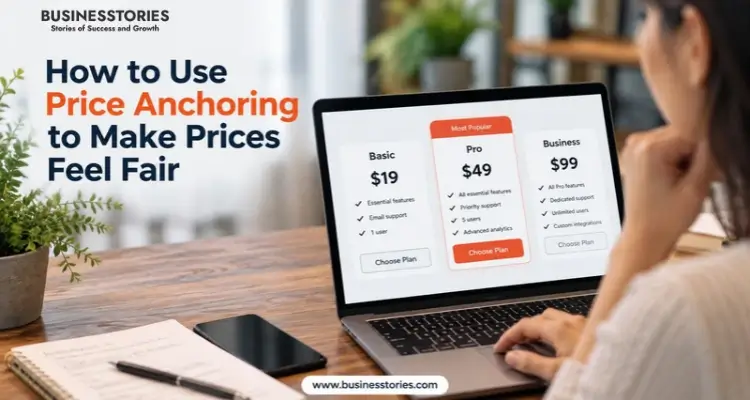
Likewise, software firms love three-tier pricing tables. The top plan sets the anchor, while the middle plan looks like the best fit. This is price anchoring in SaaS at its simplest.
6. The Value Anchor
Finally, here is the type most guides skip. Instead of comparing the price to another product, compare it to the cost of the problem it solves. A $49 bookkeeping app, for example, seems insignificant compared to the $400 monthly fee an accountant charges.
This value anchor is often the fairest of all. Why? Because it ties your price to real results. So the buyer does not just feel they got a deal. They can see exactly why the price makes sense.
How to Use Price Anchoring: A Simple 5-Step Plan
Understanding the different types is a beneficial first step. But how do you build a real price anchoring strategy? Just follow these five steps.
Step 1: Learn What Buyers Already Expect
First, find out what your buyers compare you to. Consider reviewing competitor prices, your previous pricing, and current spending patterns related to the issue. Furthermore, ask a few customers what they expected to pay. This information shows you the anchors already in their heads.
Step 2: Choose an Honest Anchor
Next, pick one anchor that is real and easy to believe. It could be a premium plan, a true former price, or the cost of doing nothing. Keep the gap clear but believable. For example, a “was $500, now $50” tag on a basic phone case will raise eyebrows, not sales.
Step 3: Show the Anchor First
Then, put the anchor where people see it first. On a pricing page, that might mean placing the premium plan on the left. In a sales call, it could mean naming the full project cost before the starter package. Order matters, because the first number frames the rest.
Step 4: Explain the Value of Each Price
After that, make every price easy to compare. Use clear plan names and list what each one includes. If buyers feel confused, they tend to walk away. So keep it simple, and highlight the plan that fits most people.
Step 5: Test, Measure, and Adjust
Finally, treat your pricing as an experiment. Try one change at a time, such as a new top tier or a new order. Then track which plan people pick and how many buy. Over time, your data will show which anchor feels fair to your buyers.
Bonus tip: Anchors also work over time. For instance, if you plan to raise prices, tell customers early. That way, the new price becomes the anchor before it starts. As a result, the rise feels expected rather than sudden.
Keep It Honest: Rules for Ethical Price Anchoring
So far, we have covered how anchors help sales. Now let’s discuss the boundary that should never be crossed. Ethical price anchoring uses real numbers. In contrast, deceptive anchoring uses fake ones.
What the Law Says
In the US, the Federal Trade Commission has clear guides on deceptive anchoring. They say a “former price” should be a real price. In fact, you must have offered it to the public on a regular basis for a fair stretch of time. You can’t just raise a price for two days and then lower it, in other words.
Meanwhile, the EU goes even further. Since 28 May 2022, the Omnibus Directive has required every announced discount to show the prior price. That prior price is the lowest one the seller used in at least the 30 days before the sale.
Then, in September 2024, the EU’s top court confirmed that sellers must work out the discount from that 30-day low.
Why Honesty Pays Off
Think about what happens with fake anchors. A shopper sees a price tag that says, “Was $200, now $120.” Then they find the same sneaker at $120 on three other sites. Suddenly, your whole store looks shady. So one fake anchor can hurt trust in every honest price you show.
Turn Rules Into a Trust Signal
Here is a fresh way to see these rules. Instead of treating them as limits, use them as proof. For example, you could show “lowest price in the last 30 days” on every sale item, even outside the EU. Few brands do this kind of pricing by choice, so it sets you apart.
Likewise, be open about your tiers. Explain why the top plan costs more and who it suits. When buyers see the logic, the anchor feels like guidance, not pressure. And that is the real goal: prices that feel fair because they are fair.
Conclusion
Price anchoring is one of the simplest tools in pricing. Yet it is also one of the most powerful. As you have seen, the first number a buyer sees shapes how they judge every price after it. That is why a $429 bread maker doubled sales of a cheaper model. It is also why one unsold magazine plan lifted revenue by over 40%.
- To recap, start by learning what your buyers already expect.
- Then pick an honest anchor, such as a premium tier, a real former price, or the true cost of the problem.
- Next, please present it first, explain the value of each option, and continue testing.
Above all, stay honest. Laws in the US and EU already demand real reference prices. More importantly, your buyers do too.
The big lesson is this: anchors do not just make prices look cheap. Instead, they give buyers the context to see why a price is fair. When you get that right, you sell more without pushing harder.
So here is your next step. Please open your pricing page today and consider asking, “What is the first number my buyer sees?” If you do not like the answer, pick one idea from this guide and test it this week. Minor adjustments to your anchor can significantly impact your results.
Frequently Asked Questions
1. What is price anchoring in simple terms for a small business owner?
Price anchoring means showing a reference price first, so buyers judge your real price against it. For a small business, the anchor could be a premium option, a true former price, or the cost of the problem.
2. Is price anchoring legal, and when does it become deceptive pricing?
Yes, price anchoring is legal when your anchor is real. It becomes deceptive when a seller displays a fictitious former price. Both the FTC and the EU’s Omnibus Directive require reference prices that sellers actually charged.
3. How does price anchoring psychology affect what buyers think is fair?
Buyers rarely know a product’s true worth, so they compare. The first price they see sets their expectation. So if your honest anchor is higher, your actual price feels reasonable and fair rather than expensive.
4. What are the best price anchoring examples for SaaS pricing pages?
Common SaaS price anchoring examples include three-tier tables with the premium plan shown first, annual plans set against monthly ones, and usage tiers. The high tier makes the middle plan feel like the best value.
5. Can price anchoring work for service businesses and freelancers too?
Yes. Freelancers can quote a full-scope package first, then offer smaller options. Service firms can also compare their fee to the cost of hiring in-house. This value anchor helps clients see why your rate is fair.

Senior Business Analyst / Prduct Owner with 12+ years of experience driving data-driven insights, optimizing business processes, and delivering strategic IT solutions.