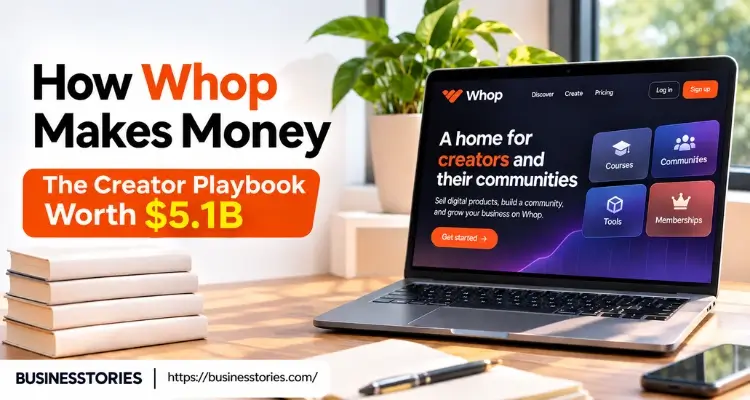
Two kids met in a Facebook group. They built bots to buy rare sneakers. Ten years later, their company is worth $5.1 billion. That company is Whop. In October 2026, it raised a big Series D led by Sequoia Capital and Shopify Ventures. So people now ask one simple question: how Whop makes money.
The short answer? Whop takes a small commission when its sellers make a sale. But that is only part of the story. In fact, Whop now earns from ads, AI tools, and money services too.
In this listicle, you will learn what Whop is and how the founders built it. You will also see the full Whop business model, the numbers behind the valuation, and the lessons you can use in your own business. Let’s dive in.
What Is Whop? The Founder Story Behind the Platform
So, what is Whop? Put simply, Whop is an online marketplace where people sell digital products. Think courses, paid communities, software, coaching, and services. Buyers locate these products, pay for them, and obtain access in one place.
Picture a giant online mall. Each seller runs a small shop, while Whop runs the mall and the payments.
From Sneaker Bots to a Startup
The story starts with a pair of sneakers. At 13, Steven Schwartz wanted a rare pair of Nikes. His parents said no. So he taught himself to code a bot that could buy shoes before they sold out.
Soon after, he met Cameron Zoub in a Facebook group. Cameron was a fellow middle schooler from Chicago. Together, they sold their bots under the name Sole Sniper for $20 to $500 each. Later, Jack Sharkey joined them from the same sneaker world.
The duo then attempted about 23 side hustles. They built apps, games, social networks, and even an IT company. Some made substantial money. Still, none felt right.
Then, in late 2020, a friend showed them a forum. Thousands of people were buying and selling software there. However, the forum had no reviews, no support, and no easy way to pay. The team saw a gap. So they launched Whop in March 2021 to fix it.
What Whop Does Today
Today, Whop is far bigger than a software forum. For example, sellers on Whop now include a tree removal service in Canada, a music playlist curator, and a private jet app. Furthermore, Sequoia says about 10,000 new businesses start on Whop each day.
Unique insight: Most articles call Whop a “creator platform.” However, that label fails to capture the essence of Whop. Whop began as a fix for trust between strangers online. Reviews, safe payments, and instant access are still its real product. Everything else sits on top of that trust layer.
How Whop Makes Money: The Core Fee Engine
Now for the big question. How Whop makes money comes down to one idea: Whop wins only when its sellers win.
There is no monthly fee to join. Instead, Whop takes a small slice of each sale. As a result, a new seller pays nothing until money comes in. That makes it simple to start.
The 3% Platform Fee
First, there is the core Whop platform fee. According to Whop’s own docs, it is 3% plus payment processing fees on sales made through Whop Payments. The 3% is Whop’s charge for using the platform.
Here is a simple example. Say you sell a $100 course. Whop keeps $3. Then the card processor takes its share on top. So you keep most of the money, and Whop earns a small, steady cut.
The 30% Discover Marketplace Cut
Next comes the bigger fee. Whop has a section called Discover. It works like a shop window where buyers browse new products.
If a buyer finds you through Discover, Whop takes a much larger share, often reported at 30%. But if you bring the buyer yourself, you pay only the 3% fee. In other words, Whop charges more when it does the selling for you.
Payment, Payout, and Extra Fees
On top of that, there are smaller fees. Card processing starts at about 2.7% plus 30 cents. International cards add 1.5%, and currency conversion adds 1%. Furthermore, payouts to a US bank cost about $2.50 each.
When you consider all the factors, the average cut becomes evident. In fact, CEO Steven Schwartz told Bloomberg that Whop’s blended average fee is about 6%.
Unique insight: Most guides treat these fees as a cost to avoid. However, it is helpful to think of these fees as similar to a toll road. Whop charges a tiny toll on millions of trips.
Because the toll grows with every sale, Whop does not need to win big on one seller. Instead, it just needs many sellers to keep moving forward.
The Whop Business Model Beyond Transaction Fees
Fees are the base of the Whop business model. However, the company is now stacking new income streams on top. Each one adds a new way to earn from the same sellers.
Whop Ads
In May 2026, Whop launched Whop Ads with a Meta integration. Now, sellers can run Facebook and Instagram ads right from their Whop dashboard.
Why does this matter? This matters because Whop has data from more than 22 million buyers across its network. So its ads can target people who already buy digital products. Earlier, Whop bought an ad agency called Hidden Studios in October 2025 to lead this push.
AI “Economic Intelligence”
Next, Whop built an AI tool that studies its sales data. Then it tells each seller the next best move, like launching an ad or sending a weekly message to top buyers.
Here is the twist. Sellers who use this tool pay Whop an extra share of the revenue it helps them earn. So far, Whop has not shared the exact rate. Furthermore, in July 2026, it released the Whop CLI, which lets AI agents run a business through simple prompts.
Whop Finance and Stablecoins
Finally, Whop moved into money services. In February 2026, Tether invested $200 million in Whop. Soon after, in March, Whop launched Whop Finance. Its Treasury product offers up to 6% yield on stablecoin balances.
So Whop can now earn from money that simply sits in seller accounts. That is a big step beyond a simple checkout.
Unique insight: Look closely, and you will see a pattern. Whop is not just building tools. Instead, it is turning each tool into a new toll gate. Payments, ads, AI advice, and savings all sit inside one dashboard. So the more a seller uses, the harder it becomes to leave.
The Numbers Behind the $5.1B Valuation
Big valuations need big numbers. So let’s look at what investors saw.
Revenue Growth
The growth is steep. At the start of 2025, Whop’s yearly revenue pace sat near $60 million. Then, by late 2026, Schwartz said it had passed $400 million. Meanwhile, Sequoia’s Doug Leone put it closer to half a billion dollars.
Keep in mind that these are company-reported numbers. Still, even the lower figure means revenue grew more than six times in under two years.
Funding Timeline
Here is how the value climbed:
- 2023: About $17 million Series A led by Insight Partners, with Peter Thiel taking part.
- July 2024: Series B of over $50 million, led by Bain Capital Ventures, at about $800 million.
- February 2026: $200 million from Tether at a $1.6 billion valuation.
- October 2026: $200 million Series D led by Sequoia and Shopify Ventures at $5.1 billion.
In other words, the value more than tripled in just eight months. Additionally, with yearly revenue at $400 million, the $5.1 billion valuation equates to approximately 13 times that revenue. That is high, but not wild for a fast-growing payments company.
So, investors are betting that growth will continue and that sellers will continue paying.
Platform Scale
Furthermore, the platform itself is huge. Around 25,000 business owners generate about $550 million a month on Whop. Plus, the company says it has handled more than $7 billion in sales across 185 countries.
Unique insight: Here is a fun fact. Sequoia once passed on Whop. Leone said the firm changed its mind after seeing that Whop’s sellers kept growing instead of quitting. So the lesson is clear.
Investors did not pay for hype. Rather, they paid for low churn, which means sellers who stay.
Why Creators Choose Whop (and the Risks to Watch)
So why do so many sellers pick Whop over other tools? There are a few simple reasons.
The Benefits for Sellers
- First, it is free to start. You only pay when you make a sale. By contrast, platforms like Gumroad and Patreon often charge around 10%.
- Second, everything lives in one place. You get checkout, access control, Discord and Telegram links, affiliates, and now ads. So you do not need to glue five tools together.
- Third, there is built-in traffic. Discover can send buyers your way, even if you have no audience yet. That is why many beginners start here.
The Risks to Keep in Mind
However, no platform is perfect. For one thing, the real cost is higher than the headline 3%. Once you add processing, payouts, and currency fees, many sellers pay closer to 6% or more.
Furthermore, the 30% Discover cut can hurt if most of your buyers come from there. And because Whop owns the checkout, you depend on its rules.
Then there is the risk associated with AI. As AI reduces the cost of building websites and apps, sellers have more options. Therefore, Whop must consistently demonstrate its value.
Additionally, refunds can be detrimental; when you refund a buyer, the fees you previously paid typically do not return. Thus, it is beneficial to establish clear refund policies from the outset and communicate them on your sales page.
Unique insight: Here is the real test for any seller. Ask yourself, “Does Whop bring me buyers, or do I bring them?” If you bring your own buyers, you pay less and keep control. But if Whop brings them, the 30% cut is the price of growth. Know which one you are before you build.
The Creator Playbook: Lessons You Can Use From Whop
Whop’s story is not just about a startup. It is also a playbook you can copy. Here are simple steps that work for any online seller.
Step 1: Start Before You Feel Ready
The founders tried about 23 side hustles before Whop worked. Schwartz’s main advice is simple: you have to start. So pick one small idea and launch it this week. Then learn as you go.
Step 2: Solve a Trust Problem
Whop won because buyers did not trust the old forums. Likewise, your buyers want proof. So add reviews, clear refund rules, and quick support. As a result, more visitors will become buyers.
Step 3: Charge When You Deliver Value
Whop earns only when sellers earn. You can use the same idea. For example, try results-based pricing, free trials, or a low entry price. That way, buyers feel less risk.
Step 4: Build Your Own Audience
Next, don’t rely solely on a marketplace. Instead, grow an email list or community you own. That way, you pay lower fees and keep your buyers.
Step 5: Stack More Products Over Time
Finally, copy Whop’s layering move. Start with one product. Then add a community, a coaching tier, or a template pack. So each buyer becomes worth more over time.
Step 6: Track Your Real Costs
Last, know your true take-home pay. Add up every fee, from processing to payouts. Then compare it with your price. That way, you can raise prices or switch tools before small fees eat your profit.
Unique insight: The hidden lesson here is patience with small cuts. Whop never charged huge fees. Instead, Whop took a small percentage from many sales. Small, fair prices that grow with your buyers often beat big one-time wins.
Conclusion
So, how Whop makes money is simpler than it looks. Whop’s primary revenue model involves taking a small percentage of each sale made on its platform. That starts with a 3% fee, rises to about 30% on Discover sales, and averages around 6% overall.
But the story goes deeper. Today, the Whop business model stacks new streams on top of those fees. For example, Whop Ads helps sellers find buyers. Meanwhile, its AI tool takes an extra share of the revenue it helps create.
And Whop Finance lets the company earn from money sitting in seller accounts. Behind it all is a founder story worth knowing. Three young friends started with sneaker bots. Then they failed many times and finally built a trusted place to buy and sell online.
As a result, revenue jumped from about $60 million to over $400 million, and the company is now worth $5.1 billion. For you, the lesson is clear. Start small, earn trust, and charge when you deliver value. Furthermore, build an audience you own, and add new products over time.
Frequently Asked Questions
1. How Whop makes money from the creators who sell on its platform?
Whop makes money mainly by taking a cut of each sale. Sellers pay a 3% platform fee plus card processing fees. Sales from the Discover marketplace carry a bigger cut, often reported at about 30%.
2. What is Whop, and what kinds of digital products can you sell there?
Whop is an online marketplace for digital products. You can sell courses, paid Discord or Telegram communities, software, coaching, and services. It handles checkout, access, and payouts, so sellers can run their business from one dashboard.
3. What is the real average fee in the Whop business model for sellers?
The real average cut is about 6%, according to CEO Steven Schwartz. That blends the 3% platform fee, processing costs, and higher Discover fees. So your exact cost depends on where your buyers come from.
4. Who founded Whop, and how did the founders first meet each other?
Steven Schwartz, Cameron Zoub, and Jack Sharkey founded Whop in 2021. Schwartz and Zoub met as teens in a Facebook group, building sneaker bots. Sharkey later joined from the same online sneaker reselling world.
5. Why did Sequoia and Shopify back Whop at a $5.1 billion valuation?
Investors backed Whop for its rapid revenue growth and loyal sellers. Revenue rose from about $60 million to over $400 million in less than two years. Sequoia also noted that sellers on Whop kept growing instead of quitting.

Senior Business Analyst / Prduct Owner with 12+ years of experience driving data-driven insights, optimizing business processes, and delivering strategic IT solutions.