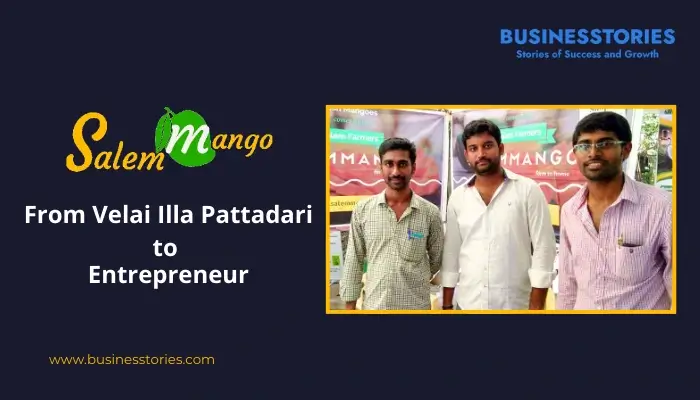
By Sathish Ramasamy, a Founder of SalemMango
I am Sathish Ramasamy, born and brought up in Mottandipalayam, a small village in the Salem district of Tamil Nadu. I come from a traditional agricultural family where farming was not just a profession, but a way of life passed down through generations.
Like many students from tier-2 towns and rural backgrounds, my first dream after completing my Bachelor of Engineering was simple and practical — to secure a stable IT job in a reputed company. I achieved that goal and entered the IT industry immediately after graduation. However, that phase of my life was short-lived. A recession forced me out of the company, and suddenly, I found myself at a crossroads, questioning what I truly wanted to do with my life.
Back in my village, people jokingly called me “VIP – Velai Illa Pattadari” (an unemployed graduate). What sounded like casual humor slowly became silent fuel for my entrepreneurial journey.
Journey & Beginnings: How SalemMango Was Born
After losing my IT job, I started preparing for government exams while also helping my family with farming activities. Every evening, I would sit with my childhood friend Dinesh Kumar, a software engineer like me, who also came from an agricultural background. Our conversations were simple — life, cities, opportunities, and the contrast between rural and urban living.
One such evening, during a normal village conversation, a question changed everything:
“Why are people in cities forced to eat chemically ripened, carbide-laced mangoes when we grow natural, organic mangoes here?”
That single question sparked a powerful idea. What if we could directly connect our village farms to urban homes? What if people in cities could eat the same naturally grown Salem mangoes that we grew up eating?
That was the seed of SalemMango.
The idea was born in March 2016, but we knew an idea alone was not enough. We spent months doing groundwork — researching customer needs, checking feasibility, and understanding how online ordering and logistics could work for a small, village-based venture.
With limited money but unlimited belief, we built a basic website. By September 2016, it was ready, and in November 2016, we officially launched SalemMango. That quiet launch firmly changed the direction of our lives.
Challenges & Setbacks: The Reality of Starting from a Village
As a first-generation founder from a rural background, I started with more questions than answers. We had excellent quality fruits, but no idea how to reach urban customers, build trust, or manage technology and logistics.
Some of our biggest challenges were:
1. Technology Gap
I had started using a smartphone only about eight months earlier. In our village, even a stable 3G connection felt like a luxury. Even today, network quality is poor, and there are no direct bus transport options — we still walk nearly 3 kilometers to reach the nearest bus stop.
2. Market Access
Competing with established urban brands without branding or marketing experience was extremely difficult. Convincing city customers to trust a village-based brand was an uphill battle.
3. Operations & Logistics
Shipping perishable products like mangoes safely across cities while maintaining freshness and quality was a completely new learning curve.
Learning, Support, and Growth
We tackled each challenge step by step. I leaned heavily on my friend Dinesh Kumar, who joined as co-founder, bringing his software expertise along with deep agricultural roots inherited from our grandparents.
We listened carefully to early customer feedback, learned basic digital tools, improved packaging methods, and optimized logistics. Most importantly, we focused on one core promise:
Truly farm-fresh, organic fruits — directly from farmers’ hands to urban homes.
Our families and friends became our first investors — not through money alone, but through moral support, ideas, patience, and encouragement during every low phase.
SalemMango Work, Team, and Vision
SalemMango began with just two people — me as founder and Dinesh Kumar as co-founder — both from farming families with software backgrounds. Over time, our team naturally expanded to include farmers from our village and nearby areas.
Today, these farmers have started adopting natural cultivation methods for mangoes and traditional rice varieties. SalemMango has grown into one of the most trusted brands for natural Salem mango delivery across India.
Our long-term vision is simple yet powerful:
To connect urban families who crave authentic, chemical-free, traditional food with farmers who grow it naturally and responsibly.
We want to make healthy cooking easy for city households using ingredients that come directly from villages like ours — at prices fair to both farmers and customers. Instead of depending heavily on external funding, we have grown organically with the support of family, friends, and customers.
SalemMango Founder Message to Readers: What I Want to Share
If you dream of starting something of your own — especially if you come from a non-metro town or a small village — remember this:
Your roots are your biggest strength, not your weakness.
You don’t need a perfect plan, huge funding, or a big office. You need a real problem, a deep belief, and the courage to work harder than your comfort zone allows.
There will be rejection, jokes, and moments of self-doubt. I went from being an IT employee to being called an unemployed graduate, and today, I am an entrepreneur creating livelihoods in my own village.
Use every setback as fuel. Keep learning. Dream big, even if you start small.
To everyone reading this:
Respect the food on your plate and the farmer behind it. If you have a dream that keeps you awake at night, start today. One small step — one bold decision — can completely rewrite your life story.
And always try to find solutions in nature’s way, not through harmful modern chemicals.
👉 If you want to explore more inspiring stories from rural India, don’t miss Agriculture Heroes: Tribal and Rural Heroes Transforming Indian Agriculture.