Introduction: Why India’s Startup Scene Is Exploding in 2026
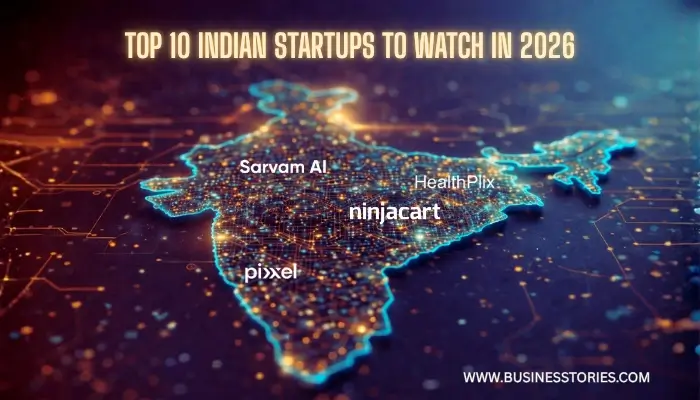
India has firmly cemented its position as the world’s third-largest startup ecosystem. 2026 is shaping up to be a landmark year. With over 1.4 billion people, a digitally empowered middle class, and deep-tech talent pools from IITs and NITs. The government is actively rolling out policies to back homegrown innovation. The country is producing ventures that don’t just solve Indian problems but are also addressing global challenges. Top 10 Indian Startups to Watch in 2026 captures a market moment where angel rounds are turning into unicorn rounds faster than ever before.
From AI-powered healthcare to climate fintech, vernacular edtech, and space tech, Indian founders are building with a scale and ambition that draw global attention.
In this article, we profile the Top 10 Indian startups that investors, entrepreneurs, and tech enthusiasts truly must keep on their radar in 2026. Each profile includes what they do, why they matter, and what makes them stand out.
The Top 10 Indian Startups to Watch in 2026
1. Sarvam AI (AI Infrastructure Startup in India)
Sarvam AI is building India’s own large language model (LLM) infrastructure. It is purpose-built for Indic languages and the specific cultural nuances of over a billion users.
| Sector | Artificial Intelligence / NLP |
| Founded | 2023 |
| HQ | Bengaluru, Karnataka |
Why it’s in the top list: In a world dominated by OpenAI and Google, Sarvam AI is carving out a critical niche by training models. Those who truly understand Hindi, Tamil, Telugu, Marathi, and a dozen other Indian languages. As enterprises race to deploy AI in Tier-2 and Tier-3 cities, Sarvam’s foundational models could become the de facto AI layer for India’s next 500 million internet users.
Key Highlight: Backed by Lightspeed India, Sarvam AI completed a $41M Series A round. It already has pilot deployments with major Indian public sector banks.
2. Pixxel (Space Technology Startup in India)
Pixxel is building a constellation of hyperspectral Earth-imaging satellites that can detect crop diseases, oil spills, and climate patterns invisible to standard satellites.
| Sector | Space Technology / Earth Observation |
| Founded | 2019 |
| HQ | Bengaluru, Karnataka |
Why it’s in the top list: India’s space economy is projected to reach $44 billion by 2033. Pixxel is right at the frontier. Its hyperspectral data platform is not just for defence agriculture; insurance and climate-tech companies are queuing up to access insights from Pixxel’s growing orbital network. With ISRO’s liberalisation of India’s space sector, Pixxel is in a prime position to become a global data provider.
Key Highlight: Pixxel successfully launched its first commercial satellite in early 2024 and has signed data access agreements with several Fortune 500 agribusinesses.
3. Ninjacart (AgriTech Supply Chain Startup in India)
Ninjacart is India’s largest agri supply chain platform, directly connecting farmers to retailers, restaurants, and quick commerce platforms, eliminating middlemen.
| Sector | AgriTech / Supply Chain |
| Founded | 2015 |
| HQ | Bengaluru, Karnataka |
Why it’s in the top list: Food inflation and supply chain inefficiencies remain persistent problems across Indian cities. Ninjacart has tech-driven cold chain and last-mile logistics. It solves a real pain point for millions of farmers and millions more urban consumers. As quick-commerce giants like Blinkit and Zepto scale, Ninjacart’s B2B fresh-produce infrastructure becomes even more strategically valuable.
Key Highlight: Walmart and Tiger Global-backed Ninjacart processes over 2,000 tonnes of fresh produce daily and expanded to Southeast Asia in 2025.
Explore practical tips to keep your business afloat in Startup Survival Strategies When the World Turns Unpredictable.
4. Ather Energy (Electric Vehicle Startup in India)
Ather Energy designs and manufactures premium electric scooters entirely in India, with a vertically integrated approach covering hardware, software, and charging infrastructure (Ather Grid).
| Sector | Electric Vehicles / Clean Mobility |
| Founded | 2013 |
| HQ | Bengaluru, Karnataka |
Why it’s in the top list: India’s EV two-wheeler market is growing at over 40% CAGR, and Ather is the tech-first choice for urban commuters wanting a connected, intelligent ride. Unlike many rivals, Ather builds its own chip software and over-the-air update systems. Its upcoming IPO and aggressive expansion into 300+ cities make 2026 a defining year for the brand.
Key Highlight: Ather crossed 1 lakh registered vehicles in 2025 and launched the 450X Gen 3 — its fastest scooter yet — with a top speed of 130 km/h and a true range of 150 km.
5. HealthPlix (HealthTech AI Startup in India)
HealthPlix is building the operating system for Indian doctors — an AI-powered Electronic Medical Record (EMR) platform that streamlines consultations, prescriptions, and patient follow-ups for independent clinicians.
| Sector | HealthTech / Clinical AI |
| Founded | 2015 |
| HQ | Bengaluru, Karnataka |
Why it’s in the top list: India has over 1.3 million registered allopathic doctors, most of whom still operate on paper or fragmented systems. HealthPlix’s conversational AI turns a 10-minute consultation into structured clinical data in real time. As India’s digital health mission (ABDM) scales nationally, HealthPlix’s interoperable data network becomes critical infrastructure for the country’s healthcare backbone.
Key Highlight: HealthPlix is used by over 80,000 doctors across 10,000 towns in India and raised a $22M Series C in late 2024 to expand its AI diagnostics layer.
6. Perfios (FinTech Data Platform in India)
Perfios is a B2B financial data platform that aggregates, analyses, and enriches financial data in real time, helping banks, NBFCs, and insurance companies make faster and smarter lending decisions.
| Sector | FinTech / Data Intelligence |
| Founded | 2008 |
| HQ | Bengaluru, Karnataka |
Why it’s in the top list: India’s formal credit gap is estimated at over $300 billion. Perfios’s infrastructure allows lenders to perform real-time bank statement analysis, GST verification, and income profiling in seconds rather than days. As ONDC, UPI, and Account Aggregator frameworks deepen financial data availability, Perfios sits at the most valuable junction of India’s fintech stack.
Key Highlight: Perfios crossed the $1 billion valuation mark in 2023 and serves over 900 financial institutions globally, including banks in Southeast Asia, the Middle East, and Europe.
7. Leap Finance (EdTech Student Financing Startup in India)
Leap Finance provides study-abroad loans, test preparation, and visa counselling to Indian students aspiring to attend universities in the US, UK, Canada, and Australia.
| Sector | EdTech / Student Financing |
| Founded | 2019 |
| HQ | Bengaluru, Karnataka |
Why it’s in the top list: India sends over 1.3 million students abroad every year, making it the world’s largest source of international students. Leap Finance is building the full financial and informational stack around this massive market — from IELTS prep to loan disbursement to post-landing support. With rising global tuition costs and a lack of collateral-free lending options, Leap’s underwriting model using future earning potential is genuinely disruptive.
Key Highlight: Leap Finance has disbursed over ₹3,000 crore in student loans and partnered with over 500 universities across 10 countries.
8. Zuddl (B2B SaaS Event Platform in India)
Zuddl is an enterprise-grade virtual and hybrid events platform helping global companies run conferences, product launches, and field marketing events with deep analytics and personalisation.
| Sector | B2B SaaS / Event Technology |
| Founded | 2020 |
| HQ | San Francisco, USA (India HQ: Bengaluru) |
Why it’s in the top list: The enterprise events market is a $1.5 trillion industry globally, and hybrid formats are now permanent. Zuddl’s platform goes far beyond Zoom or Teams — offering branded event environments, networking rooms, sponsor visibility tools, and HubSpot/Salesforce integrations out of the box. Its global customer base includes Google, Qualcomm, and Deutsche Telekom, making it a rare Indian SaaS export story.
Key Highlight: Zuddl raised a $13.35M Series A from Alpha Wave and Qualcomm Ventures and was named a 2025 G2 Leader in virtual event platforms for the third consecutive year.
9. Carbon Clean (CleanTech Carbon Capture Startup in India)
Carbon Clean develops modular, cost-effective carbon capture technology for hard-to-abate industrial sectors such as cement, steel, and chemicals.
| Sector | CleanTech / Carbon Capture |
| Founded | 2009 |
| HQ | London, UK (India co-founded & engineering HQ: Bengaluru) |
Why it’s in the top list: As COP commitments tighten and carbon markets mature globally, Carbon Clean’s technology enables heavy industries to decarbonise without shutting down operations. India’s industrial sector is one of the world’s largest emitters, and Carbon Clean’s modular approach — deployable at existing plants — is commercially viable at a scale that no competitor has matched. Its Indian engineering roots and global customer base make it a standout story.
Key Highlight: Carbon Clean raised $150M in a Series C led by ADIA and Chevron Technology Ventures, and its CycloneCC unit is operating at major industrial plants in India, the UK, and the US.
10. Jar (FinTech Micro-Savings App in India)
Jar is a micro-savings app that automatically invests users’ digital transaction spare change into digital gold, making wealth-building effortless for India’s 300 million first-time investors.
| Sector | FinTech / Micro-Savings |
| Founded | 2021 |
| HQ | Bengaluru, Karnataka |
Why it’s in the top list: Financial savings penetration remains remarkably low in India despite massive smartphone adoption. Jar’s ’round-up and save’ model — inspired by Acorns in the US — is brilliantly simple: every UPI payment rounds up, and the difference goes into gold. With over 11 million users and partnerships with Zepto and PhonePe, Jar is turning India’s daily digital transactions into a long-term savings habit.
Key Highlight: Jar hit 11M+ users in 2024, processes over 1 million daily transactions, and raised a $22M Series B from Tiger Global and Rocketship.vc.
Key Trends Driving Top 10 Indian Startups in 2026
Understanding why these top 10 Indian startups are positioned to break out requires zooming out to the macro forces reshaping India’s innovation economy:
- India AI Mission: The government’s ₹10,300 crore AI mission is funding compute infrastructure and AI startups, making India competitive with China and the US in applied AI.
- UPI & ONDC at Scale: With 14 billion monthly UPI transactions and the Open Network for Digital Commerce onboarding millions of sellers, fintech and commerce startups have unparalleled rails to build on.
- Deep-Tech Investment Surge: VC funding is rotating from consumer apps to deep-tech climate, biotech, and space—and India’s engineering talent pool makes this transition natural.
- Tier-2 & Tier-3 Market Expansion: The next 300 million internet users are coming from smaller cities. Startups that crack Bharat, not just metro India, will dominate the next decade.
- India as a Global SaaS Hub: Indian B2B SaaS companies are now competing globally. Products built in Bengaluru and Pune are being used in New York, London, and Singapore.
Discover how Sortyx is leveraging AI to revolutionize waste segregation in India and expand its impact on a global scale.
Conclusion: India’s Startup Moment Has Arrived
The top 10 Indian startups profiled above are not outliers; they represent the tip of an enormous iceberg. India’s startup ecosystem in 2026 is defined by a new generation of founders who are technically sophisticated, globally ambitious, and deeply rooted in local realities. Whether it’s Sarvam AI building the language model stack for a billion Indian speakers or Jar turning spare change into gold savings for first-time investors, these ventures are creating genuine value at extraordinary scale.
The top 10 Indian startups in 2026 are not just chasing valuations; they’re building infrastructure, solving structural problems, and exporting world-class technology. For investors, partners, and curious observers, paying attention to India’s startup scene right now is not optional. It’s essential.