Introduction
What if you could own a piece of a lush mango farm without ever leaving your city apartment? That is exactly the idea behind Rent a Tree. A groundbreaking, eco-friendly startup from India that is quietly reshaping the way urban citizens connect with nature, food, and sustainable living.
In a world where cities are expanding rapidly and green spaces are disappearing even faster, this innovative concept offers something truly refreshing. A personal tree growing on a real farm, producing real fruit, just for you.
Furthermore, Rent a Tree is not simply a novel business idea. It represents a powerful shift in how we think about agriculture. The urban sustainability, and the relationship between consumers and the food they eat.
As climate concerns grow louder and people increasingly seek meaningful ways to reduce their environmental footprint, a tree rental service feels both timely and transformative. This article explores the full story, how it started, how the Rent a Tree business model works, why it’s gaining traction, and how it’s transforming urban sustainability.
What Is Rent a Tree? Understanding the Concept
At its core, Rent a Tree is a tree rental service that allows urban customers to digitally lease a fruit tree, specifically, premium Alphonso mango trees, on a working farm. Instead of buying mangoes from a supermarket, where fruits are often picked unripe and chemically ripened. Customers pay a seasonal lease fee and receive the entire natural harvest from their dedicated tree, delivered directly to their door.
The startup was founded by Kochi-based entrepreneur Umesh Damodaran. Who previously ran an edtech startup in Bengaluru between 2018 and 2023 before transitioning into the agri-tech space.
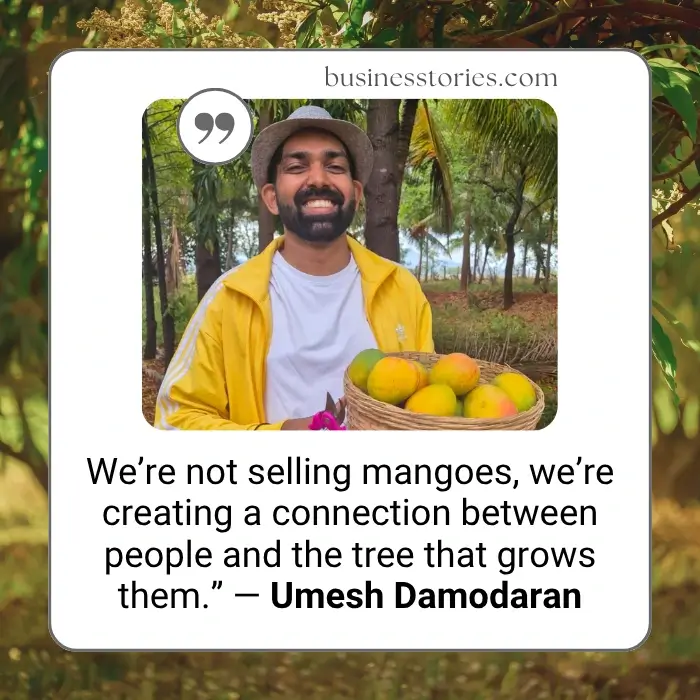
The origin story is charmingly simple. During his frequent travels between Bengaluru and South India, Damodaran carried high-quality Alphonso mangoes for neighbors and colleagues. One neighbor loved the fruit so much that she asked whether she could get the entire harvest from a single tree
That neighbor’s family became the company’s very first customer. That simple request gave Umesh the spark to build Rent a Tree. What makes this concept particularly exciting is the emotional dimension it adds to food consumption.
Customers are not merely buying fruit; they are forming a relationship with a living tree. Customers receive video updates and watch their tree grow through the season. They share the harvest with family and friends, much like tending a small garden, but without any of the hard work.
How to Rent a Tree in three simple steps:
- Visit the official website, Rent a Tree, and browse the available trees listed by farm location and variety.
- Choose your tree and pay the seasonal lease fee online.
- Sit back while the farm team handles all cultivation, care, and harvesting, then receive your naturally ripened fruit at home.
This farm-to-home direct delivery model eliminates middlemen, reduces food miles for local customers, and ensures every mango reaches you at peak natural ripeness.
Rent a Tree Business Model: A Simple Idea Turning Trees into Profits
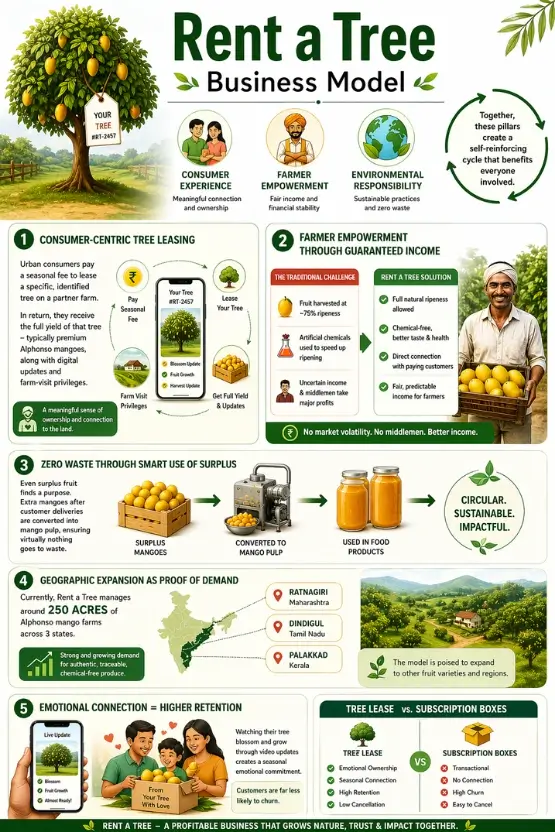
The Rent a Tree business model is built on three interconnected pillars:
- Consumer experience,
- Farmer empowerment, and
- Environmental responsibility.
Together, these pillars create a self-reinforcing cycle that benefits everyone involved.
Consumer-Centric Tree Leasing
Urban consumers pay a seasonal fee to lease a specific, identified tree on a partner farm. In return, they receive the full yield of that tree. Typically, a substantial quantity of premium Alphonso mangoes, along with digital updates and farm-visit privileges. This gives city dwellers a meaningful sense of ownership and connection to the land, which is increasingly rare in modern life.
Farmer Empowerment Through Guaranteed Income
For farmers, the model solves one of agriculture’s biggest problems: income uncertainty. Traditionally, Indian mango farmers harvest fruit at only about 75% ripeness because fully ripened mangoes spoil quickly during transit. As a result, traders often use artificial chemicals to speed up ripening, which affects both taste and health outcomes for consumers.
By connecting farmers directly with committed paying customers, Rent a Tree allows farmers to wait for full natural ripeness and earn a fair, predictable income for the season. No market volatility, no middlemen taking the bulk of the profits.
Zero Waste Through Smart Use of Surplus
Even surplus fruit finds a purpose. If there are extra mangoes after customer deliveries, the company converts them into mango pulp, ensuring virtually nothing goes to waste. This circular approach to production is a hallmark of genuinely eco-friendly startups in India and beyond.
Geographic Expansion as Proof of Demand
Currently, Rent a Tree manages around 250 acres of Alphonso mango farms spread across Ratnagiri in Maharashtra, Dindigul in Tamil Nadu, and Palakkad in Kerala. This three-state footprint, achieved in just a few years, reflects strong and growing consumer demand for authentic, traceable, chemical-free produce.
As the tree rental service India model gains traction, it is poised to expand to other fruit varieties and regions.
A unique insight worth noting: unlike subscription food boxes, which are easily cancelled, a tree lease creates a seasonal emotional commitment. Customers who have watched their tree blossom over video updates are far less likely to churn. This makes customer retention organically higher than in traditional e-commerce food businesses.
Why Rent a Tree Matters for Urban Sustainability
Urban India is facing an escalating environmental crisis. Cities are growing hotter; greener spaces are shrinking. The disconnect between urban consumers and the agricultural systems that feed them has never been wider.
This is precisely where Rent a Tree, as an eco-friendly startup in India, makes its most powerful case.
Reducing the Chemical Footprint of Food
Most commercially sold mangoes in India travel through a supply chain that involves early harvesting, chemical treatment with calcium carbide (a known health hazard), and long cold-chain storage.
By contrast, Rent a Tree’s model ensures that fruit is picked at natural ripeness and sent directly to the customer. This dramatically reduces the chemical load in the food and builds genuine trust between grower and consumer.
Strengthening the Urban-Rural Connection
Ideas like renting a mango tree may seem strange today, yet they reflect a growing realization that agriculture is not just a sector. It is an asset class waiting to be reimagined. When city dwellers invest in a tree, they develop a personal stake in rural farming communities.
They begin to understand seasonal patterns, weather impacts on crop yields, and the human effort behind each piece of fruit. This empathy drives broader support for sustainable farming practices.
Contributing to Ecological Balance
A single tree can absorb up to 48 pounds of carbon dioxide in a year and produce enough oxygen to sustain two people. By encouraging people to “own” trees even remotely, Rent a Tree creates a psychological shift: people who care about their tree tend to care more about trees in general.
Over time, this mindset contributes to broader support for reforestation, urban greening initiatives, and climate-positive policies.
Inspiring the Next Wave of Agri-Tech Startups
The success of Rent a Tree signals to the broader startup ecosystem that there is a real market for sustainable agriculture innovation. It demonstrates that consumers are willing to pay a premium for transparency, authenticity, and a direct connection to their food source.
Key insights that can inspire dozens of follow-on ventures across India’s diverse agricultural landscape.
How Rent a Tree Compares to Global Tree Rental and Ownership Models
Rent a Tree is not entirely alone on the world stage. Several international companies have explored similar concepts, and comparing them reveals what makes the Indian model uniquely compelling.
EcoTree (Europe)
EcoTree is a green-tech company that allows individuals and businesses to own trees in managed European forests, with owners receiving revenue from timber sales when trees mature. It is a longer-term financial investment model. It shares the core philosophy of giving ordinary people a personal stake in living trees.
Tentree (Canada)
Tentree, a clothing brand turned environmental movement, plants ten trees for every purchase customers make. It has already resulted in over 30 million trees being planted globally. This is a “plant-and-forget” model, impactful at scale but lacking the personal connection that Rent a Tree offers.
What Makes Rent a Tree Different?
The Indian model stands out because it combines the following:
- Economic return (real fruit you actually eat),
- Emotional engagement (your personal tree and your harvest), and
- Environmental impact (supporting natural farming practices) in a single, accessible subscription.
Moreover, it directly addresses a uniquely Indian consumer pain point: the desire for authentic, unadulterated, premium-variety mangoes that have become hard to find in urban markets.
Conclusion
The story of Rent a Tree is, at its heart, a story about reconnection between cities and farms, between people and the food they eat, and between commerce and nature. In just a few years, Umesh Damodaran’s idea has grown from a single neighbor’s request into a multi-state operation managing hundreds of acres of premium mango farms.
Moreover, it has done so by solving real problems:
- Chemically ripened fruit,
- Farmer income insecurity, and
- The urban consumer’s hunger for authenticity.
As an eco-friendly startup in India that genuinely walks its environmental talk, Rent a Tree offers a template for what sustainable business can look like:
- Profitable
- Purposeful
- Rooted in the community.
The model proves that innovation does not always mean cutting-edge technology; sometimes, it means having the imagination to see an ancient practice tending a fruit tree through an entirely modern lens.
If you are an urban consumer tired of tasteless, chemically treated fruit, consider renting a tree this season. Visit the Rent a Tree website, pick your tree, and experience the joy of receiving mangoes that were grown just for you.
If you are an entrepreneur or investor, pay close attention to this space. The Rent a Tree business model may well be a blueprint for the future of sustainable agriculture in India and beyond.
Act now: Support eco-friendly farming by renting a tree, gifting a tree lease to someone you love, or simply sharing this story to spread awareness about sustainable food systems.
Frequently Asked Questions (FAQs)
Q1: How does the Rent a Tree tree rental service work for first-time customers?
First-time customers can visit the Rent a Tree website, browse available mango trees listed by farm and region, pay a seasonal lease fee, and then receive the full natural harvest delivered to their home. Video updates keep customers connected to their tree’s growth throughout the season.
Q2: What makes Rent a Tree different from simply buying mangoes online?
Unlike standard online grocery delivery, the Rent a Tree business model gives customers a personally assigned tree, ensuring naturally ripened fruit with no chemical treatment. The emotional connection to “your own tree” and full-season harvest exclusivity sets it apart from any standard fruit e-commerce platform.
Q3: How does Rent a Tree help farmers in India?
The tree rental service India model guarantees farmers a committed buyer before the harvest season even begins. This stable income allows farmers to let fruit ripen naturally rather than harvesting early and using chemicals, ultimately improving both the quality of produce and farmers’ livelihoods.
Q4: Is Rent a Tree available across all of India?
Currently, Rent a Tree operates farms in Ratnagiri (Maharashtra), Dindigul (Tamil Nadu), and Palakkad (Kerala), serving customers across India with direct doorstep delivery. As an eco-friendly startup in India, the company is actively expanding to new regions and potentially new fruit varieties.
Q5: Can I visit the farm where my rented tree is located?
Yes, Rent a Tree offers farm-visit privileges to customers, allowing them to see their tree in person. This agri-tourism dimension deepens the urban-rural connection and makes the sustainable farming experience truly personal and memorable.

I am Tabassum, a writer and storyteller passionate about sharing inspiring startup stories and real entrepreneurial journeys. I believe in keeping things simple and practical, offering actionable insights on business, marketing, and growth. Through my content, I aim to inspire aspiring entrepreneurs to believe in themselves and take bold steps toward success.