
Introduction
Imagine when a CRM shows entries like “Businesstories,” “BUSINESSTORIES Corporation,” “Businesstories Inc.,” “businesstories LLC,” and even “Busiensstories, Inc.” However, instead of recognizing them as one entity, it treats them all as separate companies. The sales team doubles up on outreach. The reports show inflated pipeline numbers. And the analytics quietly fall apart. This is not a hypothetical scenario; it happens in thousands of businesses every day. Brand name normalization rules are the structured guidelines that prevent this chaos.
These rules precisely outline the recording, storage, and display of company and brand names across all systems your business depends on. Whether you manage a CRM, run SEO campaigns, or maintain a product catalog, applying these rules consistently is one of the highest-return investments you can make in your data infrastructure.
This article breaks down what brand name normalization is. Why brand name normalization matters more than ever in 2026. The specific rules you need to implement, the costliest mistakes to avoid, and how to build a process that scales with your business.
What Are Brand Name Normalization Rules and Why Do They Matter?
Brand name normalization is the process of converting all variations of a brand or company name into a single, standardized “canonical” form. Instead of treating “Businesstories,” “Businesstories Inc.,” “BUSINESSTORIES Corporation,” and “businesstories.com” as four separate entities, normalization ensures all references resolve to one clean record: Businesstories.
Brand name normalization rules are the specific guidelines that govern this transformation. It covers how capitalization is applied and which legal suffixes are removed, how punctuation is handled, and what is done with abbreviations, acronyms, and regional spelling differences.
Where It’s Used?
- CRM systems
- SEO and content management
- E-commerce catalogs
- Data analytics platforms
- AI and search engines
Why Brand Name Normalization Rules Matter for Businesses
The business cost of ignoring normalization is staggering. According to Gartner data quality research, organizations lose an average of $12.9 million per year to poor data quality, with 15–25% of annual revenue at risk from inaccurate CRM records alone.
A separate survey found that 44% of organizations lose more than 10% of annual revenue due to poor-quality CRM data. For a business doing $2 million per year, that translates to $200,000 quietly disappearing through bad records and broken attribution.
Beyond revenue, inconsistent brand data creates practical problems daily:
- Misrouted leads,
- Fragmented customer histories,
- Broken segmentation lists, and
- Analytics that cannot be relied upon.
Without a system to normalize data, values lack uniformity, causing problems with sorting, segmenting, and routing leads accurately.
A real-world example makes the stakes vivid. Payfit, a payroll software company, applied company name standardization techniques. It reduced duplicate companies in their CRM from 30% to 9%, enabling their sales team to reduce multi-rep outreach to the same company and focus entirely on net new business.
That kind of operational improvement is the direct result of applying consistent company name normalization rules.
What are The Core Brand Name Normalization Rules?
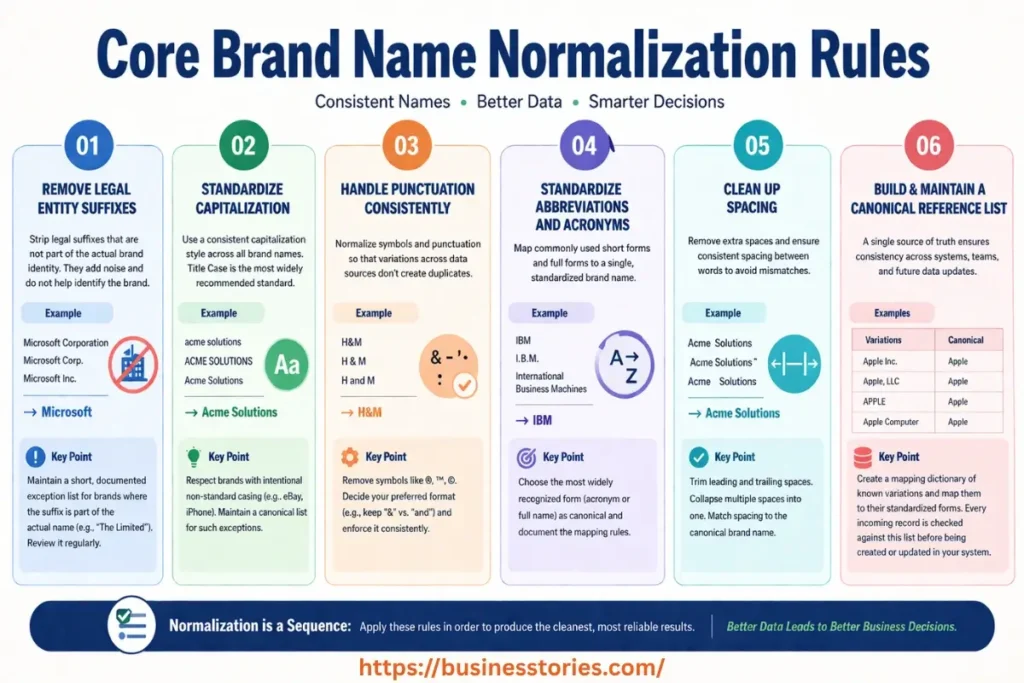
Normalization follows a logical, ordered hierarchy of transformations. Applying these rules in sequence produces the cleanest, most reliable results.
Rule 1: Remove Legal Entity Suffixes
Legal suffixes like “Inc.,” “Corp.,” “LLC,” “Ltd.,” “GmbH,” and “S.A.” exist for legal and compliance purposes. For most operational uses, they add noise to CRM data and should be stripped out. “Microsoft Corporation” and “Microsoft Corp.” both resolve to “Microsoft.”
Important exception: Some companies incorporate a suffix as part of their genuine brand identity. “The Limited” (the fashion retailer) cannot simply become “The.” Maintain a short, documented exception list and review it regularly.
Rule 2: Standardize Capitalization
Inconsistent casing creates matching failures and looks unprofessional in outbound communications. The most widely recommended standard is Title Case (e.g., “Acme Solutions”), but whatever convention you choose, apply it universally.
Watch for companies with intentional non-standard casing: “eBay” is not “Ebay,” and “iPhone” is not “IPhone.” Maintain a canonical list of brands with specific casing requirements that bypasses your standard rule.
Rule 3: Handle Punctuation Consistently
Ampersands, hyphens, apostrophes, and periods vary wildly across data sources. Symbols like ®, ™, and © are typically removed during normalization.
While important in legal contexts, they are not useful for data matching or analytics. For example, “H&M” and “H and M” may be normalized to a single preferred format.
Decide upfront, document your choice, and enforce it every time new data enters your system.
Rule 4: Standardize Abbreviations and Acronyms
Many brands are commonly referred to by abbreviations or acronyms, which can create confusion if not properly normalized. Brand name normalization rules clarify whether an acronym should serve as the canonical name or be mapped to a full version.
In cases where the acronym is more widely recognized (IBM vs. International Business Machines), make the acronym your canonical form and document the rule explicitly.
Rule 5: Clean Up Spacing
Brand Name Normalization Rules address spacing by removing leading and trailing spaces, collapsing multiple spaces into one, and standardizing formatting to match the canonical brand name.
These small adjustments play a surprisingly large role in accurate data matching.
Rule 6: Build and Maintain a Canonical Reference List
Every normalization effort ultimately depends on a single source of truth, a master list of official, standardized brand names.
Create a mapping dictionary: build a list of known variations and map them to their standardized forms. This becomes your normalization reference. Every incoming record is checked against this list before being created or updated in your system.
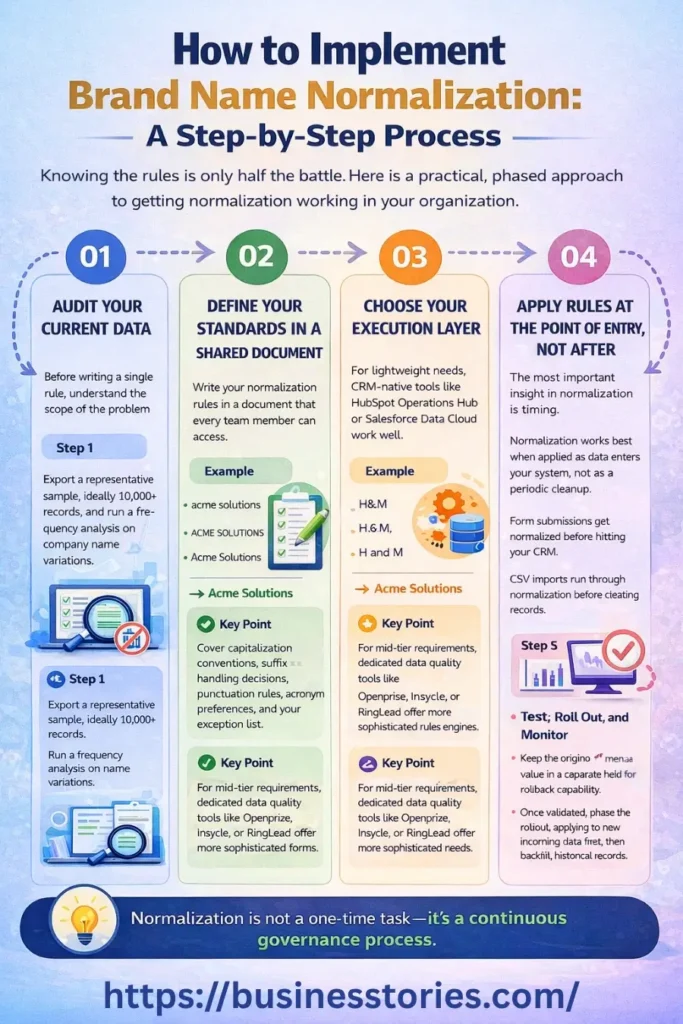
How to Implement Brand Name Normalization
Knowing the rules is only half the battle. Here is a practical, phased approach to getting normalization working in your organization.
Step 1: Audit Your Current Data
- Before writing a single rule, understand the scope of the problem.
- Export a representative sample, ideally 10,000+ records, and run a frequency analysis on company name variations.
- Export records and run a quick frequency analysis on name variations.
- Then define your rule set in a shared document and get sales, marketing, and data teams to sign off.
Step 2: Define Your Standards in a Shared Document
- Write your normalization rules in a document that every team member can access.
- Cover capitalization conventions, suffix handling decisions, punctuation rules, acronym preferences, and your exception list.
- Update this document quarterly as new data patterns emerge.
Step 3: Choose Your Execution Layer
- For lightweight needs, CRM-native tools like HubSpot Operations Hub or Salesforce Data Cloud work well.
- For mid-tier requirements, dedicated data quality tools like Openprise, Insycle, or RingLead offer more sophisticated rules engines.
- An enterprise needs MDM platforms or enrichment APIs to apply rules automatically on data ingestion.
Step 4: Apply Rules at the Point of Entry, Not After
- The most important insight in normalization is timing.
- Normalization works best when applied as data enters your system, not as a periodic cleanup.
- Form submissions get normalized before hitting your CRM.
- CSV imports run through normalization before creating records.
- Integration data from third-party tools gets standardized on arrival.
Step 5: Test, Roll Out, and Monitor
- Always validate rules on a staging or sandbox dataset before touching production data.
- Keep the original raw value in a separate field for rollback capability.
- Once validated, phase the rollout, applying to new incoming data first, then backfill historical records.
- Set up weekly anomaly reports to catch new variations before they accumulate.
Normalization is not a one-time task—it’s a continuous governance process.
Using Fuzzy Matching to Catch What Simple Rules Miss
Even perfectly applied normalization rules cannot catch every variation. Fuzzy matching is the tool that bridges this gap.
Fuzzy matching enables you to find near-matches of company names to review manually, efficiently maximizing the accuracy of your normalization. A fuzziness index controls how strict the match detection is, ranging from 0.1 (loose match) to 1.0 (tight match).
The critical word when using fuzzy matching is “carefully.” Set your matching sensitivity too loose, and you will merge records that should stay separate. “Businesstories Consultants” and “Businesstories Media” are probably not the same company. The right approach is to use fuzzy matching to flag potential duplicates for human review, not to auto-merge them.
This human-in-the-loop approach preserves the accuracy that full automation cannot always guarantee, especially for names that are similar but genuinely distinct.
Common Mistakes to Avoid in Brand Name Normalization
Even a team with good intentions makes these costly errors. Knowing them in advance saves significant rework.
Treating normalization as a one-time project:
- Data is constantly entering your systems from new sources.
- Normalization is not a one-time task.
- Schedule periodic audits to ensure your brand identity stays strong over time.
- Teams that bake normalization into every inbound data flow consistently outperform those who treat it as a quarterly cleanup.
Over-normalizing and losing brand identity:
- Stripping too much information can erase intentional brand choices. “monday.com” should not become “Monday” just because it starts with a lowercase letter.
- Respect deliberate brand decisions and document them as exceptions.
Conflating legal names with operational names:
- Your operational name for a partner, which appears in your CRM, dashboards, and communications, and their legal business name.
- What appears on contracts serves different purposes.
- Conflating the two creates problems in both directions: overly formal names in marketing contexts and casual nicknames in legal documents.
- Maintain separate fields and normalize each independently.
Skipping documentation:
- Rules held in one person’s head vanish when that person leaves.
- Every rule, exception, and decision must be written down in a shared, accessible format.
Not involving cross-functional teams:
- Engage stakeholders from various departments to gather insights on how names are used across different contexts.
- This collaborative approach ensures that the rules developed will be practical and widely accepted.
Brand Name Normalization Rules and SEO: The Connection Most Businesses Miss
Brand normalization is not only a CRM and data quality concern. It has a direct impact on search visibility. When your brand appears inconsistently across websites, directories, social platforms, and review sites, search engines may treat these references as separate entities, diluting your overall authority.
Consistent brand name formatting across Google Business Profile, social media handles, schema markup, and backlink anchor text reinforces your brand as a single, authoritative entity in the eyes of search algorithms.
This is especially important for local SEO, where NAP (Name, Address, Phone) consistency is a well-documented ranking signal.
Applying company name normalization rules to your external digital presence, not just your internal CRM, amplifies your brand authority and improves how your business is recognized and ranked across the web.
Conclusion
Brand name normalization rules are not glamorous. They live in the operational layer of your business, the back-end systems, the CRM configuration, and the data governance playbooks that most people never see.
But their absence is felt everywhere: in the duplicate outreach that embarrasses your sales team, the fragmented reports that mislead your leadership, and the analytics that quietly fail to reflect reality.
The good news is that getting this right is achievable for any organization willing to commit. Start with an audit of your current data. Define a clear, documented set of rules. Apply them at the point of entry.
Maintain a canonical reference list and update it regularly. Involve your teams cross-functionally so the rules stick.
Treating company name normalization rules as part of your broader data governance strategy rather than a one-off cleanup project. That is what separates organizations that scale cleanly from those that spend endless hours firefighting data quality issues.
Clean brand data is not an end in itself. It is the foundation that makes every downstream process, segmentation, personalization, attribution, and forecasting more reliable and more valuable. Start normalizing today, and your future self will thank you.
Audit your CRM for brand name variations this week. Even a quick export and a frequency analysis will show you exactly how much opportunity is hiding in your data.
Frequently Asked Questions
Q1: What are Brand Name Normalization Rules, and who needs them?
Brand name normalization rules are a structured set of guidelines that convert inconsistent brand or company name variations into a single, standardized canonical form. They are especially critical for B2B companies with large account databases, e-commerce businesses with extensive product catalogs, and data-driven marketing teams.
Q2: How do company name normalization rules differ from general data cleaning?
General data cleaning addresses a wide range of data quality issues: invalid emails, missing fields, and outdated records. Company name normalization rules are a specific subset focused entirely on standardizing how brand and company names are written and stored.
Q3: What tools are best for automating brand name normalization at scale?
Several tools serve different needs. HubSpot Operations Hub and Salesforce Data Cloud offer CRM-native normalization for smaller teams. Dedicated data quality platforms like Insycle, Openprise, and RingLead provide more sophisticated rule-based engines for mid-market use cases. For enterprise environments, MDM (Master Data Management) platforms and enrichment APIs such as Databar can apply normalization rules automatically at the point of data ingestion. The right choice depends on your CRM, data volume, and how complex your exception list is.
Q4: Should legal suffixes always be removed during brand name normalization?
The best practice is to remove suffixes by default and maintain an explicitly documented exception list for brands where the suffix is meaningful. Never apply a blanket rule without reviewing your specific data.
Q5: How often should brand name normalization rules be reviewed and updated?
Normalization rules should be reviewed at least quarterly. New data sources introduce new naming variations. Companies rebrand, merge, or restructure, and teams’ terminology evolves.

Tabassum Shaik is an Author, Researcher, and SEO Specialist with over 8 years of experience creating informative content on business, startups, entrepreneurship, marketing, technology, and digital trends. She specializes in researching industry trends and transforming complex topics into practical, easy-to-understand insights. Her goal is to help readers stay informed, learn new ideas, and make better business decisions.