
You built the product. You launched the site. Then you waited. And nobody came. If that resonates with you, you’re not alone. In fact, almost every big startup began in this exact spot. So the real question is not “Why is nobody here?” Instead, it is about how to get your first 10 customers when no one knows you exist.
The encouraging news is that the answer is not a secret growth hack. Rather, it is a set of simple, hands-on moves. Founders at Slack, Zapier, DoorDash, and Stripe all used them. Furthermore, none of them waited for buyers to show up on their own.
In this listicle, you will see how each of them landed their first paying customers. Then you will get a plain, step-by-step plan you can start this week. So let’s dig in.
1. Slack: Start With People Who Already Trust You
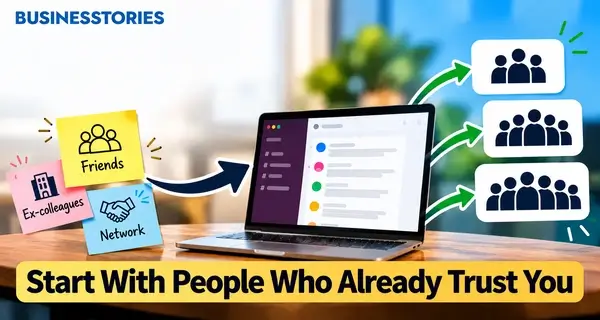
Before Slack was a giant, it was a rough tool used by one small team. So how did they find their first users? They asked their friends.
What Slack Actually Did
By March 2013, the Slack team was using the product every day. But they still needed outside teams. So Stewart Butterfield did something simple. As he told First Round Review, the team begged and cajoled friends at other companies to try it and share feedback. That gave them roughly six to ten companies to start.
Then they grew the circle bit by bit. Each new group was a little larger than the last. As a result, each feedback round revealed new problems before launch. On the first day of Slack’s launch, approximately 8,000 people requested an invitation. Two weeks later, that number hit 15,000.
Why Your Network Works
This approach is the most common answer to how to get your first 10 customers for a startup. In fact, Lenny Rachitsky studied over 100 consumer startups.
He found that friends and former colleagues drove early growth for about 20% of them. Furthermore, Y Nominator’s advice suggests your first three customers will often come from people you know.
However, this is the aspect that most guides overlook. Your network is not your market. Rather, it is your test lab. Friends will forgive bugs, so they let you learn fast and cheap. However, your friends may also be overly generous in their feedback. So don’t treat their praise as proof.
How to Use It Without Fooling Yourself
- Ask for use, not praise. Butterfield asked teams to run their work in Slack. In other words, he wanted real use, not polite nods.
- Ask for a small payment. Even $20 shows if the need is real.
- Ask for one intro. Each friend likely knows one person with the exact problem.
So start here, but don’t stop here. Your network gets you to three. After that, you need strangers.
2. Zapier: Go Where Buyers Already Complain
Zapier had a different problem. The founders had no famous network. So Wade Foster went searching for people who were already in pain.
The Forum Strategy
Foster spent hours in help forums for tools like Evernote, Salesforce, and Dropbox. There, users kept asking for ways to connect one app to another. So he replied to each post. First, he explained the problem. Then he shared a link to Zapier’s early demo.
As Foster later put it, an early startup does not need a thousand customers. Instead, it needs one customer, or ten. And this narrow, personal outreach took Zapier from nothing to something.
Charging Before It Was Ready
Here is the bold part. Zapier asked beta users to pay. In fact, early buyers paid a one-time fee of up to $100. Later, the price dropped to $10 as more people noticed. Their first paying customer was also Andrew Warner of Mixergy.
Still, this was slow work. Foster said it took about eight months of reaching out before anyone approached them first. So if your inbox is empty after four weeks, don’t panic. That is normal.
The Insight Most People Miss
Most advice says, “Find where your customers hang out.” But that is too vague. Instead, identify the platforms where they express their concerns. A complaint is a buyer telling you, in public, what they will pay for.
So search for phrases like “is there a way to,” “I wish,” or “does anyone know a tool.” Those posts are warm leads.
Try This Today
- List five places your buyers ask for help, such as Reddit, Slack groups, or product forums.
- Search for pain words like “frustrated,” “workaround,” or “wish.”
- Reply with help first. Only then share your link.
- Ask for a paid pilot, even a small one.
3. DoorDash: Do the Work by Hand First
Many founders want to build the perfect system before they sell. DoorDash did the opposite. So their story is a valuable lesson in early customer acquisition.
A Website Built in One Afternoon
The idea came from a talk with a macaron shop owner in Palo Alto. She showed the founders pages of delivery orders she had to turn down. So the team built a basic site called PaloAltoDelivery.com. It had PDF menus and their phone number. That was it.
According to TechCrunch, the first order came in about half an hour later. So they drove to the restaurant and delivered the food themselves. In fact, the four founders handled the first 200 deliveries on their own.
Why Manual Work Wins Early
You might think the process wastes time. But it does the opposite. Every delivery taught them something new, such as how long food stays warm and where drivers become lost.
As a result, they developed a genuine product that addressed actual problems. Furthermore, they later had new hires start as drivers, so the team understood the job.
This approach matters because the top reason startups fail is building something no one wants. CB Insights reviewed 101 failed startups. It found that 42% cited “no market need.” So proving demand with a cheap test is far safer than building for months.
A Fresh Way to See It
Here is a view you rarely hear. A manual first version is not a shortcut. It is research that pays you. Each sale provides you with cash and data at the same time. By contrast, a survey gives you only opinions. And opinions are cheap.
How to Copy This
- Build the smallest test. A form, a landing page, or a phone number is enough.
- Fulfil orders by hand. Use email, spreadsheets, and your own time.
- Write down every snag. Those notes become your product roadmap.
4. Stripe and Airbnb: Founder-Led Sales That Close the Deal
Interest is not the same as a customer. So the next step is to close. That is where founder-led sales come in.
The “Collision Installation”
Stripe solved an urgent problem. Still, the Collison brothers did not wait for users. Instead, when someone agreed to try Stripe, they would say, “Right then, give me your laptop.” Then they set it up on the spot. Paul Graham later named this the “Collison installation.”
Think about why it works. Most people say yes to a trial and then forget. But the Collisons removed the gap between “yes” and “done.” So the deal closed in minutes, not weeks.
Airbnb Knocked on Doors
Airbnb did the same in New York. The founders visited potential hosts in person. They signed up new hosts and helped others improve their listings. In fact, Graham wrote that about 30 days of meeting users in person made the difference between success and failure.
Why the Founder Must Sell
You may want to hire a salesperson. But don’t do it yet. SaaStr notes that buyers love talking to the CEO, even if you’re not a natural seller. Furthermore, only you can change the product based on what you hear in a call.
Here’s a deeper point. Your first 10 sales are not really sales. Rather, they are interviews with a contract at the end. So listen more than you pitch. Ask, “What would make this product a must-have for you?” Then build that. Furthermore, note the exact words they use, because those words become your sales copy.
Simple Closing Moves
- Remove friction. Set it up for them, just like Stripe.
- Offer a pilot. Use a short, low-cost trial with a clear goal.
- Set the next step live. Before you hang up, book the follow-up call.
How to Get Your First 10 Customers in B2B: A 30-Day Plan
Now let’s turn these stories into action. This plan is designed to help you acquire your first B2B customers, but it is also applicable to most service and SaaS startups.
Week 1: Pick One Narrow Buyer
First, choose one type of customer. For example, don’t say “small businesses.” Instead, say “dental clinics with two to five chairs.” Then, write down the top three problems they face, using their own words.
Week 2: Warm Outreach
Next, message 30 people you know. But ask for advice, not a sale. Y Nominator’s advice suggests this framing builds trust before you try to close. Additionally, please ask each person, “Who else has this problem?”
Week 3: Go Where Pain Lives
Then copy Zapier. Find two online spaces where your buyer complains. Reply to ten posts with real help. Thereafter, send 50 short, personal cold emails. Each one should lead with the problem, not your product.
Week 4: Close and Deliver
Finally, offer paid pilots to everyone who showed interest. Do the setup yourself. Then, over-deliver by providing personal support calls, similar to how Zapier did. Furthermore, ask each happy pilot for two things.
- First, ask for a short quote you can use on your site.
- Second, ask for an introduction to a peer who is experiencing the same issue.
In short, every early win should open the door to the next one. That is how 10 customers turn into twenty.
Track These Three Numbers
- Reply rate. If the rate is low, consider adjusting your message or target.
- Call-to-pilot rate. If it’s low, your offer is unclear.
- Pilot-to-paid rate. If it’s low, the product needs work.
Furthermore, wait to automate. YC advice says tools like Apollo or Clay make sense only after you have a small base of customers. In short, earn the right to scale.
Conclusion
Getting customers when nobody knows you is a challenge. But as you’ve seen, every big startup started at zero. So the real lesson on how to get your first 10 customers is simple: go get them yourself.
Slack began with friends at other companies. Zapier found buyers in help forums and asked them to pay early. In just one afternoon, DoorDash built a site and then made the first 200 deliveries by hand. Meanwhile, Stripe and Airbnb closed deals in person, one laptop and one door at a time.
Together, these stories share three threads on how to get your first 10 customers.
- First, start close to home, but don’t confuse kindness with demand.
- Second, search for people who are already expressing dissatisfaction with the problem.
- Third, do the work by hand until you know exactly what you should automate.
Furthermore, remember the CB Insights finding. Most startups fail because no one needs what they built. So your first 10 customers are not just revenue. Instead, they are proof that your idea deserves to exist.
Don’t wait for the perfect launch. Instead, choose one specific buyer today. Then write down 30 names and send your first five messages before tonight. After that, come back to this listicle each week and track your three numbers.
Frequently Asked Questions
1. How to get your first 10 customers for a startup?
It often takes three to six months. Still, timing varies by market. Zapier needed about eight months before its first inbound request. So keep doing steady outreach and measure progress by conversations held, not just by sales closed.
2. Should I offer my product for free to land my first paying customers?
Usually, no. Instead, charge a small amount. Zapier charged beta users up to $100. A small fee proves the need is real. Free users give polite feedback, while paying customers tell you what truly matters.
3. What is founder-led sales, and why does it matter for early startups?
Founder-led sales means the founder sells directly to early buyers. It matters because you hear raw feedback firsthand. Furthermore, buyers trust founders more. As a result, you can fix the product fast and close deals sooner.
4. Where can I find my first B2B customers if I have no network at all?
Go where buyers already complain. Look at product forums, Reddit threads, LinkedIn groups, and industry Slack spaces. Then help first and pitch later. That is how Zapier found early users without a famous network.
5. When should a startup start using automated outreach and paid ads?
Wait until you have about ten happy, paying customers. By then, you know your buyer, message, and offer. So automation will amplify what works. Before that point, tools mostly help you send the wrong message faster.

Tabassum Shaik is an Author, Researcher, and SEO Specialist with over 8 years of experience creating informative content on business, startups, entrepreneurship, marketing, technology, and digital trends. She specializes in researching industry trends and transforming complex topics into practical, easy-to-understand insights. Her goal is to help readers stay informed, learn new ideas, and make better business decisions.