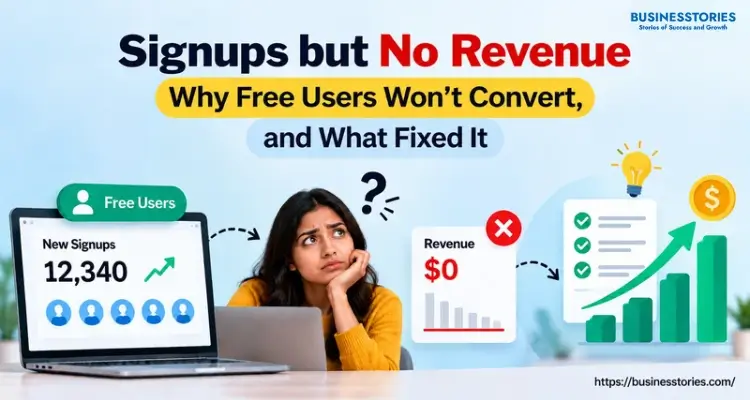
You launched. People signed up. In fact, the dashboard looked impressive for weeks. But the bank account didn’t move. If that sounds familiar, you have a classic case of signups but no revenue.
This problem hits more founders than you might think. Still, it is fixable. In most cases, the cause is not your price or your feature list. Instead, it is what happens between the signup and the first “wow” moment.
In this listicle, we’ll break down why free users won’t pay. Then we’ll look at real teams that fixed their free-to-paid conversion. Finally, you’ll get a simple plan you can start this week.
What “Signups but No Revenue” Really Tells You
First, let’s get clear on the numbers. Your freemium conversion rate is the share of free users who start paying. To find it, divide paid upgrades by total free users. Then multiply by 100.
So what is normal? According to the ChartMogul Conversion Report, the median free-to-paid rate across products is about 8%. However, most products sit far from that middle. In fact, one in four freemium products converts to less than 2.5%. Meanwhile, another one in four lands between 10% and 15%.
For a self-serve freemium product, ChartMogul calls 3% to 5% acceptable. Likewise, it calls 8% to 12% great. Other studies come in lower. For example, First Page Sage puts the average for classic freemium at about 3.7%.
Why the Average Can Fool You
Here’s the catch. Most founders compare their rate to one average and stop there. But the data looks more like two camps than one bell curve. Some products convert well. Others barely convert at all. That’s why “we’re close to average” can hide a real problem.
Furthermore, a low rate is not always a crisis. For instance, if your free plan brings in giant volume at low cost, 2% can still work. Conversely, if each free user incurs costs for support time and server bills, a 2% conversion rate can lead to significant losses.
The Unique Angle: It’s a Signal, Not a Score
Most articles treat conversion rate as a grade. We think that misses the point. Instead, treat signups but no revenue as a signal. It tells you that your signup promise and your product experience don’t match yet.
In other words, people believed your homepage. Then the product didn’t prove it fast enough. So before you touch pricing, ask one question: “What did paying users do in week one that free users didn’t? That gap is where your revenue is hiding.
5 Reasons Free Users Won’t Convert
Now let’s dig into the causes. Usually, more than one is at play.
1. They Never Reach the “Aha” Moment
This is the big one. An “aha” moment is the first time a user feels real value. For example, Slack found that teams who sent about 2,000 messages tended to stick around. However, most users never get that far.
One Userpilot study of 62 B2B companies found that only 36% of users activate. That leaves nearly two in three users who never see the value.
2. Your Free Plan Is Too Good
Next, there’s the generous free plan. When Appcues offers a free plan that includes all the features a typical user needs, there is no incentive for those users to upgrade to a paid plan. So users stay content, and they also stay free.
3. The Upgrade Path Is Hard to Find
Sometimes users want to pay, but they can’t find the button. Or checkout asks for too much. Either way, friction kills intent. As a result, warm buyers walk away.
4. You Attracted People Who Can’t Pay
This one hurts. SaaStr warns that if your free users have no budget, you’ve built a base that simply cannot become customers. For instance, a tool for junior staff may get lots of love. Yet those users rarely hold a company card.
5. Your Upgrade Prompts Show Up at the Wrong Time
Finally, timing matters. A pop-up on day one feels pushy. On the other hand, silence until “your trial ends tomorrow” feels like a panic sale. In both cases, the prompt ignores what the user is doing right now.
Our take: Many teams address reason 2 first because it’s the easiest lever. However, tightening limits before users reach the aha moment only leads to earlier departures. We recommend focusing on activation first, followed by adjusting limits.
What Fixed It: 4 Real Free-to-Paid Conversion Stories
Theory is helpful. Still, real stories show what works. Here are four teams that had signups but no revenue and then turned it around.
RB2B: From 0.2% to 9% With a Pricing Fix
Forty-five days after launch, RB2B had a free-to-paid rate of just 0.2%. The problem? They gave away unlimited leads and a Slack push for free. In short, free users already had the core value.
So the team rebuilt pricing around the features people valued most. As a result, the rate jumped to about 9% within three weeks, with no sales team.
Reforge: Swapping a Free Product for a Free Trial
Reforge launched a free product to grow a big user base. However, paid conversions started to slide. So the team switched to a free trial instead. Thereafter, paid subscription rates rose by 131%. The lesson? More free users are not the same goal as more paying ones.
SparkToro: Better Onboarding and Smarter Emails
SparkToro’s onboarding had around 15 steps. So the team simplified the tour. Then they added emails based on what each user actually did. According to Databox, they doubled their free-to-paid rate in about four to six months. Additionally, they did it without any new traffic source.
Opal: Lower Conversion, Higher Revenue
Here’s a twist. Opal, a focus app, made its free tier more generous. Its paid rate fell from 20% to 9%. However, free users started to share their experiences. As a result, Opal passed one million daily users and $10 million in yearly revenue.
The Pattern Most People Miss
Notice something? Each team fixed a different lever. RB2B fixed pricing. Reforge fixed the model. SparkToro fixed onboarding. Opal fixed reach. So there’s no single magic fix. Instead, the win came from finding the one real bottleneck and attacking it hard.
How to Convert Free Users to Paid: A 6-Step Plan
Ready to act? Here’s a simple plan. Follow the steps in order, because each one builds on the last.
Step 1: Find Your Aha Moment in the Data
First, pull your event data. Then compare paying users with free users who left. Look for one or two actions that paying users did early. Don’t guess here. Instead, let the numbers pick the moment.
Step 2: Cut the Clicks to Value
Next, count every click from signup to that moment. Then remove what you can. For example, use sample data so new users don’t face an empty screen. Furthermore, move setup tasks until after the first win.
Step 3: Draw a Clear Line Between Free and Paid
Thereafter, review your free plan. Ask yourself: Does the free plan offer the same benefits as the paid plan? If so, move it behind the paywall. However, keep enough value so free users still talk about you.
Step 4: Trigger Upgrades by Behavior, Not by Calendar
Now, time your prompts to real actions. For instance, show an upgrade note when someone hits a limit or tries a paid feature. That way, the offer matches the need.
Step 5: Make Paying Effortless
Then fix your checkout. Put the upgrade button where people already look. Also, cut extra form fields. Every added step lowers your free-to-paid conversion.
Step 6: Qualify Your Signups
Finally, look at who signs up. Do they have a budget and authority? If this is not the case, please consider adjusting your messaging. Fewer, better signups often beat a flood of the wrong ones.
Unique tip: Run a “five-user call” each month. Call five free users who never upgraded. Ask what almost made them pay. You’ll learn more in an hour than in a month of dashboards.
How to Track Freemium Conversion the Right Way
Resolving the problem is one thing. However, you also need to know if your fixes work. So let’s talk about measurement.
Use Cohorts, Not One Big Number
First, stop tracking one blended rate. Instead, group users by their signup month. Then track how many from each group pay after 30, 60, and 90 days. This way, you can see if a change in March actually helped March signups.
Watch Activation Next to Conversion
Next, track the activation rate alongside your freemium conversion rate. If activation climbs but sales don’t, the problem is likely pricing or checkout. On the other hand, if both stay flat, go back to onboarding.
Know Your Cost per Free User
Also, add up what each free user costs you. Think servers, support, and email tools. That number tells you how low a rate you can afford. For example, a cheap free user can justify a 2% rate. But a costly one can’t.
Fresh Insight: Track “Time to First Payment”
Here’s a metric most teams skip. Measure the days between signup and first payment. If that gap shrinks, your fixes are working, even before your overall rate moves. In other words, it’s an early warning light that turns green first.
Split Your Free Users Into Groups
Not every free user is the same. So split them by role, company size, or how they found you. For example, users from a partner blog may convert twice as fast as users from social ads.
You can then invest more in the channels that actually attract buyers. Furthermore, you can stop chasing signups that never pay. In short, segments turn one vague number into clear next steps.
Finally, review these numbers every two weeks. Small, steady checks beat a big quarterly panic.
Conclusion: Turn Signups but No Revenue Into Real Growth
Seeing signups but no revenue feels painful. However, it’s also useful. It tells you that people want what you promised. Now your product just needs to prove it faster.
Let’s recap.
- First, benchmarks vary widely, so don’t chase one average.
- Instead, compare yourself to your cohorts.
- Next, remember the five usual causes. Users miss the aha moment.
- The free plan gives too much. The upgrade path is hidden.
- The wrong people sign up. Additionally, prompts are sent at inappropriate times.
Then look at the stories. RB2B fixed its pricing and increased its rate from 0.2% to 9%. Reforge switched to a free trial and lifted paid signups by 131%. SparkToro simplified onboarding and doubled its rate. Meanwhile, Opal proved that a lower rate can still mean more money.
The big lesson is simple. There’s no single solution. Identify your primary bottleneck and address it first. Above all, focus on activation before you tighten limits or raise prices.
Your next step: Open your analytics today. Compare what paying users did in week one with what free users did. Then pick one gap and close it this month. Furthermore, call five free users and ask what would make them pay.
Small changes add up. So start now, measure often, and watch your free users turn into paying customers.
Frequently Asked Questions
1. What causes signups but no revenue in a new SaaS or startup product?
Typically, users fail to experience the “aha” moment. Additionally, the free plan can provide excessive value. As a result, people stay happy for free. Fixing activation first is the fastest way to start turning signups into revenue.
2. What is a satisfactory freemium conversion rate for a self-serve SaaS tool?
According to ChartMogul, 3% to 5% is a good freemium conversion rate for self-serve products. Meanwhile, 8% to 12% is great. However, your cost per free user decides what rate your business can truly afford.
3. How can I convert free users to paid without annoying them a lot?
First, time upgrade prompts to real actions, like hitting a usage limit. Then make the paid value clear and the checkout simple. That way, the offer feels helpful instead of pushy, and more free users happily upgrade.
4. Is a free trial better than freemium for free-to-paid conversion?
Free trials often convert at a higher rate. However, freemium usually brings more signups. So the right choice depends on your product. Reforge switched to a free trial and saw paid subscriptions grow by 131% afterward.
5. How long does it take to improve a low free-to-paid conversion rate?
It often takes a few weeks to several months. For example, RB2B jumped from 0.2% to 9% within three weeks. Meanwhile, SparkToro doubled its rate in about four to six months by improving onboarding.

Market Research Analyst with 20+ years of experience delivering data-driven insights and strategic market intelligence.