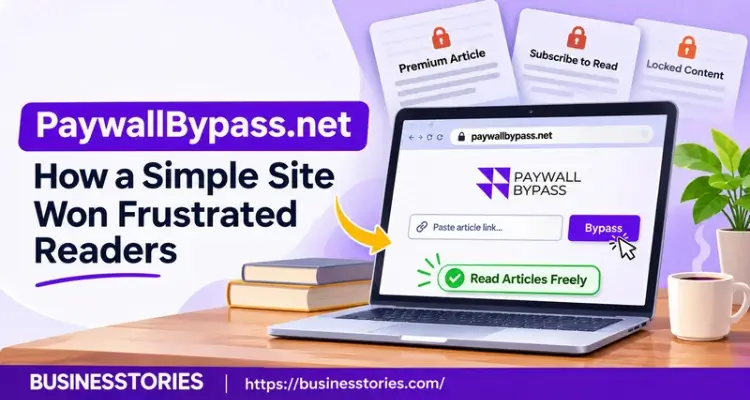
You click a link. The story looks excellent. Then a pop-up blocks the page and asks for your card. Sound familiar? That small moment of anger is where PaywallBypass.net found its audience.
PaywallBypass.net is a free web tool. It promises to show readers locked news articles with no sign-up and no app to install. It has no famous founder and no big funding round. Still, it pulls steady search interest. So how did such a plain site win so many frustrated readers?
In this story, we look at the problem it solves, how it works, and the legal storm around tools like it. Then we share smarter, legal ways to read the news you need. Let’s dig in.
What Is PaywallBypass.net, and Why Did Readers Notice It?
At its core, PaywallBypass.net is a single-purpose website. You paste a link to a locked article, and the site tries to show you a readable copy. That is the whole product. However, that simple promise is precisely why people talk about it.
Most paywall bypass tools ask you to do work first. For example, browser extensions need to be installed, updated, and trusted with access to every page you visit. In contrast, PaywallBypass.net runs in the browser tab.
According to one recent review, the site usually needs no account, no download, and no personal details. As a result, it works the same on a phone, a tablet, or a laptop.
A Startup With No Public Face
Here is the strange part. We could not find any public founder, team page, or funding news for the site. Similarly, there is no public traffic data to confirm how big it really is. So the “win” here is not a viral launch. Instead, it is quiet, steady demand from people who search for help when a paywall blocks them.
That makes PaywallBypass.net a useful case study. It indicates that a product can locate users with almost no brand at all. Rather than marketing, it rides on a strong, repeated pain point. Every new paywall on the web acts like free advertising for it.
The Real Product Is Less Friction
Our view is a little different from most reviews. They frame the site as a “free content” tool. However, free content is only part of the overall picture. In fact, the bigger draw is zero friction. No login screen. No extension. No setup.
Think about it this way. Many readers already juggle a dozen logins for streaming, shopping, and work apps. So when a site asks for one more account, people often leave.
PaywallBypass.net wins that moment by asking for nothing. For founders, that is the key lesson: the fewer steps you ask for, the more people stay.
The Reader Frustration That Built the Market
Every startup needs a real problem. For paywall bypass tools, the problem is easy to see. Most readers simply do not pay for news, and paywalls keep growing anyway.
The Numbers Behind the Anger
Consider the data. The Reuters Institute’s 2025 Digital News Report found that only 18% of people across 20 richer countries pay for online news. Moreover, that figure has barely moved for years.
Even worse for publishers, the 2026 edition showed the share of paying readers in the United States fell seven points in one year, down to just 13%.
Meanwhile, readers continue to encounter obstacles. In one survey of more than 6,500 US consumers, over half said they try to get around publisher paywalls. In other words, wanting a workaround is common. It is normal behavior.
It Is Not About Hating Paywalls
Here is a twist that many articles miss. Researchers studying young news readers did not find that people opposed paywalls in principle. Instead, they found that juggling many subscriptions felt like a draining chore. Too many logins, too many passwords, and too many monthly bills wore people down.
The Reuters Institute calls this subscription fatigue. Essentially, people get tired of paying for lots of separate online services. Therefore, a reader might gladly pay for one news site, yet still feel stuck when a link from another outlet appears.
Where PaywallBypass.net Fits
This is the gap that PaywallBypass.net fills. It does not try to replace your main news source. Rather, it targets the “one-off article” moment. For instance, a student might follow a single link for a project.
Alternatively, it could be a small business owner checking a single market report. They do not want a new subscription for one story.
So the market was never about people who refuse to pay at all. Instead, it is about occasional readers with no viable option. Publishers that solve this with simple single-article pricing or gift links could win those readers back.
How PaywallBypass.net Works: A Simple Product Bet
Now let’s look under the hood. The positive news is that the tool does not hack anything. According to the StartupRise review, it tries to fetch versions of locked articles that are already public somewhere online. It does not break into secure systems.
The Borrowed Engine
Why do public copies exist at all? The existence of public copies is primarily due to search engines. Many news sites let Google’s crawler see the full text so their stories rank well.
As a result, cached and archived copies of those pages often sit in public places. Tools like PaywallBypass.net look for those copies and show them to you.
This is a clever bet. However, it also means the site’s “engine” belongs to someone else. Its success depends on choices that publishers and search engines make. That is a weak moat for any startup.
Where It Falls Short
Because of that design, the tool does not work everywhere. Typically, it struggles with:
- Hard paywalls that never show full text to anyone without a login
- Sites that change their code to block cached or archived views
- Fresh stories that no archive has saved yet
Reviewers also note that a site that worked last month may stop working this month. In fact, publishers constantly update their defenses. So the product is always at risk of breaking with any change.
The Lesson for Founders
Here is our take. PaywallBypass.net shows the power of a thin wrapper around an existing behavior. Readers were already trying tricks such as private windows and archive sites. The tool simply bundled that habit into one box.
Yet thin wrappers face two big risks.
- First, the platform you rely on can shut the door.
- Second, copycats can launch in a weekend.
- Consequently, any founder building a similar tool needs a plan for when the borrowed engine stops working.
The Legal Pressure Shaping Paywall Bypass Tools
No startup story about this space is complete without the legal side. Publishers are not sitting still. In fact, they have become much more aggressive since 2024.
Case Study: 12 ft Ladder
Take 12ft.io, often called 12ft Ladder. Developer Thomas Millar built it during the pandemic after noticing that most top search results he clicked were behind paywalls. It became one of the best-known bypass sites online.
Then, in July 2025, the News/Media Alliance stepped in. This trade group represents more than 2,000 publishers. It said the site offered illegal circumvention technology. Soon after, the web host locked the site, and it went offline. The Alliance also promised to chase other tools in the same way.
Case Study: Bypass Paywalls Clean
Similarly, the popular extension Bypass Paywalls Clean faced a takedown. In 2024, the Alliance sent a notice to GitHub under the DMCA’s anti-circumvention rules.
According to TorrentFreak, GitHub removed the project along with 3,879 copies of it. Notably, the complaint said the tool scanned web archives for crawled copies of locked stories. That is very close to how many web-based bypass sites work.
What This Means for Readers
So is using a site like this legal? The honest answer is that it depends on where you live and how you use it. Even the StartupRise review admits that the legal picture varies by country. In addition, most news sites ban bypassing in their terms of service.
For readers, the practical risk is usually small. For the tool owners, however, it is large. A single notice to a web host can lead to the immediate collapse of the entire business. This is the hidden cost of building a startup on someone else’s content.
So, what is the reason for the continued operation of PaywallBypass.net? Most likely, it is simply smaller and less visible than the 12 ft ladder was. Yet size offers little shelter. As traffic grows, so does the chance of a takedown. In short, success itself becomes the biggest risk.
Smarter, Legal Ways to Read Paywalled Content
Here is the beneficial part. You often do not need a bypass tool at all. Many legal options give you the same article, and some are completely free. Please consider trying these steps first.
Step 1: Use Your Library Card
First, check your local library. Many libraries offer PressReader free to members. For example, Seattle Public Library says cardholders can read more than 7,000 newspapers and magazines this way.
Simply sign in with your card number on the website or app. Some libraries also offer Libby for magazines.
Step 2: Install Unpaywall for Research
Next, if you read academic papers, add Unpaywall to Chrome or Firefox. This free, nonprofit extension checks for legal, author-posted copies of a paper. When it finds one, a small green tab appears, and you can read the full text.
Step 3: Register for Free Article Limits
Many news sites give you a few free stories each month if you make a free account. It takes a minute. Plus, you get legal access with no risk.
Step 4: Ask for Gift Links
Furthermore, if a friend subscribes, ask them to share a gift link. Several major outlets let subscribers send a few free articles each month.
Step 5: Search for the Same Story Elsewhere
Big news rarely lives in one place. For example, wire services, press releases, and public company filings often carry the same facts. So copy the headline, search for it, and check a few free outlets. You may find a full, legal version in seconds.
Step 6: Pick One Bundle That Fits
Finally, if you keep hitting the same paywall, that site is probably worth paying for. Look for student rates, trial deals, or bundles. That way, you support the journalism you actually use, and you avoid subscription fatigue.
Conclusion
The rise of PaywallBypass.net is a story about friction, not just free news. A plain website with no public founder found an audience because it solved one moment of pain. Readers encountered obstacles, experienced frustration, and sought a quick solution.
The site provided this solution without requiring a login or download. Yet the story also shows the limits of that model. The tool depends on public copies it does not control. Publishers can block those copies at any time.
Moreover, the legal pressure is real. The takedowns of the 12ft Ladder and Bypass Paywalls Clean prove that one notice can end a product overnight. For founders, the lesson is clear. Remove friction, but build on ground you own.
For readers, the takeaway is just as simple. You have more legal options than you think. Your library card, Unpaywall, free registrations, and gift links can unlock a lot of excellent reporting. Best of all, none of them puts you or the publisher at risk.
So here is your next step. Before you reach for a bypass tool, check your library’s digital services today. Then, pick the one news source you read most and support it. Good journalism costs money to make. When readers and publishers meet in the middle, everyone wins.
Frequently Asked Questions About PaywallBypass.net
1. What is PaywallBypass.net, and how does it work?
PaywallBypass.net is a free, web-based paywall bypass tool. It tries to show public, cached, or archived copies of locked articles. It requires no account or download, but it doesn’t work on every news website.
2. Is it legal to use PaywallBypass.net to read paywalled news articles?
The legality of paywall bypass tools depends on your country and how you use them. Most news sites ban bypassing in their terms. Safer options for regular reading include library access or free registration.
3. Why does PaywallBypass.net not work on some premium news websites?
Hard paywalls never show full text without a login. Some publishers also block cached and archived views. Because of these limitations, the tool often fails on premium sites and on very new stories that archives have not saved.
4. What are the current best legal alternatives to PaywallBypass.net?
Top legal alternatives include free library access to PressReader, the Unpaywall extension for research papers, free news site registrations, and gift links from subscribers. These options provide you with full articles while still supporting publishers.
5. What can startup founders learn from the PaywallBypass.net story?
Founders can learn that removing friction attracts users fast. However, the PaywallBypass.net story also shows that relying on someone else’s platform or content creates serious legal and business risk for any startup.

Test Lead with 12 years of IT experience specializing in quality assurance, test strategy, and delivering high-performance software solutions.