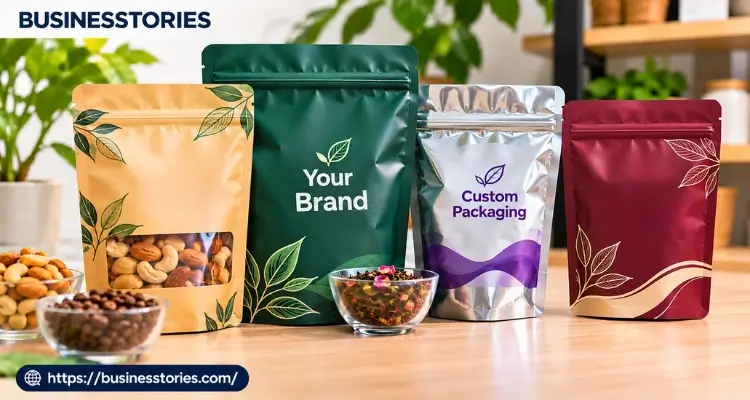
Your product might be excellent. However, if the bag fails, the buyer only remembers the stale coffee or the soggy snack. That is why custom Mylar bags matter so much. They guard your product from air, light, and moisture. At the same time, they carry your brand to the shelf and the doorstep.
In fact, flexible packaging is booming. According to Arizton, the global market was worth about $242 billion in 2025, and it could reach $320 billion by 2031. So more brands than ever are fighting for attention in a pouch.
Still, picking the right bag is not simple. You have to think about layers, thickness, size, zippers, print runs, and rules. So, where do you start?
This guide breaks it down into five clear steps. Each step gives you clear advice, real numbers, and a quick action. By the end, you will know exactly what to ask your supplier. Better yet, you will avoid the costly mistakes many first-time brands make.
Let’s dive in.
1. Start With What Your Product Needs Protection From
Before you look at colors or logos, look at your product. Mylar bags work because they block what ruins goods. But not every product fears the same thing. So your first job is to name the main threat.
Make a Simple “Threat List”
Grab a sheet of paper. Then write down what spoils your product fastest. For example, coffee and nuts go stale when oxygen gets in. Dried herbs fade in light. Meanwhile, powders and jerky clump or grow mold due to high humidity. Some products, like spices, also leak strong smells.
Once you know the top threat, the choice of material gets much easier.
Understand Barrier Layers
- Most custom Mylar bags are not one sheet. Instead, they stack thin layers together.
- A common build has a PET outer layer that holds the print.
- Next comes a foil or metal layer that blocks air and light.
- Finally, a PE inner layer lets the bag seal shut.
The foil layer does the heavy lifting. In fact, one supplier’s 4.3 mil foil bag lists an oxygen rate of just 0.001 cc per square meter per day. That is close to zero. For foods like dried meats, nuts, and coffee, experts advise an oxygen transmission rate (OTR) as near zero as possible.
Weigh the Trade-Off of Clear Windows
Here is a point many guides skip. A clear window looks wonderful, yet it is a hole in your barrier. Light and some oxygen pass through clear film more easily than through foil. So, if your product fears light, skip the window. Alternatively, keep it small and place it low on the bag, where the product sits.
Action Step
Ask each supplier for a spec sheet that lists OTR and moisture vapor transmission rate (MVTR). If they can’t provide you with numbers, that tells you something. After all, a serious maker tests its films.
2. Pick the Right Thickness and Size for Your Custom Mylar Bags
Thickness and size seem basic. Even so, they cause more reorders than any other mistake. Let’s wait until it’s correct from the start.
Thickness Comes in “Mil”
Thickness is measured in a unit called a mil. One mil equals 0.001 inches. In general, thicker bags resist punctures better and block more air. However, they also cost more and feel stiffer.
Here is a simple guide:
- 3 to 3.5 mil: Light items, short shelf life, and low cost.
- 5 mil: A solid middle ground for most retail food.
- 7 mil: Dense or sharp items like jerky, pasta, or granola, plus long storage.
That said, thicker is not always better. For instance, a soft tea blend does not need a 7-mil bag. You would just pay more for stiffness nobody needs.
Don’t Pick a Size From Weight Alone
Many sellers pick a size based on weight. Unfortunately, that often fails. Two products with the same weight can fill very different spaces. A pound of coffee beans takes far more room than a pound of sugar.
So, think in volume instead. Multiply length, width, and depth to estimate the space you need. Then leave room at the top for the seal and the zipper. As a general guideline, leave approximately one inch of headspace above the product.
Try the “Fill Test” Trick
This is the most useful step, and few guides mention it. Before you order thousands of printed bags, buy a pack of plain stock bags in two or three sizes. Next, fill each one with your real product. Shake it, seal it, and stand it up.
Then look closely. Does it slump? Does the product hide the logo area? Is there too much empty air? An overfilled bag strains the seal. Meanwhile, an underfilled bag looks cheap, and shoppers may feel cheated.
Action Step
Run a fill test with stock bags this week. Afterward, send your supplier the exact size that worked, along with a photo. As a result, you take the guesswork out of your custom order.
3. Choose a Bag Style and Closure That Fit How People Use It
Your bag style decides how the product sits on a shelf. Likewise, the closure decides how buyers feel every time they open it.
Pick a Bag Style
- Stand-up pouches have a folded bottom, so they stand on their own. They suit retail shelves well.
- Flat pouches lie flat. They work for small amounts, samples, or single servings.
- Flat bottom bags have a box-like base. They give you five panels to print on and look premium. That’s why coffee brands love them.
Think about where the bag will live. For example, an online-only product may not need to stand up. A shelf product, on the other hand, almost always does.
Choose the Right Closure
Closures matter more than many brands think. In fact, Mordor Intelligence cites a survey where 65% of shoppers based their purchase on the ability to reseal. Furthermore, 60% based it on how easy the pack was to open.
Here are the most common choices:
- Press-to-close zipper: Best for products used over days or weeks.
- Tear notch: Makes the first opening clean and straightforward.
- Heat seal only: Great for long storage or single use.
- Child-resistant zipper: Required for some regulated products.
- One-way valve: Lets fresh coffee release gas without letting air back in.
Design for the Second Opening
Here is a fresh way to think about it. Most brands design for the first time a buyer opens the bag. However, your buyer will open it again and again. So, opening and closing the zipper ten times in a row. Does it still lock firmly? Does product dust jam the track?
A bag that fails on day five hurts your reviews far more than a plain design ever would.
Action Step
List how a buyer uses your product over one week. Then pick only the features that solve a real problem. Remember, every extra feature adds cost.
4. Match the Printing Method to Your Order Size
Printing is where custom printed Mylar bags turn into a brand. It is also where costs can surprise you. Two main methods exist: digital and rotogravure.
Custom Mylar Bags Digital Printing
Digital printing sends your art straight from a file to the film. Because it needs no plates, setup costs stay low. Many suppliers offer runs from about 1,000 bags per design. As a result, it suits new brands, seasonal flavors, and test launches.
However, the price per bag stays fairly high, even on bigger runs. Furthermore, exact Pantone color matches and some special finishes can be harder to get.
Rotogravure Printing
Rotogravure uses engraved metal cylinders, one for each color. Making those cylinders takes money and time. But once they exist, each extra bag costs much less. Colors also stay the same from one order to the next.
Do the Break-Even Math
Let’s look at real numbers. CarePac, a US supplier, shows 10,000 digital bags at about $2,500, or 25 cents each. In contrast, 10,000 plate-printed bags cost about $1,450, or 14.5 cents each.
Meanwhile, ProAmpac notes that digital tends to save money on runs of roughly 30,000 pouches, depending on their size.
So which one wins? It depends on how many designs you have. Say you sell four flavors. With digital, you can print 1,000 of each with no plate fees. With gravure, by contrast, each flavor needs its own cylinders and a high minimum.
Start Digital, Then Scale to Gravure
Here is a practical plan.
- First, launch with digital.
- Next, track which designs sell.
- Once one product steadily needs 10,000 or more bags per order, move that design to gravure.
This way, you avoid boxes of unsold bags while you still cut costs on your best seller.
Action Step
Ask for quotes at three sizes, such as 1,000, 5,000, and 20,000 bags. Then compare the cost per bag, plate fees, and lead time side by side.
5. Check Compliance, Sustainability, and Your Supplier
A bag can look perfect and still get you in trouble. So, before you sign, check the rules and the claims.
Food Safety Rules
If you sell food in the US, the FDA sets rules for anything that touches it. You’ll find these rules in Title 21 of the Code of Federal Regulations, or 21 CFR. For example, Part 177 covers the plastics that touch food.
So ask your supplier for a letter that confirms the inner layer meets 21 CFR. If you ship to Europe or other regions, ask about their rules too.
Child-Resistant Packaging
Some products need child-resistant (CR) packs by law. In the US, the Consumer Product Safety Commission sets the standard in 16 CFR 1700. A pack must prevent at least 85% of children from opening it during testing before anyone demonstrates how to do so.
In addition, 90% of adults tested must be able to open and close it properly. So never trust a “CR” label alone. Instead, ask for the third-party test report.
Custom Mylar Bags Sustainability Claims
Classic foil Mylar bags protect well, yet they are difficult to recycle. That’s because recyclers can’t easily split their mixed layers. Newer mono-material pouches, built mostly from PE or PP, aim to resolve the issue.
Still, Packaging Gateway warns that a mono-material label does not automatically make a pack recyclable. Therefore, verify claims against local recycling programs before you print a green logo.
Vet the Supplier With Samples
Finally, choose a partner, not just a price. Request printed samples of past work. Pull on the seams to test seal strength. Furthermore, obtain lead times in writing. A competent supplier explains trade-offs openly. A weak one just says “yes” to everything.
Action Step
Please create a short checklist that includes the spec sheet, compliance letter, CR test report if needed, printed samples, and written lead time. Then don’t sign a purchase order until you tick every box.
Conclusion
Choosing custom Mylar bags may seem complex at first. However, it becomes easier when you approach it step by step.
- First, name the main threat to your product.
- Then pick layers and barrier ratings that stop it.
- Next, choose a thickness that fits your shelf life and a size that passes a real fill test.
- Thereafter, select a style and closure that make daily use easy, and test the zipper more than once.
- Then match your printing method to your order size.
- For most new brands, digital first and gravure later is the smartest path.
- Finally, check food safety, child-resistant, and recycling claims, and vet your supplier with samples.
Remember, the bag is not just a container. Often, it is the first thing a buyer touches and the last thing they recall. A good bag keeps the product fresh. A wonderful one also earns the second sale.
So here is your next move. Order a few stock bags this week and run the fill test. Then send three suppliers the same brief and compare their quotes side by side. As a result, you will learn more in seven days than in a month of reading.
Frequently Asked Questions
1. What thickness of custom Mylar bags works best for food products?
For most retail food, a 5-milliliter bag gives a good balance of strength and cost. However, choose 7 mil for sharp or dense items like jerky or for long-term food storage needs.
2. How many custom printed Mylar bags should I order the first time?
Start small with digital printing, often around 1,000 bags per design. This keeps your cash free and lets you test demand. Then, once one design sells steadily, move it to cheaper gravure printing.
3. Can I add a clear window to custom Mylar bags without hurting freshness?
Yes, but a window weakens the barrier. So, for products that fear light or oxygen, keep the window small or skip it. You should also check with your supplier about how much the window affects the bag’s barrier rating.
4. Are custom Mylar bags recyclable, or should I pick another pouch?
Classic foil Mylar bags are difficult to recycle because of their mixed layers. Instead, if recycling matters, ask about mono-material PE or PP pouches. Then check whether local programs actually accept them before claiming anything.
5. Do custom Mylar bags need FDA approval before packaging food items?
The FDA does not approve each bag. Instead, the materials touching food must meet its food contact rules in 21 CFR. Always request a written compliance letter for the inner layer from your supplier.

Tabassum Shaik is an Author, Researcher, and SEO Specialist with over 8 years of experience creating informative content on business, startups, entrepreneurship, marketing, technology, and digital trends. She specializes in researching industry trends and transforming complex topics into practical, easy-to-understand insights. Her goal is to help readers stay informed, learn new ideas, and make better business decisions.