Do you want to start a business but feel like you lack the skills? The great news is that you can get started without a tech degree. You also do not need coding skills or a big budget. Today, it is easier than ever to learn how to start an AI-powered business.
The global AI market was worth over $390 billion in 2025. By 2033, it could reach $3.4 trillion. That is a giant opportunity. And the best part? It is open to everyone, including complete beginners.
So, whether you want a full-time business or a side hustle, this guide is for you. In the next few minutes, you will get a clear, step-by-step plan on how to start an AI-powered business from scratch. Let us jump right in.
1. Understand Why You Do Not Need Technical Skills to Start
Most people think that building an AI business means writing code. But that is simply not true anymore. The entry barrier has never been lower.
Today, tools like Zapier, Make.com, and Bubble do the hard work for you. You just drag, drop, and connect. You describe what you want in plain English. Then the tool builds it. So, you do not need to know how AI works under the hood. You just need to know how to use it.
In fact, your lack of technical experience is actually a big plus. Here is why:
- Fresh perspective: You see problems clearly, without overthinking the tech side.
- Customer focus: You think about solving real problems first, not building fancy features.
- Less competition: Many tech experts skip simple, profitable ideas because they seem too basic.
For example, Sarah Chen was a marketing manager with no coding skills. She built a $2 million AI content agency using tools like Jasper and Copy.ai. Similarly, Mike Rodriguez ran a restaurant. He spotted a problem with inventory tracking. Thus, he built an AI service to solve it for other restaurants.
Here is the key insight: You do not need to build AI. You simply need to apply it in the right place. Your experience in your field is your real superpower.
2. Choose the Right AI Business Idea for Your Skills
Before you do anything else, you need a solid idea. The best AI business ideas come from three things working together. A problem people will pay to fix, your knowledge, and an AI tool that helps you solve it better.
Here are some excellent beginner-friendly options to consider right now:
- AI content agency: Use ChatGPT, Jasper, or Claude to write blogs, emails, and social posts for small businesses.
- Chatbot setup service: Help local shops build simple chatbots using tools like Tidio or Intercom.
- AI automation service: Use Zapier or Make.com to remove manual tasks for other business owners.
- AI tutoring or coaching: Build smart, personalized learning plans using AI tools.
- SEO service: Combine AI writing tools with keyword tools to offer cheap SEO packages.
When you pick your idea, ask yourself one simple question: What problem do I already understand deeply? For instance, a freelance writer who offers an AI writing service will beat a tech expert every single time. Why? This is because the writer understands the customer’s pain points. And that real-world knowledge is something AI cannot copy.
Pro tip: Start with a service, not a product. Services cost almost nothing to launch. Plus, you will quickly learn what your customers actually want before you ever build anything.
3. Validate Your Idea Before You Build Anything
This is the step most beginners skip. And it is also the reason most AI businesses fail early on. Validation simply means checking that real people will pay for your idea before you spend any time building it.
Here is a fact worth knowing: AI business owners are three to four times more likely to test ideas early compared to non-AI business owners, according to Shopify’s merchant survey. So, follow their lead.
Below is a simple three-step process to validate your idea fast.
Step 1: Talk to Real People First
Contact 10 to 15 individuals within your target market. Ask about their problems and their current tools. Additionally, inquire about how much they would be willing to pay for a better solution. Do not pitch your idea yet. Just listen carefully.
Step 2: Build a Quick MVP
Use Canva, Notion, or a free landing page tool to build a simple version of your offer. You do not need a full product at this stage. Even a one-page website with a clear headline and a “Book a Call” button is enough to test interest.
Step 3: Land Your First Paying Customer
Do not wait for perfection. Instead, offer a small discount to your first few clients. Their honest feedback will teach you far more than any business plan ever could.
Most people spend months building before they talk to a single customer. So, treat validation as the most important step. It saves time, money, and stress.
4. Set Up Your AI-Powered Business: Tools and Stack
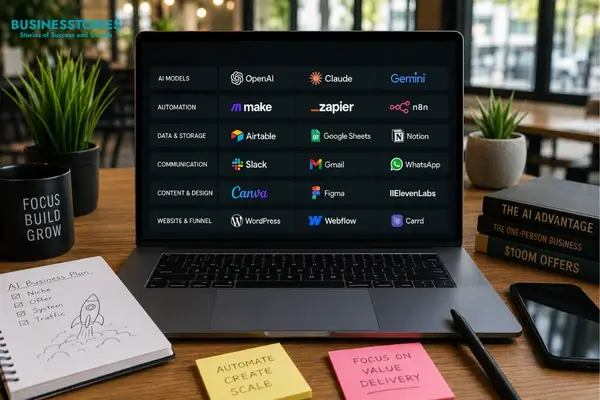
Once you have validated your idea, it is time to set up your business tools. The good news is that most of the tools you need are free or very low-cost.
Tools for Communication and Operations
- Notion: Keep your tasks, notes, and client files in one tidy place. Its built-in AI can write content, summarize meetings, and answer questions about your work.
- Gmail + Google Workspace: Set up a professional email address and use Google’s built-in AI features for writing and meetings.
Tools for Automation and Workflows
- Zapier: Connect more than 8,000 apps and automate your work without any code. The free plan allows 100 tasks per month, more than enough to start.
- Make.com: A flexible and budget-friendly tool for building more complex automations.
Tools for Building Products
- Bubble: Build a web app without writing a single line of code.
- Gumloop: Great for first-time builders who want fast results.
- Replit: Describe your app in plain English, and an AI agent builds it for you.
Tools for Marketing and Content
- ChatGPT or Claude: Write copy, plan content, and handle customer messages with ease.
- Canva AI: Design beautiful graphics, presentations, and social posts in minutes.
Do not try to use every tool at once. Start with just three: one for automation, one for communication, and one for content. Master those first, then add more as you grow.
5. Build Your Brand and Online Presence
Your brand helps people find you and trust you. Fortunately, AI makes branding faster and cheaper than ever. So let’s keep it easy.
Pick a Clear Niche and a Name
Use ChatGPT or a free AI name generator to brainstorm name ideas. Keep your name short and easy to say. Furthermore, avoid tech jargon if your target audience is non-technical.
Build a Simple Website
Use Framer, Wix ADI, or Hostinger’s AI site builder. You can have a clean, working website live in under one hour. Your site needs only three things: a strong headline that explains what you do, one testimonial or proof of results, and a clear call to action like “Book a Free Call.”
Create a LinkedIn profile and post weekly.
LinkedIn is the best platform for selling AI services to other businesses. Post about your work, your wins, and what you are learning. Consistency beats perfection every single time here.
Here is something important to note: 69% of businesses already use AI for content creation, according to Shopify’s 2025 merchant data. So, your future clients are already open to AI-powered help. You just need to show them your value clearly.
6. How to Start an AI-Powered Business and Get Your First Clients
Getting your first client is a big deal. It feels scary at first. But it does not have to be. Here is a simple, proven plan that works even with no portfolio or audience.
Start With the People You Already Know
Reach out to old colleagues, friends, and local business owners. Tell them what you offer. Then ask if they know anyone who might need help. Most first clients come through warm connections, not cold strangers.
Use Cold Outreach With a Personal Touch
Write a short, friendly message to potential clients. Keep it focused on their problem, not your service.
For example:
“Hi [Name], I noticed your business handles follow-ups manually. I help businesses automate that in under a week—want to hop on a quick call?”
Offer a Free Audit or Quick Win
Give a potential client one piece of free value. Review their current process. Identify a quick improvement. Demonstrate how the process looks after implementing the solution. This builds trust fast and often converts to a paid project.
Post on Freelance Platforms
List your service on Upwork, Fiverr, or Toptal. These platforms put you in front of buyers who are already looking. Early reviews grow your credibility quickly, so prioritize getting those first few ratings.
Furthermore, consider this: the AI agents market is growing from $8.03 billion in 2025 to $11.78 billion in 2026. More businesses want AI help right now. Therefore, you are entering the market at the perfect time.
7. Scale Your AI Business with Automation
Once you have a few clients and a steady income, it is time to grow. The best part about an AI business is that you can scale without working more hours. Here is how to do it smartly.
Automate the Parts That Repeat
Use Zapier or Make.com to handle your repetitive tasks. For example, if you run a content service, build a simple workflow. It pulls the client brief, generates a draft, and sends it for review—all on its own. As a result, you save hours every week.
Build Templates for Everything
After each client project, turn your best work into a reusable template. Every project you finish should make the next one faster. Then, store all your templates and processes in Notion so you can hand them off or automate them later.
Turn Your Service Into a Product
Move away from charging per task. Instead, create a monthly subscription plan. For example, offer a flat-rate content package rather than charging per article. This brings predictable income and lets you serve more clients at once.
Keep Learning Every Week
The AI world moves fast. So, set aside one hour each week to try new tools and read industry news. The businesses that stay curious grow the fastest.
Conclusion: Your AI Business Journey Starts Today
Now you know exactly how to start an AI-powered business, even with zero experience. The steps are simple: find a real problem, check that people will pay for it, pick the right tools, build a basic brand, land your first clients, and then scale using automation.
The AI industry grows at over 27% each year. So, the entrepreneurs who start today will be far ahead of those who wait until tomorrow.
Here is the truth: you do not need to be a developer. You do not need a lot of money. Do not even need a perfect plan.
You just need the courage to take the first step.
Start small. Stay consistent. Allow AI to take on the more challenging tasks.
Your action step for today: Pick one idea from this guide. Write down three people you can contact this week. Then send your first message today. Because the sooner you start, the sooner you succeed.
Frequently Asked Questions
Q1: Can I start an AI business with no money at all?
Yes! Many top AI tools have free plans. Zapier, ChatGPT, Canva AI, and Notion all let you launch a service-based AI business with zero upfront cost.
Q2: What is the easiest way to start an AI-powered business for beginners?
An AI content or social media service is the easiest entry point. You use tools like ChatGPT and Canva AI to get results quickly. You don’t need any tech skills.
Q3: How long does it take to make money with an AI business?
With a service model, many beginners land their first client in two to four weeks. To expedite the process, initiate outreach early and concentrate on a single, well-defined offer.
Q4: Do I need to learn coding to run an AI-powered business?
No coding needed. Tools like Bubble, Zapier, and Make.com use simple drag-and-drop builders and plain English inputs to create full workflows and products.
Q5: What are the best no-code AI tools for starting a business?
Start with Zapier for automation, Notion for organization, ChatGPT or Claude for content, Canva AI for design, and Bubble or Replit for building simple apps.

Tabassum Shaik is an Author, Researcher, and SEO Specialist with over 8 years of experience creating informative content on business, startups, entrepreneurship, marketing, technology, and digital trends. She specializes in researching industry trends and transforming complex topics into practical, easy-to-understand insights. Her goal is to help readers stay informed, learn new ideas, and make better business decisions.