Introduction
AI-powered DAOs are changing how businesses run. They mix artificial intelligence, or AI, with decentralized autonomous organizations, or DAOs. Together, they form a new kind of company. This new model is often faster, fairer, and leaner than a normal firm.
Old-style companies lean on managers and rigid layers. Instead, AI-powered DAOs use automation and blockchain tech to make choices and run daily work. So, this shift is not just a passing trend. In fact, it marks a big change in how firms build and run themselves.
Think about a normal office. A choice climbs through a manager. Then, it climbs through a director. Then, it reaches a VP, who finally says yes. That takes real time. Now, picture a group where every member can vote in minutes. AI counts the result right away. That is the core idea behind an AI-powered DAO.
This article explains what AI-powered DAOs are and how they work. It also explains their current significance in straightforward terms. Furthermore, it looks at their perks, their risks, and what comes next for this space. After reading, you will see why these groups are reshaping business around the world, one sector at a time.
What Are AI-Powered DAOs?
Understanding DAOs
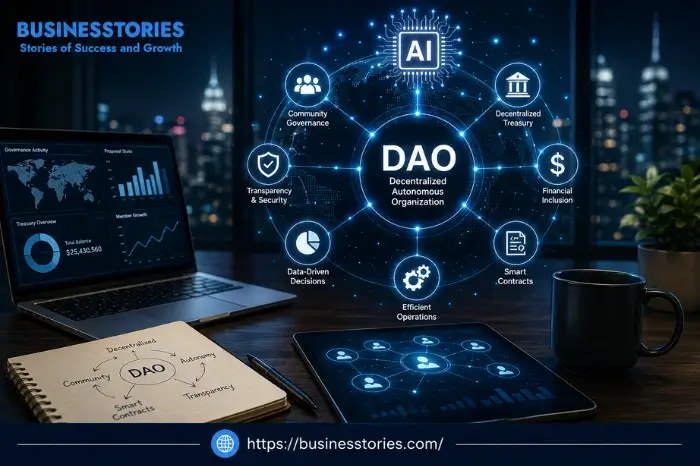
A DAO, or Decentralized Autonomous Organization, is a group run by its members through blockchain tech. Instead of one boss or board, members make choices together. Rules live inside smart contracts, and these contracts run on their own once a vote passes. No single person can change the rules alone, since the code enforces them for everyone equally.
Members usually hold tokens, and these tokens often carry voting weight. Therefore, the more tokens a person holds, the greater their influence in most setups. This structure is quite different from a normal firm. There, a small group of owners or a board often holds all the real power.
Adding AI to DAOs
When AI joins a DAO, choices get smarter and faster. AI scans data, guesses outcomes, and helps settle conflicts among members. As a result, the technology cuts delays and human slip-ups that often slow a normal vote. So, an AI-powered DAO can run with little day-to-day oversight and can shift fast when market conditions change.
For instance, an AI agent might read a long proposal and write a short, plain summary for busy members. Or, it might flag a proposal that looks risky based on past patterns. This kind of help means members spend less time on research and more time on real decisions.
Key Features of AI-Powered DAOs
- Automated governance: Smart contracts enforce rules without manual work from any single person.
- Data-driven choices: AI spots trends in the data and suggests smart next steps for the group.
- Open records: Blockchain logs every move in plain sight, so anyone can check the full history.
- Fast shifts: The group can update its own rules quickly, based on fresh AI input and member votes.
For example, DAOstack uses AI tools to speed up voting and proposal checks. This fixes a delay that trips up many normal firms. There, a single proposal can sit in a queue for weeks. Often, nobody even looks at it during that time. Speed like this can make a real difference for a small team racing against a fast-moving market.
How AI-Powered DAOs Disrupt Traditional Corporate Structures
Flattening Hierarchies
A normal firm has many layers of management. So, a choice often crawls through many desks before it gets approved. Each layer adds its own delay. Each manager may also want to add a personal opinion before passing the idea along. But AI-powered DAOs cut out these middle layers almost entirely.
Every member votes right away, and AI quickly counts the votes and posts the results on-chain. As a result, choices land quicker, with far less red tape and far fewer meetings.
Boosting Transparency and Trust
Many ordinary companies make decisions in private. Workers often hear about a big decision only after it is already final. In contrast, AI-powered DAOs log every action on the blockchain the moment it happens. So, members can track spending, votes, and proposals at any time, from anywhere.
Meanwhile, AI checks these records to catch fraud or errors early, well before they grow into a bigger problem. This open habit builds real trust among members and backers alike. Nobody has to simply take a leader’s word for it anymore.
Reducing Costs and Increasing Efficiency
Many office jobs take heavy manual effort. Think of compliance work or financial reports. Both cost real money to run. However, AI can automate many of these repeat tasks inside a DAO, from checking records to drafting reports. This cuts costs by a wide margin, since fewer staff hours go toward routine, repeat work. Then, the saved cash can fund new ideas, better tools, or fresh marketing instead of paperwork.
MolochDAO offers a strong case study here. It funds Ethereum projects without any normal managers or a formal office. Members vote on grants. AI handles much of the proposal flow with ease. It sorts and flags requests for the group to review. This initiative shows something big. A group run by AI and its members can handle tough tasks. It can do this at a real scale, not just as a small side project.
The Role of AI in Improving DAO Governance
Smart Contract Automation
Smart contracts run automatically, but they can still be vulnerable to bugs or outside attacks. So, AI watches contract activity around the clock to spot risk early and flag odd behavior before it causes harm. This step enhances security and ensures smooth daily operations by catching problems before they escalate. In effect, AI acts like a tireless night guard for the whole system.
Predictive Analytics for Decisions
AI studies past data and member habits to suggest smart, well-informed proposals. So, members get fact-backed input before they even cast a vote. This cuts down on guesswork. It also leads to better choices overall. After all, the group can lean on real numbers instead of a hunch. Over time, this data trail also helps the group learn from past mistakes and repeat what has worked well.
Conflict Resolution with AI
Votes can stall when members strongly disagree. A normal group might then spend weeks stuck in back-and-forth debate. Here, AI tools weigh each side fairly and suggest a middle ground based on facts and shared goals, rather than emotion. This accelerates disputes and propels the entire group forward, preventing a standstill that benefits no one.
Benefits of AI-Powered DAOs Over Traditional Models
Democratizing Power
A normal firm often stacks power in a few top hands, like the board or the CEO. Everyday workers, meanwhile, often have little real say. AI-powered DAOs, though, spread that power evenly among members through open voting. So, every voice counts almost equally, which helps fairness and fresh ideas thrive within the group.
Quick Adaptability
A stiff corporate ladder moves slowly. But AI-powered DAOs can shift their own rules fast when needed. Sometimes, such a change takes days rather than months.
For instance, if a market moves sharply, AI can suggest a fresh policy right away, based on the latest data. Then, members simply vote on it. This bend-not-break trait helps the group stay sharp, current, and competitive in a fast-moving world.
Global Collaboration Made Easy
AI tools help members work together across the globe with real ease. It does not matter where each person sits. So, time zones or language gaps no longer block a person from joining in fully. This widens the pool of talent and chances for everyone involved. After all, a remarkable idea can come from anywhere on the map.
A Powerful Human-AI Hybrid
Human ideas mixed with AI’s speed make a genuinely strong team. Humans bring vision, values, and a sense of right and wrong that code alone cannot offer. Meanwhile, AI handles the heavy data work and the routine, repetitive grind that would otherwise eat up a person’s whole day.
So, this hybrid setup often beats a fully manual group. It also beats a fully machine-run one. After all, it plays to the strengths of both sides.
Challenges Facing AI-Powered DAOs
None of this comes without cost, so it helps to know the risks up front before you dive in.
- Technical complexity: Building an AI-powered DAO takes real skill in blockchain code, AI logic, and cyber defense. Many groups lack these skills in-house, which slows the whole rollout and often forces them to hire outside help.
- Legal uncertainty: Most governments still lack clear laws for a group like a DAO, since the model is still fairly new. Therefore, this situation leaves real risk around who is liable when something goes wrong and how taxes should even apply.
- Security risks: Blockchain is fairly secure on its own, but smart contracts can still have bugs that hackers try to exploit.
Furthermore, bad data can trick AI systems, and they can also make honest mistakes. So, steady updates and close, ongoing watch remain vital for any group that wants to stay safe.
Best Practice: Hybrid Governance
To cut these risks, many experts suggest a mix. Blend human checks with AI automation, rather than leaning fully on either side alone. In short, humans review the big, critical calls that matter most. AI, meanwhile, handles the smaller, routine tasks that do not need a person’s full attention.
The Future of AI-Powered DAOs
Blending With Traditional Companies
More firms will likely borrow DAO ideas. AI can boost this shift, adding more openness and speed to how they run. At the same time, they may keep some central control in place. This helps with legal needs and compliance. Few firms will go fully decentralized overnight.
Smarter Autonomous Organizations
AI continues to improve at a rapid pace. So, some groups may soon run almost fully on their own, without much daily human input at all. Even so, they will likely still follow ethical rules. These rules are integrated into their code from the outset to ensure fair and safe outcomes.
Broad Industry Adoption
Banks and tech firms lead this trend today, since they already work closely with digital tools and data. However, fields like healthcare, education, and supply chains are likely to adopt these tools soon. After all, AI-powered DAOs can offer them more trust, more speed, and smoother teamwork. This helps most across large, spread-out teams.
Conclusion
AI-powered DAOs are reshaping corporate life around the world, one industry at a time. They flatten old hierarchies, cut costs, boost open records, and make rapid global teamwork truly possible. Even though technical and legal hurdles remain, many forward-thinking groups find that the gains outweigh the risks by a wide margin. This trend will likely grow stronger each year, as tools mature and more people learn the ropes.
If you want your business to grow in tomorrow’s market, it pays to study how AI-powered DAOs might fit your model. Pair the right tech with solid human judgment. Then, your firm can become more agile, fairer, and more open than ever before. So, take the first step today. Pick one AI-powered DAO. Study how it operates daily. Then, see what real lessons apply to your team.
FAQs About AI-powered DAOs
1. What are AI-powered DAOs?
AI-powered DAOs mix shared, blockchain-based rules with artificial intelligence to speed up choices and boost efficiency across an organization.
2. How do these differ from traditional companies?
They split power evenly among members through blockchain. AI, meanwhile, speeds up choices and cuts down on human error along the way.
3. What advantages do they offer compared to traditional models?
They offer open records, real cost savings, fast shifts when markets move, wide global reach, and a fair, shared style of governance.
4. What risks come with using AI in DAOs?
Main risks include tricky tech builds, security gaps in smart contracts, and unclear rules from governments around the world today.
5. Can existing businesses adopt AI-powered DAO elements?
Yes, many firms blend in DAO-style features to boost trust and openness. They still keep a solid core of central control, though.

Tabassum Shaik is an Author, Researcher, and SEO Specialist with over 8 years of experience creating informative content on business, startups, entrepreneurship, marketing, technology, and digital trends. She specializes in researching industry trends and transforming complex topics into practical, easy-to-understand insights. Her goal is to help readers stay informed, learn new ideas, and make better business decisions.