

Introduction
Running a startup without outside money is hard. Every dollar matters. One wrong move can drain your cash fast. That is exactly why startup booted financial modeling is now a key skill for founders.
So, what does it mean? Simply put, it is the process of planning your revenue, costs, and cash flow using only the money your business earns. Instead of waiting for investors, you use real customer income to guide every choice. As a result, you stay in control, keep your equity, and build a business that stands on its own.
In this guide, you will learn how to build a clear financial model step by step. You will also learn which numbers to track and how to use scenario planning to prepare for the unknown. Whether you are new to this or want to scale smarter, this guide gives you a simple and useful roadmap.
What is Startup Booted Financial Modeling, and why does it matter?
Startup booted financial modeling is the process of planning a startup’s finances without outside funding. Instead, it focuses on using your own revenue to drive growth. Unlike the investor-backed approach, this method puts survival and sustainability first.
Why does it matter? Because when your revenue funds the business, risk becomes clear and manageable. You stop guessing and start planning. As a result, you only grow when the numbers say it is safe.
Bootstrapped founders face a real challenge. They cannot afford to make costly mistakes. Every hire, every ad spend, and every product decision must be backed by real data. So, for a booted startup, a financial model is not a tool to impress investors. Instead, it is an operating guide for survival and smart growth.
Here is what sets this approach apart from VC-backed modeling. Traditional models assume outside funding will cover costs. But a booted model assumes your revenue must cover everything. That one shift changes how you price, hire, and scale.
Also, even if you do not plan to raise money now, a strong financial model helps you get ready for the future. It shows maturity and discipline. So, when investors do come calling, you are already prepared.
In short, startup booted financial modeling is not just about numbers. It is about making faster, smarter decisions using the data you already have.
The Three Core Financial Statements Every Founder Needs
Before you build a model, you need to know the three key documents. Together, they give you a full picture of your startup’s financial health.
1. The Profit and Loss Statement
This statement tracks revenue, costs, and net profit over time. It simply tells you if your business is making or losing money. For bootstrapped founders, the most important number here is gross margin. This is the revenue left after you subtract direct costs. For SaaS startups, a gross margin above 70% is a good target. If your margin is low, you have less money to reinvest and grow.
Also, pay close attention to both fixed costs and variable costs. Fixed costs, like rent and salaries, stay the same each month. Variable costs, like shipping and payment fees, rise as your sales grow. Knowing the difference helps you see how profitable each new sale really is.
2. The Cash Flow Statement
A cash flow statement tracks every dollar going in and out of your business. Even a profitable startup can fail if cash runs out too soon. So, always aim to keep enough cash to cover three to six months of expenses. This buffer protects you when revenue dips or costs jump.
Moreover, do your cash flow forecasting every month, especially in year one. That level of detail is where financial risk shows up early enough for you to act.
3. The Balance Sheet
The balance sheet shows what your business owns, owes, and is worth at a single point in time. Even a small startup benefits from keeping a simple one. It gives partners and future investors a quick look at your overall financial health.
How to Build a Startup Booted Financial Model: Step by Step
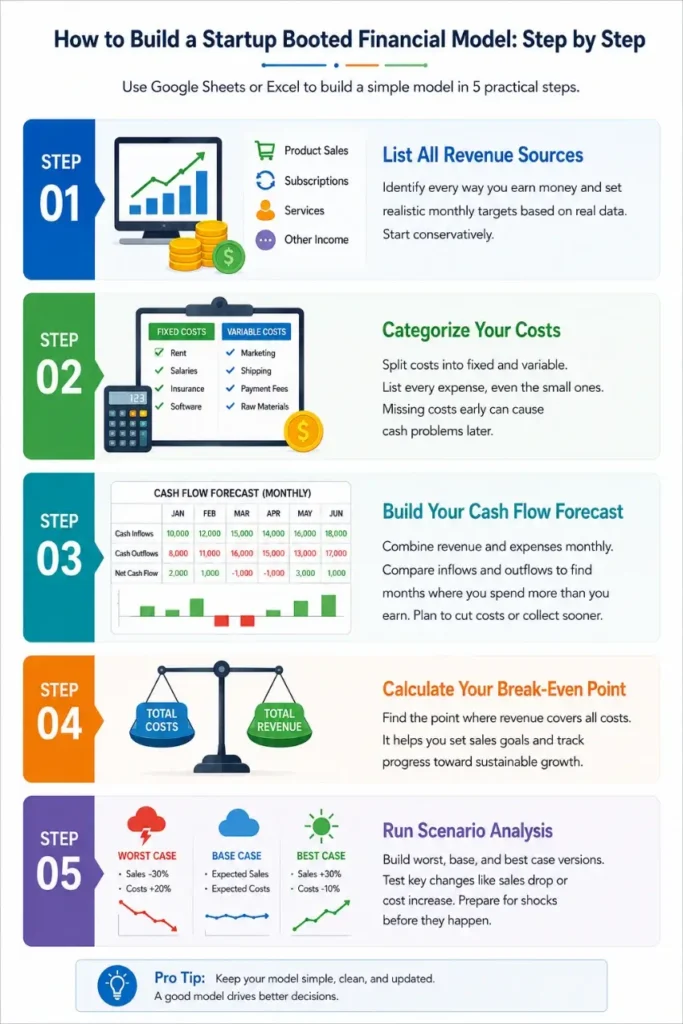
Building a financial model does not require a finance degree. Most founders simply use Google Sheets or Excel. Here is a practical, step-by-step process to follow.
Step 1: List All Revenue Sources
First, identify every way your startup earns money. Then, set realistic monthly income targets for each source. Base your numbers on real data, like early sales figures, customer interest, and your pricing. Rather than being too optimistic, start conservatively. That way, your plan stays solid even when growth is slow.
Step 2: Categorize Your Costs
Next, split your costs into fixed and variable groups. Write down every expense, even the small ones. Costs tend to creep up quietly over time. Many founders miss this in the early stages, and it leads to cash problems later.
Step 3: Build Your Cash Flow Forecast
Now, combine your revenue and expense numbers into a monthly cash flow forecasting sheet. Put inflows and outflows side by side. Then, look for any months where you spend more than you earn. Those are your danger zones. Plan by cutting costs or collecting payments sooner.
Step 4: Calculate Your Break-Even Point
The break-even point is when your revenue fully covers all your costs. For many startups, this moment marks the shift from survival to real, sustainable growth. Knowing this number helps you set clear sales goals and measure your progress over time.
Step 5: Run Scenario Analysis
Finally, build three versions of your model. Create a worst case, a base case, and a best case. Ask yourself, what if sales drop by 30%? What if costs double? Scenario analysis helps you plan for shocks before they hit. Founders who do this stay calm under pressure. Those who skip it often get caught off guard.
Understanding Burn Rates and Cash Runway
For any bootstrapped startup, burn rates and cash runway are the most vital numbers to watch. Your burn rate is how much cash you spend each month above what you earn. Your runway is how many months you can keep going before you run out of money.
In fact, cash runway is the most critical metric in startup booted financial modeling. Even a profitable startup can fail if cash timing goes wrong. So, revenue growth matters, but cash survival matters even more.
How do you extend your runway? There are two simple levers. First, earn more. Second, spend less. Ideally, do both at the same time. A data-driven approach works best here. Track your burn rate every month. Then compare it to your forecast. If spending grows faster than revenue, act now before the gap becomes a serious problem.
Here is an insight many guides miss. Your burn rate is not just a financial figure. It is a sign of how well your team manages money day to day. Founders who check it weekly make better choices than those who look just once a month. Real-time visibility changes your daily behavior and spending habits.
Furthermore, only hire full-time staff when your recurring revenue has already covered that new salary for at least three to six months. Hiring too early raises your fixed costs and cuts your financial flexibility quickly.
Scenario Planning for Long-Term Resilience
One of the best tools in startup booted financial modeling is scenario planning. Most founders build just one version of their financial model. That is a mistake, because the future rarely goes exactly as planned.
Scenario planning means building several forecasts based on different possible outcomes. Best case, you gain more clients than expected. In the worst case, a major customer leaves, or costs jump without warning. In the base case, things move at a steady and normal pace.
This process helps you prepare for the unknown. Furthermore, it pushes you to ask hard questions early. For example, what would you cut first if revenue fell 20%? How fast could you change your pricing? When you have these answers ready, a crisis becomes a managed response instead of a shock.
Long-term scenario planning also helps with hiring timelines, product launches, and marketing spend. Rather than making emotional calls under stress, you simply follow a clear playbook. That is the real difference between reactive founders and proactive ones.
For best results, review your scenarios every quarter. Then, update them using real data from the period. Over time, your model becomes sharper and more accurate. Eventually, it becomes a truly powerful strategic decision-making tool.
Key Metrics That Reflect True Financial Health
Tracking the right numbers is just as important as building the model itself. Here are the metrics that matter most for startup booted financial planning.
Monthly Recurring Revenue (MRR)
MRR is the steady income your business earns each month. It is the backbone of any subscription-based startup. Moreover, rising MRR is a clear and reliable sign that your model is working well.
Customer Acquisition Cost (CAC) and Lifetime Value (LTV)
CAC is how much you spend to get one new customer. LTV is how much that same customer pays you over their lifetime. For a strong bootstrapped model, aim for an LTV-to-CAC ratio of 3:1 or higher. If your CAC is too high compared to LTV, your growth simply will not last.
Gross Margin
Gross margin is the revenue left after direct production costs. A healthy gross margin gives you room to invest in growth without burning through all your cash. So, track it monthly and compare it to your industry benchmarks regularly.
Churn Rate
Churn is the rate at which customers leave each month. High churn kills LTV and makes growth nearly impossible. Therefore, keeping churn low is one of the best ways to protect your financial health over the long term.
Common Mistakes Bootstrapped Founders Make
Even experienced founders repeat the same errors. Here are the most common ones you should avoid.
Overestimating revenue is the biggest trap. Many founders expect fast growth and plan accordingly. But then they spend based on projected sales that never arrive. The result is financial strain and a shrinking runway.
Ignoring variable costs is another common problem. Founders often plan well for fixed costs but forget that variable costs grow with sales. As revenue rises, so do payment fees, shipping costs, and customer support expenses.
Skipping monthly updates makes your model quickly useless. You must refresh it every month with real numbers. Then compare your actual results to your forecast. A model based on old data cannot help you make good decisions today.
Finally, confusing profit with cash is a hidden danger. A business can look profitable on paper, yet still run out of cash if customers pay late. So, always manage your cash flow statement as a separate priority from your profit report.
Conclusion: Build Smarter, Grow Stronger
Startup booted financial modeling is more than a finance task. It is a mindset and a daily habit. It teaches you to value every dollar, challenge every assumption, and prepare for what could go wrong. Founders who build this habit create businesses that are tough, independent, and truly scalable.
To sum up, the key steps are simple. Start with realistic revenue estimates. Separate your fixed and variable costs. Build a monthly cash flow forecast. Find your break-even point. Run regular scenario analysis. And always track the metrics that show the true state of your business.
The good news is that you do not need expensive tools or a finance team to do this. A simple spreadsheet, updated each month with real data, gives you a strong edge over most competitors. Over time, your model grows with your business. It guides every big strategic decision you face.
So, if you are ready to take charge of your startup’s future, start today. Build your first model, even a very basic one. Review it next month. Then improve it the month after. That simple habit alone will set you apart from most founders.
Your next step: Open a spreadsheet. List your top three revenue sources. Write down your five highest costs. You have already started your startup booted financial model. Now keep going.
FAQs: Startup Booted Financial Modeling
Q1. What is startup booted financial modeling in simple terms?
Ans: It is a way to plan your startup’s revenue, costs, and cash flow using only internal funding. It helps founders make data-driven choices and grow steadily without relying on outside investors or venture capital.
Q2. How often should I update my bootstrapped financial model?
Ans: Update it every month using real results. Monthly updates help you catch problems early, refine your cash flow forecasting, and keep your long-term projections accurate and on track.
Q3. What is the break-even point, and why does it matter?
Ans: It is the point where your revenue covers all your fixed and variable costs. Reaching it means your business no longer runs at a loss. It is a key milestone on the road to sustainable, self-funded growth.
Q4. How do burn rates affect startup survival?
Ans: Your burn rate shows how fast you spend cash beyond what you earn. A high burn rate shrinks your runway quickly. So, tracking it monthly helps you cut spending before it threatens your startup’s financial health.
Q5. Can startup booted financial modeling help attract future investors?
Ans: Yes. A clear and disciplined model shows investors you are serious and capable. It proves you can grow using real revenue and make smart choices backed by solid financial projections and real data.

Tabassum Shaik is an Author, Researcher, and SEO Specialist with over 8 years of experience creating informative content on business, startups, entrepreneurship, marketing, technology, and digital trends. She specializes in researching industry trends and transforming complex topics into practical, easy-to-understand insights. Her goal is to help readers stay informed, learn new ideas, and make better business decisions.