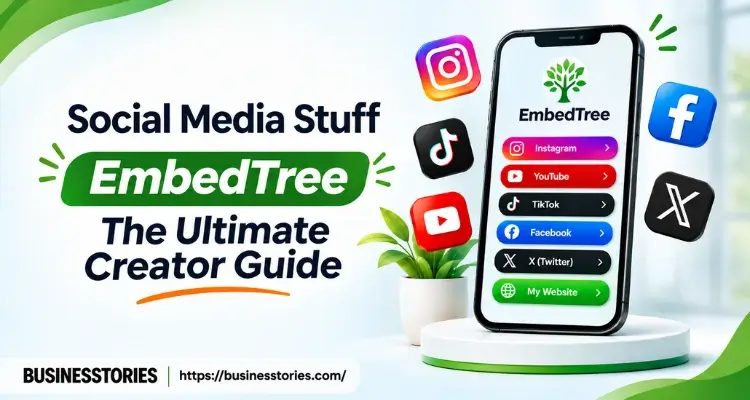
Your content lives in too many places. You post Reels on Instagram, clips on TikTok, and long videos on YouTube. Then you drop a podcast, a newsletter, and maybe a shop link too. As a result, your fans get lost. They tap your bio, see one link, and leave. That is the exact problem Social Media Stuff EmbedTree tries to solve.
In simple terms, it means putting all your social posts, videos, and links in one tidy place. But most listicles skip a key twist. So in this guide, we will clear up what the term really means.
Thereafter, you will get clear steps, real data, and the best tools to build your own hub. Let’s dive in.
What Social Media Stuff EmbedTree Really Means
First, let’s be honest about the name. EmbedTree is not one confirmed product. Several reviewers have looked for an official app or website. So far, none of them found a single, clear owner of the name. Instead, people use the phrase as a loose label for an idea.
So what is the idea? It is a central content hub. This hub pulls your social media content into one page. It can hold profile links, embedded posts, videos, playlists, and shop items. In other words, think of it as a link-in-bio page mixed with a live social feed.
Link Hub vs. Embed Hub
There are two common styles. Here is how they differ:
- Link hub: A simple list of buttons. Each button sends fans to another site. Linktree is the best-known example.
- Embed hub: A page that shows your content in place. Fans can watch a video or read a post without leaving.
Most creators start with a link hub. Over time, though, many move toward an embed hub. Why? Because each extra click is a chance for a fan to drop off.
Why the Fuzzy Name Matters to You
Here is our unique take. Since EmbedTree is not a verified brand, you should be careful. Some sites may use the name to push unknown apps or scripts. Therefore, never paste code from a tool you can’t trace back to a legitimate company.
Stick with official embed codes from the platforms or with well-known tools. Once you see EmbedTree as a method, not a product, things get easier. You stop hunting for one magic app.
Instead, you focus on the result: a social media content hub that keeps fans engaged. And that result is what really grows your audience over time, no matter which tool you choose.
Why Creators Need a Central Content Hub in 2026
Now, let’s look at why this information matters. The statistics present a compelling narrative.
According to DataReportal, there were 5.79 billion social media user identities worldwide by April 2026. Moreover, the typical user visits around six or seven platforms each month.
That means your audience is spread thin. Your fans may love your TikToks but never see your YouTube channel. At the same time, the creator economy keeps growing.
Goldman Sachs Research says it could reach about $480 billion by 2027. In addition, link-in-bio tools have exploded. Linktree alone reports well over 70 million users. Clearly, creators want a single platform to direct their fans.
The “Rented Land” Problem
Here is a point many guides miss. Every platform you post on is rented land. The rules can change overnight. For example, Meta replaced its old oEmbed feature, and the old version was switched off in November 2025. Sites that did not update ended up with broken embeds.
Because of these changes, your hub should sit on ground you control. Ideally, that means a page on your domain. Even if you use a link-in-bio tool, keep a backup page on your site. That way, a single policy change can’t wipe out your traffic.
What a Hub Does for You
A good hub gives you three big wins:
- Fewer lost fans: People find what they want in one or two taps.
- Better data: You can see which links get clicks and which are ignored.
- Stronger branding: Your colors, photo, and voice stay the same everywhere.
In short, a hub turns scattered posts into a clear path. It also saves you time, since you update one page instead of ten bios. And that path leads fans to the content, products, or sign-ups that matter most to you.
How to Build Your Social Media Stuff EmbedTree Hub in 6 Steps
Ready to build one? Good news: you don’t need to code. Just follow these simple steps to build Social Media Stuff EmbedTree.
Step 1: Pick Your Main Goal
First, decide what the hub is for. Do you want more newsletter sign-ups? More sales? More YouTube views? Pick one main goal. Then put that link at the very top.
Step 2: Choose Three or Four Content Types
Next, resist the urge to add everything. The best hubs show only three or four types of content. For instance, a fitness creator might show the latest video, a workout plan, a shop link, and a newsletter form. That’s it.
Step 3: Choose Your Platform
Next, choose where the hub will live. You have two main options:
- A link-in-bio tool, such as Linktree, Beacons, or Later. These are quick and straightforward.
- A page on your website, built with WordPress, Wix, or Squarespace. This option takes a bit longer, but you own it.
Step 4: Grab Official Embed Codes
Then, collect your embed codes. Most big platforms give you one. On YouTube, for example, click Share, then Embed, and copy the code. Instagram and Facebook also offer embed options for public posts. Always use these official codes first.
Step 5: Design for Mobile First
Most fans will see your hub on a phone. So keep buttons large and text short. Furthermore, use clear labels like “Watch My Latest Video” instead of vague ones like “Click Here.”
Step 6: Test, Track, and Trim
Finally, review your hub every month. Look at which links receive clicks. Remove the ones nobody uses. In addition, test every embed to make sure it still works.
Our Tip: The Three-Tap Rule
Here is a simple test we use. A new fan should reach your most important content in three taps or fewer. That means tap your bio, tap the hub button, and land on the content. If it takes more, your hub is too busy. So trim it until it passes.
Best Tools and Methods for Embedding Social Media Content
Now let’s talk tools. Since there is no single EmbedTree app, you’ll need to combine different options. Here are the four main options, from simplest to most advanced.
Official Platform Embeds
The official platform embed is the safest choice. YouTube, Instagram, Facebook, TikTok, and X all offer free embed codes. You copy the code and paste it into your page. On top of that, Meta’s newer oEmbed tool now covers Facebook, Instagram, and Threads posts.
Best for: creators with their website who want full control.
Link-in-Bio Tools
These tools give you a quick, ready-made page. Linktree is the most popular, followed by Later and Beacons. Many of them now let you show videos and products right on the page.
Best for: creators who want to launch in under 10 minutes.
Social Feed Widgets
Some tools pull your posts from many platforms into one live wall. You connect your accounts, design the layout, and paste one code into your site. As a result, your feed updates itself whenever you post.
Best for: small businesses and brands that want an always-fresh feed.
CMS Blocks
If you use WordPress, you already have embed blocks built in. Simply paste a post link into the editor, and it turns into an embed. Wix and Squarespace work in a similar way.
Best for: bloggers who already run a site.
How to Choose the Right One
Here is a quick guide to help you pick:
| Your Situation | Best Option |
| Just starting, no website | Link-in-bio tool |
| Have a blog or site | Official embeds or CMS blocks |
| Run a brand or shop | Social feed widget |
| Want full control | Own-domain page with official embeds |
A Smart Safety Check
Before you install any widget, do a quick check. Look for a real company name, a privacy policy, and recent reviews. Also, read what data the tool asks for. If a tool wants full control of your accounts, walk away. Your followers trust you, so protect that trust.
Speed, SEO, and Common Mistakes to Avoid
Embeds look excellent. However, they come with a hidden cost: page speed.
Google’s web.dev team notes that many popular embeds carry over 100 KB of JavaScript, and some reach 2 MB. That extra weight slows your page. Worse, slow pages lose visitors and can hurt your search rankings.
How to Keep Your Hub Fast
Luckily, there are easy fixes:
- Use lazy loading: Add loading=”lazy” to your iframe embeds. This tells the browser to wait until a fan scrolls near the embed. For a YouTube video, web.dev says this can save about 500 KB on the first load.
- Use facades: A facade is a still image that looks like the embed. The real player loads only when a fan clicks it.
- Put your own content first: Place your text and main links at the top, with embeds lower down.
Our Unique Idea: Set an “Embed Budget”
Here is an approach most guides don’t mention. Give each page an embed budget of three live embeds. For anything beyond that, use a facade or a simple link. This rule keeps your hub light, even as your content grows.
What About SEO?
Let’s be clear. Embedded posts load from another site, so their text mostly counts toward that site. In other words, embeds alone won’t boost your rankings. So add your own short text around each embed. A one- or two-line caption gives search engines something to read.
Common Mistakes to Avoid
Finally, be aware of these traps:
- Too many sections: A crowded hub confuses fans.
- Dead embeds: Deleted or private posts leave ugly blank boxes.
- Poor mobile layout: Tiny buttons drive people away.
- Mixed branding: Different photos and bios on each platform weaken trust.
- Unknown scripts: Code from unverified tools can slow or harm your site.
Fix these, and your hub will feel clean, quick, and easy to use.
Conclusion
To sum up, Social Media Stuff EmbedTree is not one magic app. Instead, it is a smart way to gather your posts, videos, and links in one central hub. With billions of users across various platforms, that hub is more important than ever.
Let’s recap the key points of Social Media Stuff EmbedTree:
- First, treat EmbedTree as a method, not a brand, and avoid unknown tools that borrow the name.
- Second, build your hub on ground you control, ideally your own domain.
- Third, follow the six steps: set one goal, pick a few content types, choose a platform, use official embeds, design for mobile, and trim often.
Additionally, ensure that your page speed is optimized. Use lazy loading, try facades, and stick to an embed budget of three live embeds per page. Furthermore, add your own text around embeds so search engines have something to read.
Most of all, remember the three-tap rule. If a new fan can reach your best content in three taps, your hub is doing its job. So here is your next step. Open your bio link and count the taps to your most important content.
If it takes more than three, start trimming. Then add one official embed and test it on your phone. Your fans are already looking for you. Now, make it easy for them to find you.
Frequently Asked Questions About Social Media Stuff EmbedTree
1. What is Social Media Stuff EmbedTree, and how do creators use it?
It is a loose term for a central content hub. Creators use it to gather social posts, videos, and links on one page. As a result, fans can find all their content without searching each platform.
2. Is EmbedTree a real app, or just a name for embedding social content?
There is no widely confirmed EmbedTree app today. Instead, the name describes a method of embedding social content in one place. Instead, you can use trusted tools such as Linktree, official embed codes, or your own website.
3. How do I embed social media posts on my website for free in 2026?
Most platforms offer free embed codes. On YouTube, click Share, then Embed, and copy the code. Next, paste it into your page editor. Instagram, Facebook, TikTok, and X offer similar options for public posts.
4. Do social media embeds slow down a website or hurt its SEO rankings?
They can. Some embeds add over 100 KB of JavaScript, which slows pages. However, lazy loading and facades resolve most issues. Furthermore, add short captions around embeds so search engines see your content.
5. What is the best link in the bio tool for creators who want to add embeds?
Linktree is the most popular, with over 70 million users. Beacons and Later are also strong options. However, if you want full control and the best SEO value, build a hub page on your own domain.

Tabassum Shaik is an Author, Researcher, and SEO Specialist with over 8 years of experience creating informative content on business, startups, entrepreneurship, marketing, technology, and digital trends. She specializes in researching industry trends and transforming complex topics into practical, easy-to-understand insights. Her goal is to help readers stay informed, learn new ideas, and make better business decisions.