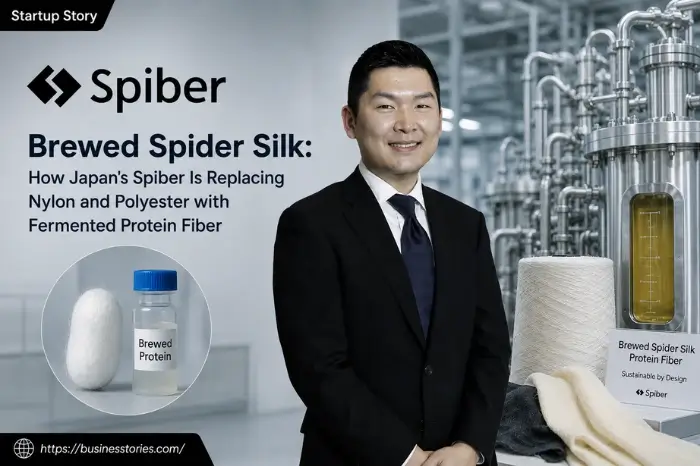
What if your jacket grew inside a tank? That idea is now real. Brewed spider silk is not a lab dream. It is on sale today. Japan’s startup Spiber Inc. has spent almost 20 years making it happen. The company makes a material called Brewed Protein™. It looks and feels like silk or wool. But it comes from microbes that eat plant sugars.
Fashion creates about 10% of the world’s carbon emissions each year. Most of that comes from nylon and polyester. These fabrics are made from oil and can last for hundreds of years in a landfill. Spiber takes a better route. Its fermented protein fiber is plant-based and breaks down in soil and water.
In this article, we look at how Spiber’s precision-fermentation materials work, why they matter, and how this bold Spiber startup is changing the world of textiles.
What Is Brewed Spider Silk, and How Does Spiber Make It?
From Spider to Tank
Spider silk is one of nature’s best materials. It is five times stronger than steel by weight. It is also far more stretchy than nylon. But you cannot farm spiders. They fight each other and are difficult to raise. For decades, this valuable material remained inaccessible.
Spiber found a smart way around this problem. Instead of spiders, the company uses tiny microbes. Scientists design the exact protein they want. Then they program microbes, like bacteria or yeast, to make that protein in a tank. It works just like brewing beer. That is why Spiber calls the result “brewed” protein.
Spiber takes ideas from spiders, silkworms, and other creatures. However, its protein design is fully custom. Each version is built to do a specific job, such as softness for a coat or strength for a jacket.
The Four Steps of Production
First, Spiber studies natural proteins and saves the data. Second, scientists design a new protein sequence for the target use. Third, microbes convert plant sugars into protein. Finally, the protein is spun into fiber. Textile makers then weave it into fabric.
This process is clean and circular. The inputs are all renewable. The finished fiber breaks down in soil and water. Furthermore, it does not need any oil or petrochemicals. In fact, Spiber’s fiber releases up to 75% less greenhouse gas than cashmere. Furthermore, it uses 94% less water and 86% less land.
Why the World Needs Brewed Spider Silk Right Now
The Problem with Nylon and Polyester
Most sports clothes today use nylon or polyester. These fabrics come from oil. As Goldwin’s development manager, Gen Arai put it, brands used these materials simply because there was no better option. They offered the right weight, strength, and function. But they also come with big problems.
First, synthetic fibers shed tiny plastic bits into rivers every time you wash them. Second, they do not break down. Third, making them pumps out a lot of carbon. On top of that, animal fibers like cashmere need a lot of land and water. They also produce methane, which warms the planet.
Furthermore, new EU regulations now require brands to demonstrate the recyclability and plant-based nature of their materials. Consequently, the market is ready for what Spiber offers. The timing could not be better.
A Market Ready to Change
The world’s technical textiles market is worth around $230 billion. So even a small share is a giant prize. Furthermore, as Spiber makes more fiber and lowers its costs, new markets open up. These include everyday clothes, car interiors, and medical products.
The Moon Parka: From Lab to Shelf
The Deal That Started It All
In 2015, Spiber began working with Goldwin, the firm that holds the North Face license in Japan. Together, they built a test jacket using Spiber’s protein material. Then, in 2019, they launched the Moon Parka. It was the world’s first jacket made with protein from microbes.
The parka costs around $1,375. Most people would not pay that for a coat. But when The North Face Japan put 50 on sale, they sold out fast. The fiber felt like silk and wool combined. It also indicated that brewed spider silk could work in real outdoor gear.
Growing the Brand List
Since then, Spiber has added many big names. Partners now include Burberry, Yohji Yamamoto, and Iris van Herpen. Van Herpen used Spiber fiber in a couture wedding dress for her Autumn/Winter 2025 show. Additionally, in October 2025, Chinese brand JNBY Group joined the list. It was the first Chinese fashion label to use Brewed Protein™. By 2025, over 45 brands and 193 products will use the material.
Spiber’s Funding and Global Growth
Scaling Up in Thailand
Spiber opened its first big factory in Rayong Province, Thailand, in 2022. The plant uses sugarcane to make protein. It can produce several hundred tonnes of Brewed Protein per year. That is about 100 times more than the Japan plant.
Therefore, this factory is key to Spiber’s growth plan. It lets the company move from luxury only to a much wider market. Plans are also in place to go beyond 1,000 tonnes per year. Furthermore, by 2026, Spiber aims to use only non-food, renewable raw inputs. That would make the whole process truly climate positive.
Nearly Half a Billion in Funding
In January 2025, Spiber raised $65 million in a new funding round. That brought its total funding to $489 million. The money will help grow its factories, expand its research, and enter new global markets. Investors clearly believe in the technology. They also see how big the market can get as costs come down.
Beyond Fashion: What Else Can Brewed Protein Do?
Cars, Clinics, and More
Brewed Protein™ is not just for clothes. The same material can become resins, films, and durable parts. Car makers are already looking at it for door panels and seats. Light, bio-based car parts are in high demand as the auto industry shifts to cleaner design.
Furthermore, the medical field is a key future target. Protein materials work well with the human body. As a result, Spiber’s fiber may one day be used in wound dressings, stitches, and tissue repair tools. These medical uses carry much higher profits than fashion does.
A Circular Future
Spiber also leads the BioCircular Materials Alliance. This group works to set global rules for bio-based, circular materials. The goal is simple: grow raw inputs from waste, brew them into protein, make durable goods, then let them return safely to nature. This vision lines up with where global laws are heading in both Europe and Japan.
Challenges Spiber Must Still Solve
The Cost Problem
Cost is still the greatest hurdle. Nylon costs less than $3 per kilogram. Spiber’s material costs much more right now. So it only makes sense for premium products. But as the Thailand plant runs at full speed, costs will fall. Still, true price parity with synthetic fiber will take a few more years.
Getting the Word Out
Most shoppers have never heard of fermented protein fiber. In February 2025, Spiber showed over 100 new fabrics at the Milano Unica trade fair in Italy. This was its first time at the show. However, generating excitement among brands is only the initial step. Getting everyday buyers to choose it is the bigger challenge.
Passing Safety and Rules Tests
Before Spiber can sell to the medical or food sectors, it must pass tough safety tests in each country. These tests take time and money. However, these tests are essential to demonstrate the material’s safety and efficacy. Step by step, Spiber is working through them.
Conclusion: Why Brewed Spider Silk Could Change the World
Spiber started as a student project at Keio University in 2004. Since then, it has grown into one of Japan’s most exciting startups. Today, brewed spider silk is on sale through The North Face, Burberry, and JNBY. It has graced the Paris couture runway. And it has raised nearly $500 million in funding.
The task ahead is big. Nylon and polyester rule the fiber market. They are cheap and easy to obtain. So they will not vanish overnight. But the shift is clear. Laws, buyers, and investors all push toward cleaner materials. Spiber is right at the center of that shift.
Moreover, the opportunity goes far beyond clothes. Cars, clinics, and packaging all need better materials. Spiber’s precision fermentation platform can serve all of these. Its fiber is strong, clean, and bio-based. That is precisely what the world needs next.
So if you follow startups, clean tech, or fashion, watch Spiber closely. Track its next factory milestone. See where it enters the medical market. The brewed protein story is still in its early chapters.

Tabassum Shaik is an Author, Researcher, and SEO Specialist with over 8 years of experience creating informative content on business, startups, entrepreneurship, marketing, technology, and digital trends. She specializes in researching industry trends and transforming complex topics into practical, easy-to-understand insights. Her goal is to help readers stay informed, learn new ideas, and make better business decisions.