
Introduction
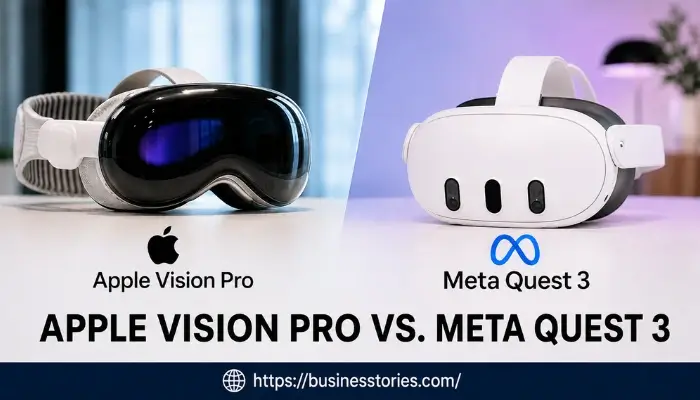
Mixed-reality headsets are hot right now. But picking the right one can feel challenging. So let us make it simple. This guide covers Apple Vision Pro vs. Meta Quest 3 head-to-head. We look at price, display, speed, comfort, and content. By the end, you will know which headset best fits your needs.
Both headsets blend the real world with digital content. But they target very different buyers. Apple goes after pros with a $3,499 device. Meta aims to provide everyday users with a budget option. However, in April 2026, Meta raised the Quest 3’s price to $599.99 due to global chip shortages. So the gap is smaller now. Still, Apple costs roughly six times more. Let’s delve deeper and determine which option is the best for you.
Apple Vision Pro vs. Meta Quest 3: Price and Value in 2026
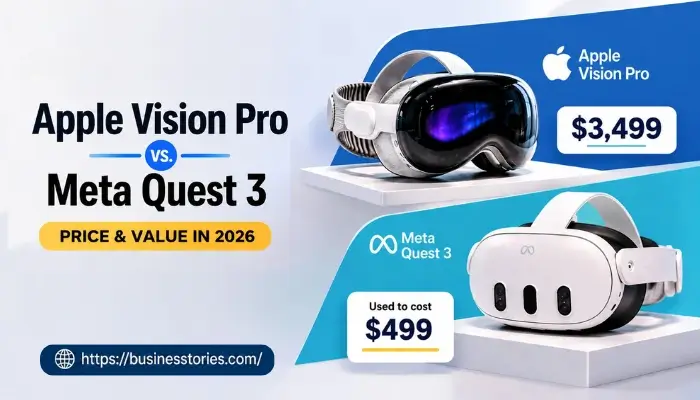
Price is the first thing most shoppers check. And here, the gap is huge.
The Apple Vision Pro costs $3,499. That is a big spend. But you get the M5 chip, sharp micro-OLED screens, and a full sensor suite. It feels like having a desktop computer on your face.
The Meta Quest 3 used to cost $499. But Meta raised the price in April 2026. It now costs $599.99. Meta blamed rising memory chip costs. Global demand for AI hardware pushed chip prices up fast. TechCrunch reported that DRAM prices could rise another 45–50% in Q2 2026. So even Meta’s “budget” headset costs more now.
Still, the Quest 3 is far cheaper than the Vision Pro. Here is a quick look at how they stack up:
Feature Apple Vision Pro ProMeta Quest 3 3Price (2026) $3,499 $599.99 Storage: 256GB, 512GB Chip: Apple M5 + R1, Snapdragon XR2 Gen 2 Display Micro-OLED (23M pixels) LCD (8.6M pixels) Battery Life ~2.5 hrs (external pack) ~2.5 hrs (built-in) Weight: 750–800 g, 515 g
Unique insight: The price hike changes the game of buying. Some shoppers may now skip the Quest 3 and save up for the Vision Pro. Others may go for the Quest 3S instead, which still starts at $349.99. Either way, the new Quest 3 price forces a tougher choice.
Display Quality: Micro-OLED vs. LCD
The screen is one of the biggest gaps between these two headsets. And the Vision Pro wins by a wide margin here.
The Vision Pro uses dual micro-OLED screens. Together, they pack 23 million pixels. That is nearly three times more than the Quest 3. The text looks razor-sharp. Colors pop. There is almost no screen-door effect, that faint grid you can sometimes see in VR. Plus, the screens cover 92% of the DCI-P3 color range. Therefore, the colors appear vibrant and realistic.
In contrast, the Meta Quest 3 uses LCD panels. They show about 8.6 million pixels in total. That works well for gaming and everyday use. But side by side, the Quest 3 looks blurrier. Text is harder to read, and colors feel less rich.
Both headsets now run at up to 120Hz. So motion looks smooth on either device. However, Apple’s contrast and color depth still win for movies and creative work.
Practical tip: If you mostly play games, the Quest 3 screen is just fine. But if you want to watch spatial video or do design work, the Vision Pro’s display is in a class of its own.
Passthrough: Seeing the Real World Through Your Headset
Passthrough lets you see your room while wearing the headset. Both devices offer full-color passthrough. But the Vision Pro looks far more natural and clear. Tech reviewer MKBHD said in 2026 that the Vision Pro’s passthrough “still sets the standard that everyone else is chasing.” The Quest 3 is excellent for its price. But colors can look slightly washed out next to Apple’s version.
Performance and Processing Power
Speed matters a lot in mixed reality. A slow headset feels laggy and breaks the experience. So let us look at the chips inside each device.
The Vision Pro runs the Apple M5 chip. Apple built it on a 3-nanometer process. It has a 10-core CPU and a 10-core GPU. The GPU supports ray tracing, which makes lighting look more realistic. The M5 also has a 16-core Neural Engine for AI work. It runs AI tasks up to 50% faster than the last version.
Next to the M5, the R1 chip handles all sensor data. It processes input in just 12 milliseconds. So tracking and passthrough feel instant. There is no noticeable lag at all.
The Quest 3 runs the Qualcomm Snapdragon XR2 Gen 2 chip. It also packs 8GB of fast LPDDR5 memory. This chip works exceptionally well for standalone VR. But it is a mobile-class chip. The M5, by contrast, is desktop-class.
Think of it simply: the Vision Pro is like a MacBook on your face. The Quest 3 is more like a high-end phone in headset form. Both do the job. However, Apple’s performance is on a completely different level.
What is the daily impact of this??
For gaming and video, the Quest 3 runs very smoothly. Most VR games do not push it to its limit. However, if you want to run many apps at once or use advanced AI tools, the Vision Pro handles it all with ease. The Quest 3 may slow down under heavy workloads.
Design, Comfort, and Wearability
Both headsets aim for comfort. But they feel unique on your head.
The Vision Pro uses an aluminum and glass frame. It looks and feels premium. It comes with two headband styles and a light seal for a snug fit. But it is heavy. With everything included, it weighs 750–800 grams. Furthermore, the battery pack sits outside the headset on a cable. Some users find the cable annoying during long sessions.
The Quest 3 is much lighter. It weighs just 515 grams. The body is plastic, which feels less fancy. But lighter always means more comfortable over time. Plus, the battery lives inside the headset. No cables. No external pack. Just put it on and go.
Unique insight: The Vision Pro’s external battery has one key perk. You can swap it out without removing the headset. That means no downtime in a work setting. Gamers will not care about the battery. But professionals and enterprise users will love it.
Controllers: Physical Buttons vs. Hand Tracking
The Quest 3 ships with Touch Plus controllers. These work excellently for games. They let you grab, shoot, and interact with precision. The Vision Pro skips physical controllers. Instead, it uses eye tracking, hand gestures, and voice commands. The experience feels futuristic. But it is less precise for fast-paced gaming.
Content, Apps, and Ecosystem
Buying a headset also means joining an ecosystem. So let us see what each platform offers.
The Vision Pro runs visionOS, now at version 3.2, as of March 2026. Apple added “Spatial Personas 2.0” recently. This feature lets up to five people share a virtual space. Apple also offers over 1 million apps, including Mac Virtual Display, Apple TV+, and Apple Immersive Video. The M5’s Neural Engine also powers Apple Intelligence features. These include better persona creation and faster spatial photo editing.
Quest 3 runs on MetaHorizon OS and links to the Quest Store. It has one of the best VR game libraries out there. Top titles include Beat Saber and Asgard’s Wrath 2. Meta keeps adding mixed reality games, too. Furthermore, the Quest 3 now supports Steam Link. So you can play PC VR games wirelessly, a giant win for gamers.
Practical tip: If you already use a Mac, iPhone, and iPad every day, the Vision Pro fits right in. If you love gaming and want a huge game library, the Quest 3 wins hands down.
Which Headset Is Right for You? Apple Vision Pro vs. Meta Quest 3
This is the big question. So let us answer it straight.
Pick the Apple Vision Pro if you
- Work in design, film, or a creative field.
- Use Apple devices every single day.
- Need sharp screens for spatial video or detailed work.
- Want top processing power to run many apps at once.
- Can invest $3,499 in the best spatial computing device on the market.
Pick the Meta Quest 3 if you:
- Want great VR and mixed reality at a much lower price.
- Love gaming and want a huge content library.
- Prefer a lighter, cable-free headset for long sessions.
- Are new to VR and want to explore it without overspending.
- Want a wireless experience right out of the box.
Also, think about the business case. Early 2026 enterprise data shows that Vision Pro use in training programs cut training time by up to 30%. So for companies, the high price can pay off over time. But for most solo buyers, the Quest 3 still delivers far better value per dollar.
Conclusion
So, what is the final verdict on the Apple Vision Pro vs. Meta Quest 3?
The Vision Pro is the most impressive headset you can buy today. Its micro-OLED display, M5 chip, and visionOS set a new bar for spatial computing. If you are a pro user or Apple fan who wants the very best, go for it. You will love every minute.
Quest 3 is a smart pick for most people. Yes, the April 2026 price hike to $599.99 stings a bit. But it still delivers excellent VR and mixed reality for a fraction of Apple’s cost. For casual users, gamers, and first-time buyers, it is the clear winner.
Our advice: start with the Quest 3 if you are new to mixed reality. Try it. Enjoy it. Then, if you want more power and depth, the Vision Pro will be there. But do not spend $3,499 until you truly know you need it.
Ready to choose?
Visit an Apple Store to try the Vision Pro in person. Or head to Meta.com and order the Quest 3 today. Trying before buying always makes the choice easier and more confident.
Apple Vision Pro vs. Meta Quest 3
| Category | Apple Vision Pro
visionOS 2 • from $3,499 |
Meta Quest 3
Meta Horizon OS • from $499 |
Pricing & Value |
||
| Starting Price | $3,499
▸ Premium tier, significant investment |
$499
▸ Excellent entry price for XR |
| Value for Money | Best justified for professional or creative use; hard to justify as a casual device.
▸ Steep for most consumers |
Delivers outstanding performance per dollar; accessible to a wide audience.
▸ Best-in-class value |
Display & Visuals |
||
| Display Type | Dual micro-OLED panels — over 4K resolution per eye; stunning pixel density.
▸ Industry-leading clarity |
LCD pancake lens panels — approximately 2K per eye; solid but visibly less sharp.
▸ Good, not best-in-class |
| Passthrough Quality | Near-transparent, color-accurate view; feels like natural eyesight through glass.
▸ Best passthrough available |
Full-color passthrough; slight graininess in low-light conditions.
▸ Solid, with some limits |
| Field of View | ~100° horizontal
▸ Slightly narrower |
~110° horizontal
▸ Marginally wider FOV |
| Refresh Rate | Up to 100Hz
▸ Comparable performance |
Up to 120Hz
▸ Smoother motion experience |
Performance & Processing |
||
| Chipset | Apple M2 + dedicated R1 co-processor for real-time sensor fusion.
▸ Most powerful XR chip available |
Snapdragon XR2 Gen 2 — capable and efficient for standalone XR.
▸ Strong, but a tier below M2 |
| RAM | 16 GB unified memory — handles demanding multitasking with ease.
▸ Exceptional headroom |
8 GB RAM — sufficient for most everyday XR tasks.
▸ Adequate for its use cases |
| Standalone / Tethered | Fully standalone; no PC or external device required.
▸ Complete untethered experience |
Standalone by default; optional PC link via Air Link or cable.
▸ More flexible hybrid options |
Input & Interaction |
||
| Primary Input | Eyes, hands, and voice — no physical controllers included by default.
▸ Elegant and highly intuitive |
Touch Plus controllers are included; hand tracking is also supported.
▸ More precise for gaming |
| Eye Tracking | Highly accurate — central to UI navigation and the EyeSight privacy feature.
▸ Best eye tracking in XR |
Available but plays a limited role in the core experience.
▸ Underutilised feature |
| Hand Tracking | Primary interaction mode — fluid, low-latency, and responsive.
▸ Feels natural and seamless |
Available as an optional mode alongside controllers.
▸ Secondary to controllers |
Design & Comfort |
||
| Weight | ~600–650g including the external battery pack tethered via cable.
▸ Heavy in extended sessions |
~515g all-in-one build with no external components.
▸ Lighter and wire-free |
| Battery Life | ~2–2.5 hours from the external battery pack (included).
▸ Short and requires a tether |
~2.5–3 hours from the built-in battery with no cables.
▸ Comparable and more convenient |
| Build Quality | Premium aluminum, polished glass, and soft textile — genuine luxury construction.
▸ Exceptional material quality |
Durable plastic shell — practical, sturdy, and travel-friendly.
▸ Functional and reliable |
| Prescription Lens Support | ZEISS optical inserts are available separately (~$99–$149).
▸ Available but adds cost |
Compatible with third-party inserts from ~$20.
▸ More affordable option |
Software & Ecosystem |
||
| App Library | visionOS App Store — growing catalogue; many iPad and Mac apps carry over automatically.
▸ Still maturing as a platform |
1,000+ native Quest apps with a strong and established gaming library.
▸ Larger and more mature library |
| Gaming | Not optimised for traditional gaming; limited VR game support.
▸ Not a gaming device |
Strong VR gaming library, including AAA and exclusive titles.
▸ Built for gaming |
| Productivity | Exceptional — spatial windows, infinite screen space, native Apple app support.
▸ Best productivity headset |
Improving — Horizon Workrooms and productivity apps available but secondary.
▸ Not a primary strength |
| Ecosystem | Deeply integrated with iPhone, Mac, and iPad — seamless for Apple users.
▸ Best within Apple ecosystem |
Platform-agnostic — works across Android, Windows, and iOS.
▸ More open and flexible |
Ideal Use Case |
||
| Best For | Professionals, creatives, and Apple power users who demand the best display, spatial productivity, and premium build quality. | Gamers, everyday users, XR newcomers, and anyone seeking the best performance-to-price ratio in a wireless headset. |
Choose Apple Vision Pro if you prioritise the best possible display, natural hand-and-eye input, and spatial computing for professional or creative work, and budget is not a limiting factor.
Choose Meta Quest 3 if you want a versatile, gaming-ready, wire-free headset at an accessible price, with a broader app library and platform flexibility.
Frequently Asked Questions
1. Is the Apple Vision Pro worth it over the Meta Quest 3 for gaming?
No. The Quest 3 offers more games, physical controllers, and a lighter build. For gaming, it gives much better value. The Vision Pro’s $3,499 price is difficult to justify for games alone.
2. Can both headsets handle remote work and video calls?
Yes, both support video calls and work apps. But the Vision Pro does it better. It offers Mac Virtual Display, multi-window layouts, and the powerful M5 chip, ideal for serious professional work.
3. Why did Meta raise the Quest 3 price in 2026?
Meta raised prices in April 2026 due to a global chip shortage. AI data center demand pushed memory costs up sharply. So the Quest 3 jumped by $100, going from $499 to $599.99.
4. How does battery life compare on these two headsets?
Both last about 2 to 2.5 hours. The Vision Pro uses an external battery pack you can swap mid-use. The Quest 3 has a built-in battery that is more convenient but cannot be replaced on the go.
5. Is the Vision Pro better than the Quest 3 for watching movies?
Yes, by a large margin. The Vision Pro’s 23-million-pixel micro-OLED display and Apple Immersive Video create a stunning cinematic feel. The Quest 3 is decent, but its LCD screen cannot match Apple’s visual quality.

Tabassum Shaik is an Author, Researcher, and SEO Specialist with over 8 years of experience creating informative content on business, startups, entrepreneurship, marketing, technology, and digital trends. She specializes in researching industry trends and transforming complex topics into practical, easy-to-understand insights. Her goal is to help readers stay informed, learn new ideas, and make better business decisions.