
Introduction
Business is changing fast. Spatial computing enterprise adoption is a giant part of that shift. This is not just a future concept. It is happening right now, in real firms, across every major field.
So, what is spatial computing? Simply put, it adds digital content to the real world. It uses sensors, cameras, and AI to do this task. The result is a smarter, more natural way to work.
Think of a factory worker who sees repair steps floating above a machine. Or think of a surgeon who walks through a digital copy of a patient before a complex op. That is spatial computing in action.
The market is growing fast, too. In 2023, it was worth $122.92 billion. By 2034, it will pass $1 trillion, growing at over 21.7% per year. Furthermore, a 2025 IDC survey found that 67% of enterprise IT leaders plan to grow their use of these tools within two years.
So, this guide is for you. It covers key challenges, real benefits, and proven best practices. Whether you lead IT, run ops, or make business calls, you will find clear, useful steps here.
What Is Spatial Computing and Why Does It Matter for Enterprises?
Before we dive into how to adopt it, let us first look at what makes spatial computing different.
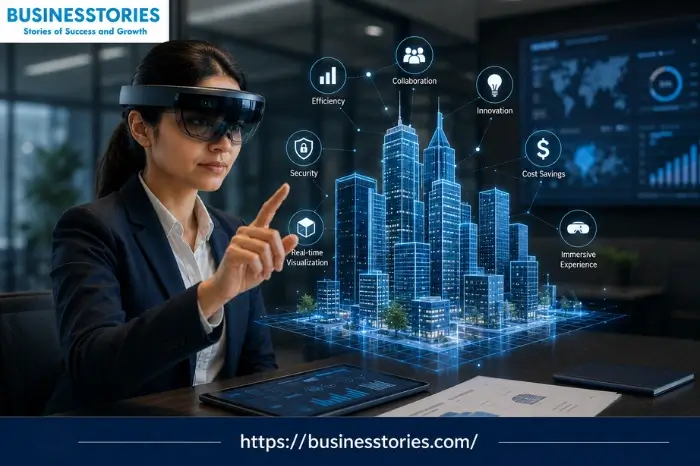
Old software lives on a screen. You look at it. But spatial computing lets you work inside it. It puts digital content into your real space. So instead of just reading data, you can see it, touch it, and act on it.
Here is a simple example. A field worker looks at a broken machine. AR glasses show her the exact part to repair and the steps to follow. She does not need to stop and read a manual. As a result, she works faster and makes fewer mistakes.
This shift matters a lot. It changes how workers obtain data. It also changes how teams work together. And it changes how leaders make calls.
Key spatial computing tools include the following:
- Augmented Reality (AR) — Adds digital content to the real world.
- Virtual Reality (VR) — Creates fully digital spaces.
- Mixed Reality (MR) — Blends digital and real objects.
- Digital Twins — Digital copies of real assets or systems.
- Extended Reality (XR) — A broad term for all of the above.
Moreover, fields like making goods, health care, and retail are already seeing strong results. For example, Deloitte’s Tech Trends 2025 report says spatial computing will reshape how teams work, decide, and grow.
Key Challenges in Spatial Computing Enterprise Adoption
Every new tech brings real hurdles. So let us look at the most common ones. And let us look at how to plan for them.
High Upfront Costs
Cost is often the first worry. AR glasses, VR headsets, sensors, and cloud systems all cost money. Software builds, and staff training add to that bill. For small firms, these costs can feel like a lot.
But the positive news is that prices are falling. Headset prices declined by more than 35% between 2022 and 2025. Furthermore, most AR projects now pay for themselves in just 14 to 18 months. So the return on spending is much easier to prove today.
The key is to start small. A trial project costs far less than a full rollout. It also helps you show real value before you spend more.
Data Privacy and Security Concerns
Spatial tools gather a lot of data. They capture user moves, real spaces, and live actions. Without strong rules in place, the collected data can pose a risk.
So act early. Build a zero-trust model from day one. Set clear rules about what data is captured and who can see it. Also, please engage in open discussions with staff about data use. That openness builds trust and cuts pushback.
Integration with Existing Systems
Most firms already run complex IT systems, ERP, CRM, supply chain tools, and more. Joining spatial tools to those systems is not simple. Data types often do not match. Building the right data links takes time and skill.
Still, this step is key. Spatial tools only reach full power when they connect to real business data. For example, a tech who sees a machine’s full repair history through AR glasses can make much better calls. So invest in this link early. Treat it as a core part of your plan.
Employee Resistance and Change Management
Even the best tech fails if staff do not use it. Many workers feel unsure or nervous about new tools. That response is normal.
But it is also fixable. First, find internal “champions”, people who are eager to try new things. Train them first. Then let them help their teammates. Furthermore, be clear and honest in how you talk about the change. When staff know why it is happening and how it helps them, they are far more likely to try it.
Fragmented Ecosystems and Cross-Platform Issues
The spatial computing world has many rival platforms. Apple ARKit, Google ARCore, Microsoft HoloLens, and Meta Quest all work in different ways. An app built for one will often not run on another.
So choose wisely. Build on open tools like OpenXR and OpenUSD. These let your apps and 3D files work across different systems. As a result, you protect your money and stay flexible as things change.
Real Business Benefits of Spatial Computing Enterprise Solutions
Despite the challenges, the benefits of enterprise spatial computing are clear and growing. So here is what firms are actually seeing on the ground.
Faster, More Accurate Training
Training is one of the best places to start with spatial tools. Firms in making goods, health care, and defense report cutting training time by 20 to 50% when they switch from class-based methods to live digital practice.
PwC research also indicates that VR-trained workers finish tasks up to four times faster than those trained in a class. Plus, error rates drop by 25 to 32% during real task work. That is a huge gain.
One great example is KLM Airlines. Their Engine Shop app overlays repair steps onto a virtual jet engine. Trainees practice real steps while the real plane stays in service. The result? Fewer errors and faster sign-offs.
Higher Productivity and Fewer Errors
AR-guided work gives staff real-time steps right in their line of sight. So instead of stopping to find a manual, they see the next step at once. That alone makes a big difference.
Boeing proved their point with their AR wiring program. They saw a 25% gain in output and a 40% drop in rework. Over time, that added up to more than $40 million in yearly savings. Similarly, inspection teams using AR cut defect rates by up to 40% across many fields.
Remote Work and Teamwork at Scale
Spatial computing breaks down distance as a wall. An expert in one city can guide a tech in another, using live AR notes tied to the exact object on screen. That means far fewer costly expert site trips.
In fact, firms save $3,500 to $8,000 per trip avoided when they use AR remote support tools. Meanwhile, teams can review 3D models together in real time, no matter where they are. So product reviews, design checks, and ops planning all move faster.
Better Decision-Making Through Data Visuals
Spatial computing turns raw data into something you can see and act on. A supply chain boss can walk through a 3D map of a warehouse and spot delays right away. An exec can check a live digital twin of a whole site without going there.
As a result, leaders make faster, better-informed calls. And because the data is visual, more team members can grasp it — not just data teams.
Strong Financial Returns
The ROI data is strong. Across 320 enterprise AR rollouts in 2025, the mean three-year return was 312%. The typical payback for industrial training is just 18 months. So the financial case for spatial computing is no longer just a guess. It is a proven fact.
Best Practices for Successful Spatial Computing Enterprise Deployment
Knowing the benefits is one thing. Getting there needs a clear plan. So here are the steps that lead to real, lasting gains.
Start Small with a Focused Pilot.
Do not try to change everything at once. Instead, pick one high-value process and test it. Good starting points include onboarding, equipment care, or remote expert help.
Run a 60 to 90-day trial with clear, measurable goals. Track the results closely. Then use those results to make the case for a wider rollout. A small, focused start builds trust and avoids big, costly mistakes.
Assess and Upgrade Your Digital Foundation
Spatial tools need strong systems to work well. So before you deploy, check your network, cloud systems, and edge computing setup. Low-lag 5G is key for real-time spatial apps. Without the right base, even the best spatial tools will fall short.
Invest in your team, not just the technology.
Hardware is only part of the picture. Your team needs to know how to use it. So invest in training programs. Create champions who learn first and then help others. Furthermore, use change plans to address fears and questions in an open way.
When workers know why spatial tools are coming and how they help, adoption is far smoother. And smoother adoption means faster ROI.
Prioritize Security and Data Governance from Day One.
Do not add security after the fact. Incorporate it from the beginning. Use zero-trust models. Enforce device rules on every headset. Set clear rules for data capture, storage, and access. Then share those rules with your whole team. Strong rules protect the business and earn staff trust at the same time.
Choose Open Standards to Stay Flexible
Build your spatial stack on open tools. OpenXR makes your apps work across many headsets. OpenUSD lets 3D files move freely between tools. This protects your spend, cuts lock-in risk, and makes it easier to grow over time.
Connect Spatial Data to Your Business Systems
The real power comes when spatial tools talk to your existing systems. Link AR and VR apps to your ERP, CRM, and ops data. When a tech sees a machine’s full history through AR glasses, that is where spatial computing truly shines. So treat data links as a core task, not an add-on.
Industries Leading the Way in Spatial Computing Enterprise Adoption
Some fields are moving faster than others. And their results offer valuable lessons for any firm thinking about adoption.
Manufacturing
Goods makers were early movers in spatial computing. AR-guided assembly tools cut errors and speed up output. Smart tools spot machine failures before they happen. And digital twins let managers test changes in a virtual space before making them for real.
For example, Lockheed Martin’s HoloLens-guided process for F-35 jet parts cut build time per unit by an estimated 30%. That kind of result makes the business case obvious.
Healthcare
In health care, spatial tools are improving both training and patient care. Surgeons use mixed reality to plan and rehearse complex steps on digital patient models. Medical students practice in virtual labs without costly physical setups. Furthermore, AR surgical tools have shown 15 to 20% shorter procedure times and up to 35% fewer issues in peer-reviewed studies.
Retail and E-Commerce
Retailers use AR to let shoppers see products in their homes before buying. Virtual fitting rooms cut return rates. 3D product tools boost online sales. These tools make shopping more fun and give retailers better data on what customers want.
Field Services and Logistics
Field teams also use AR remote assistance to fix problems faster, without waiting for an expert to travel. And logistics firms use spatial maps to improve warehouse layouts and speed up picking tasks. So the savings from each avoided expert visit make the business case compelling.
Conclusion
Spatial computing enterprise adoption is no longer a question of if. It is a question of when and how. The tools are ready. The ROI is proven. And the pressure to move keeps growing every day.
But you do not have to do it all at once. Start with one high-value trial. Build your database with care. Invest in your team. Pick open tools. And measure your results with focus.
The best lesson from leading adopters is clear: spatial computing is not just a tech upgrade. It is a new way of working. It changes how people find data, how teams work together, and how leaders decide. Firms that embrace this shift early will set the pace for the next decade of business.
So take your first step today. Find one workflow in your firm where spatial computing can make a real difference. Then launch your trial and start measuring.
Your next era of work starts with one decision. Make it now.
Frequently Asked Questions
Q1: What industries benefit most from spatial computing enterprise tools?
Making goods, health care, logistics, retail, and field services lead the way. These fields use AR, digital twins, and remote help to cut errors, speed up training, and boost output in clear, proven ways.
Q2: How long does a spatial computing enterprise deployment take?
A focused trial can show results in 60 to 90 days. But full rollouts often take 6 to 18 months, based on your systems and how many use cases you launch.
Q3: Is spatial computing enterprise adoption affordable for SMEs?
Yes, and costs keep falling. Headset prices dropped over 35% from 2022 to 2025. So starting small keeps costs low, and most rollouts pay for themselves within 14 to 18 months through output gains.
Q4: How do enterprises handle data privacy in spatial computing?
First, start with a zero-trust model and enforce device rules from day one. Also, encrypt all data streams. Set clear rules. And tell staff exactly what data is captured and why.
Q5: What is the ROI of enterprise spatial computing investments?
Across 320 enterprise AR rollouts in 2025, the mean three-year ROI was 312%. Also, training programs alone cut training time by 40 to 75% and reduce errors greatly compared to old class-based methods.

Senior Business Analyst / Prduct Owner with 12+ years of experience driving data-driven insights, optimizing business processes, and delivering strategic IT solutions.