Every year, the world makes over 400 million tonnes of plastic. Most of it comes from crude oil. Furthermore, most of it never breaks down. So, it piles up in landfills, drifts into the sea, and breaks into tiny bits called microplastics. These bits get into the food chain and cause real harm. For decades, experts looked for a better way. Then, in a quiet part of Perth, Australia, two founders found one, right under the waves. The ULUU startup story is about turning seaweed into plastic that is beneficial for the climate, too.
It is a story of science, clear goals, and big dreams. It also indicates that one of our worst problems has been growing in the ocean all along. So, let us look at how ULUU started, how it works, and why so many people now care about it.
The ULUU Startup Story: How It All Began
Every successful startup starts with a persistent problem. For ULUU co-founder Dr. Julia Reisser, that problem was deeply personal.
For example, as a marine scientist in Brazil, Julia watched sea turtles eat more plastic than food. That image stayed with her for years. Later, she did a PhD on ocean plastics. She also helped create the first map of microplastics in Australian waters. Then she joined The Ocean Cleanup, a Dutch group that pulls plastic from the sea. But even with all that beneficial work, Julia knew she was treating a symptom. She was not fixing the root cause.
She puts it clearly: “I realized that until we have a suitable alternative to plastic, the problem is just going to keep getting worse.”
Goal of the ULUU program
So she began thinking about a bold new idea. Instead of cleaning up plastic after the harm is done, why not swap out the material itself? She looked at the market and found a clear gap. Unlike clean energy, there were no real options to replace fossil-fuel plastic. That gap sparked the idea for ULUU.
So, in 2020, Julia teamed up with Michael Kingsbury. Michael was a former business lawyer who also loved the ocean. Together, they shaped her idea into a clear business plan. Both Michael and the author felt ready to dedicate their lives to the business. So, they started ULUU in 2021, based in Perth, Western Australia.
Their goal was simple but bold. They wanted to create a seaweed-based material that works like plastic, fits on current factory machines, and leaves no toxic trace. In short, they wanted a plug-and-play fix for the plastics world and one that helps the planet too.
The name “Uluu” (say it oo-loo) comes from their deep love of nature and the sea. The team set up their first lab at the Indian Ocean Marine Research Centre in Perth. They also worked closely with experts from the University of Western Australia and CSIRO.
How ULUU Turns Seaweed Into Plastic: The Science Made Simple
At its core, ULUU’s process is easy to follow. In fact, it works a lot like brewing beer.
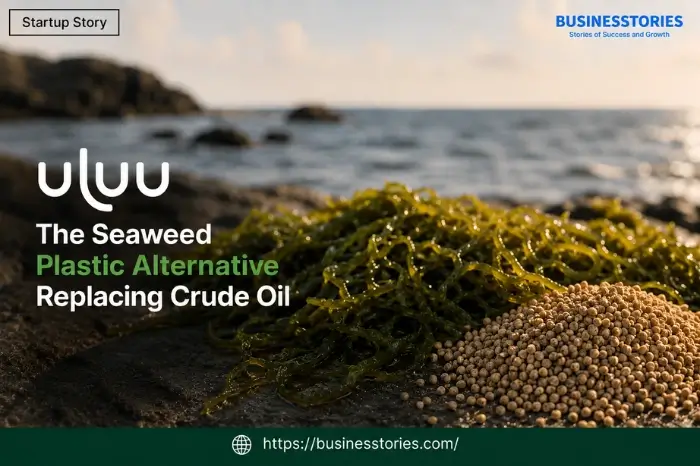
First, the team grows seaweed on farms. Then they feed it to tiny microbes through a fermentation process. These microbes eat the sugars in the seaweed. As a result, they make natural materials called polyhydroxyalkanoates, or just PHAs. Next, ULUU gathers these PHAs and forms them into small pellets. So, factories can use these pellets just like they use normal plastic pellets today.
PHAs are natural polymers. In fact, microbes make them as a way to store energy. Experts have known about PHAs for many years. However, making them cheaply and in large amounts has always been challenging. Most methods rely on corn or sugarcane. Those crops need farmland and fresh water, which causes new problems while solving old ones.
ULUU’s key move is using seaweed as its main input. Here is why it matters so much:
- Seaweed grows fast—some types grow up to a meter per day.
- It needs no fresh water, no fertilizer, and no farmland at all.
- It pulls CO₂ from the ocean and cleans up other waste, too.
- Coastal towns, especially in places like Indonesia, can grow it with ease.
By using seawater instead of fresh water, ULUU also cuts out harmful chemicals. Also, seawater keeps the process clean on its own. As a result, both costs and environmental impact decrease simultaneously.
The end product is strong, light, safe in water, and non-toxic. Better still, ULUU’s plastic is reusable, recyclable, and safe in the ocean. It breaks down in a home compost bin and leaves no microplastics behind. Best of all, it works on current factory machines, so firms need no new gear to make the switch.
This plug-and-play trait is one of ULUU’s biggest edges. Many green options fail because they need brand-new equipment. ULUU skips that problem fully, and that is a huge deal for buyers.
ULUU’s Climate Impact: The Carbon Numbers That Matter
Many startups make bold climate claims. ULUU, however, backs its claims with hard data, and the numbers are truly striking.
At full scale, ULUU’s process locks away up to 5 kg of CO₂ for every 1 kg of plastic it makes. By contrast, normal plastic puts out around 3 kg of CO₂ per kilogram. So, think about that. Regular plastic adds carbon to the air. ULUU’s plastic takes carbon out. That is a full flip in impact.
At scale, the tech could cut global CO₂ output by more than 2 gigatonnes per year. To put that simply, 2 gigatonnes is close to the total yearly carbon output of several large nations combined. That is a huge potential win for the planet.
Meanwhile, plastic takes between 20 and 500 years to break down. It also drives 3.4% of global carbon output today. On top of that, plastic output is set to triple by 2060. So, the problem is clearly growing fast. ULUU is going right at this trend.
The climate story gets even better when you look at seaweed farming itself. ULUU’s seaweed farms take in more carbon than they put out. They also clean waste from the water near them. Therefore, the entire supply chain, from the farm to the final product, operates in a carbon-positive manner. That is rare and truly worth noting.
This puts ULUU in a rare class of firms. These founders are not just cutting harm. They are actively reversing the situation. For firms trying to hit Scope 3 carbon goals, that gap is enormous.
Funding, Investors, and Awards: ULUU’s Rise to Global Attention
Great science needs outstanding backing. Fortunately, ULUU has drawn some truly special supporters along the way.
In 2022, Main Sequence led an $8 million funding round for ULUU. Surprisingly, the round also brought in supermodel Karlie Kloss and musician Kevin Parker of Tame Impala. Glastonbury Festival director Melvin Benn also joined in. These were not just money sources. They were real fans of ULUU’s mission and vision.
Then, in October 2025, ULUU made a major leap. The startup raised AU$16 million in Series A funding. German investor Burda Principal Investments led this round. Main Sequence, Novel Investments, Startmate, Fairground, and Trinity Ventures also joined the team.
Karlie Kloss, who also joined the Series A, says it well: “ULUU is tackling one of the greatest challenges of our time, plastic pollution, with a natural, scalable answer.” “I wanted to be part of a positive change that showed sustainability can be beautiful.”
Beyond funding, ULUU has also won big awards. In 2025, it took home the SXSW Innovation Award in Austin, Texas, one of the top tech prizes in the world. Also, the Australian Government gave ULUU AU$2.1 million through its Industry Growth Program. That grant helped lift output from 100 kg per year to 1 tonne per year.
Also, ULUU’s team grew from 13 to 23 people in 2025 alone. That kind of rapid growth shows clear momentum. Clearly, this firm is picking up speed in a big way.
Real-World Products and Brand Partnerships
Tech only counts when real people use it. Therefore, let us look at how ULUU’s plastic is already reaching everyday buyers.
The firm runs a pilot plant that makes 100 kg of plastic per year. Despite its small output, ULUU has already produced tangible products for well-known brands. Quiksilver, the global surf brand, used ULUU to make a surfboard wax scraper. PAPINELLE, an Australian luxury pyjama brand, used ULUU for buttons on its sleepwear. Both items now sit in real buyers’ hands.
These early wins may seem small at first. However, they prove something very key. Big brands trust ULUU enough to put its plastic in items that reach daily shoppers. That kind of trust is difficult to earn, and ULUU has earned it well.
Moreover, ULUU now works with partners in beauty, fashion, and the car world. Audi has notably collaborated with ULUU on a public campaign. Cars use huge amounts of plastic in dashboards, panels, and trim. So, if ULUU can supply Audi, it is clearly ready for large-scale use.
Looking ahead, ULUU plans to build a plant that can make 10 tonnes of plastic per year. Also, it aims to have a full commercial plant by 2028 that turns out thousands of tons each year. Also, ULUU has set up SeaSae, a new arm based in Indonesia. SeaSae works with local farm groups to grow seaweed fairly and clearly. So, the supply chain helps local people as much as it helps the planet.
What Makes ULUU Different From Other Bioplastics
The bioplastics market already exists. So, why does ULUU stand out from the rest? The answer lies in three distinct areas: its performance, its source, and its disposal.
Most bioplastics today use PLA, or polylactic acid. PLA comes from corn or sugarcane. However, it has fragile points. It melts in water. It only breaks down fully in large compost plants. Also, it competes with food crops for land and water. As a result, many brands feel disappointed and abandon PLA.
ULUU’s PHA plastic works in a very different way. It is tough and safe in water, just like normal plastic. Yet it breaks down in a home compost bin or even in the ocean. Best of all, it leaves zero microplastics behind. This mix of toughness and true breakdown is very difficult to find. Very few plastics in the world can do both things at once.
Then there is the supply side. Seaweed needs no land, no fresh water, and no added inputs. It grows in the sea. Coastal groups all over the world can farm it with ease. Initially, Indonesia will be ULUU’s top source. Many seaweed farmers are women, so this initiative also creates steady pay for those who need it most.
Finally, ULUU works with current factory machines. Brands do not need to rebuild their plants to switch over. This eliminates the primary obstacle to adopting environmentally friendly practices. As a result, the path to scale is much faster for ULUU than for nearly any other green plastic on the market today.
Conclusion: Why the ULUU Startup Story Matters for All of Us
The ULUU startup story is more than a science win. It shows that driven founders, with a clear goal and the right technology, can take on huge global problems and truly fix them.
From heartbreak watching sea turtles eat plastic to a global deal with Audi and an AU$16 million raise, ULUU has moved very far, very fast. More importantly, it has done so with care and truth. Its plastic truly delivers on every green promise it makes.
The key facts are self-evident. ULUU’s seaweed plastic locks away up to 5 kg of CO₂ per kg made. It breaks down safely in the sea. It works on machines already in use at plants around the world. And at full scale, it could cut global CO₂ by more than 2 gigatonnes each year.
So, plastic pollution is not a done deal. ULUU proves that a natural, scalable, and ready-to-ship answer exists right now. Also, as brands from surf gear to luxury fashion to car makers start using these products, the big shift gets closer every day.
Here is what you can do right now. As a buyer, look for brands that use ULUU plastic and choose to back them. As a business leader, ask how seaweed-based plastic can replace oil-based plastic in your goods. And as an investor or founder, watch the ocean biotech space closely. ULUU is just the start.
So, the ocean has always held plastic’s greatest rival. It turns out the answer was growing right there all along.

Tabassum Shaik is an Author, Researcher, and SEO Specialist with over 8 years of experience creating informative content on business, startups, entrepreneurship, marketing, technology, and digital trends. She specializes in researching industry trends and transforming complex topics into practical, easy-to-understand insights. Her goal is to help readers stay informed, learn new ideas, and make better business decisions.