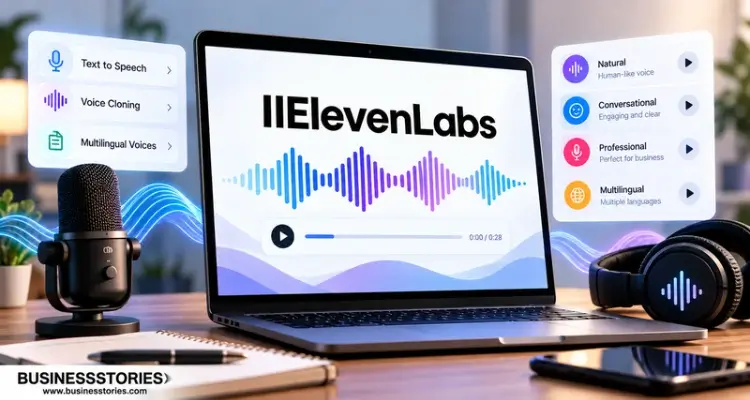
You type a few lines of text. Then, seconds later, a warm human voice reads them back to you. That is the magic that made Eleven Labs AI one of the most talked-about tools on the internet.
However, the magic comes with fine print. First, credits run out fast. Furthermore, the free plan has limits you might not expect. Moreover, voice cloning has rules that can get you into trouble if you skip them.
So before you sign up, it pays to know how the tool really works. In this listicle, we cover the seven things every new user should know. You will learn what Eleven Labs does, how the pricing works, and how to stay safe and legal. As a result, you can pick the right plan and avoid costly mistakes.
What Is Eleven Labs AI, Really?
#1: Eleven Labs Is Much More Than a Text-to-Speech Tool
Most people meet Eleven Labs as an AI voice generator. You paste in text, pick a voice, and download an audio file. Even so, that is still the core of the product. That first trick, however, is just a small part of how much the company has grown.
Two friends, Mati Staniszewski and Piotr Dąbkowski, started Eleven Labs in 2022. Today, the London-based firm builds tools for speech-to-text, sound effects, dubbing, music, and AI voice agents. In fact, its pricing page now lists text-to-speech, voice design, music, image, and video tools under one account.
The business side is just as striking
In February 2026, Eleven Labs raised $500 million at an $11 billion valuation in a round led by Sequoia Capital. Meanwhile, research firm Sacra estimates the company hit $500 million in yearly recurring revenue by April 2026. Sacra also reports that 41% of Fortune 500 firms use the platform.
Plus, big brands are using it for real work. For example, Revolut rolled out Eleven Labs voice agents for customer support across the UK and Europe. As a result, it took about eight times less time to fix customer issues.
Why does this matter to you? Simply put, it tells you two things.
- First, the tool is not a weekend side project that may vanish next month.
- Second, the product changes fast. For instance, a newer model called Eleven v4 was just announced as the most emotive model so far.
Here is our unique tip: do not judge Eleven Labs by an old YouTube review. Features, prices, and model names shift every few months. Therefore, always check the live pricing page and the model list before you plan a big project. A tutorial from last year may show menus that no longer exist.
Quick action step: Sign up for the free plan first. Then, click through every tab once. That way, you will see the full toolkit before you pay for anything.
How Eleven Labs AI Pricing and Licensing Work
#2: You Pay in Credits, Not Minutes
At first, the pricing structure is the part that confuses most new users. Eleven Labs does not sell you minutes of audio. Instead, it sells you credits. For the standard models, one text character usually costs one credit. Even spaces and commas count.
Here is how the main plans look on the official pricing page as of October 2026:
| Plan | Monthly Price | Credits per Month | Rough TTS Minutes |
| Free | $0 | 10,000 | ~10 |
| Starter | $6 | 30,000 | ~30 |
| Creator | $22 | 121,000 | ~121 |
| Pro | $99 | 600,000 | ~600 |
| Scale | $299 | 1.8 million | ~1,800 |
| Business | $990 | 6 million | ~6,000 |
Furthermore, note that faster models like Flash cost about half a credit per character. So your choice of model changes your real budget.
Most guides overlook this important insight: The credit count shows your raw output, not your finished output. In practice, achieving a flawless take on the first attempt is uncommon. You might regenerate a line three times to fix a pause or a name.
Therefore, plan for about 1.5 times the credits your script needs. If your script is 60,000 characters, budget for 90,000 credits. This simple rule saves you from a mid-project upgrade.
Also, paid plans let unused credits roll over for up to two months. So, make sure to time your big projects so you can use those saved credits before they expire.
#3: The Free Plan Does Not Give You Commercial Rights
This is a common surprise for many creators. The free plan is ideal for testing. However, it does not include a commercial license. That means you should not use free-plan audio in monetized YouTube videos, paid ads, or client work.
You need at least the Starter plan to get commercial rights. In addition, Starter unlocks instant voice cloning and the dubbing studio.
Action steps before you publish:
- Check which plan you were on when you made the audio.
- If you were on the free plan, consider upgrading and generating the audio again.
- Keep a simple log of the plan, date, and voice used for each project.
That log takes two minutes. Yet it can save you a big headache if a client or platform asks for proof later.
Voice Cloning: Power, Rules, and Safety
#4: There Are Two Entirely Unique Kinds of Voice Cloning
Eleven Labs offers two ways to clone a voice. They sound alike, but they work very differently.
Instant Voice Cloning needs only a short audio sample. Better yet, it is quick and comes with the Starter plan. However, the result can sound a bit off in long passages or with odd words.
Professional voice cloning needs much cleaner audio. Furthermore, it takes longer to train. Still, it gives you a far more natural copy of the voice. It starts with the Creator plan.
So which one should you pick? If you want a quick demo or a fun test, go instant. On the other hand, if you plan to narrate a course or an audiobook in your own voice, go professional.
Tips for a better clone:
- Record in a quiet room with soft furnishings.
- Use one microphone and keep the same distance from it.
- Speak in the tone you want the clone to copy.
- Cut out coughs, music, and long silences.
#5: You Can Only Clone Voices You Have the Right to Use
Eleven Labs learned this lesson the hard way. In early 2023, users on 4chan used its beta tool to make fake clips of celebrities saying hateful things. As a result, the company quickly added new safeguards.
Today, Eleven Labs blocks the cloning of celebrity and other high-risk voices. Moreover, it requires technical voice checks before you can use professional voice cloning.
It also offers a free AI Speech Classifier, so anyone can test whether a clip came from its tools. In addition, the company says it can trace generated audio back to the account that made it.
Our unique perspective: the platform’s rules are only the first gate. Local laws also apply, and they are getting stricter. So even if the tool lets you clone a voice, you still need clear, written consent from that person.
Simple consent checklist:
- Get written permission from the voice owner.
- State exactly where the voice will be used.
- Tell your audience when a voice is AI-made, where it matters.
- Never use a cloned voice to trick or impersonate anyone.
Language Support and Real-World Voice Quality
#6: It Speaks Many Languages, but Quality Can Vary
Eleven Labs is known for its multilingual text-to-speech. The official pricing page lists 74 languages for its Eleven v3 model. Clearly, that is a huge range for creators who want to reach a global audience.
Overall, real users are often impressed. For example, one G2 reviewer said the tool handles Persian better than other AI tools they tried. Meanwhile, another reviewer noted some trouble with Italian. In other words, quality is strong overall, but it is not the same in every language.
So what does this finding mean for you? Simply put, do not assume every language sounds as good as English. After all, accents, names, and local slang can trip up any AI model.
For example, a brand name or a city like Leicester may come out wrong. Similarly, a long string of numbers can sound rushed. Fortunately, small changes to your script can often fix these issues.
Here is a fresh way to test it. Most people test the tool with a simple, friendly paragraph. Instead, test it with your hardest lines first. Use brand names, numbers, dates, and tricky local words. If the tool handles those well, the rest of your script will likely be fine. This “worst-case first” test saves credits and time.
Quick steps to improve output:
- Spell out numbers and short forms in the way you want them read.
- Add commas or line breaks where you want a pause.
- Try a few voices before you commit to one.
- Tweak the stability and similarity settings, then compare short samples.
Furthermore, keep in mind that ElevenLabs makes only voice. It does not make the video. So, if you need a talking avatar, you will likely pair it with another tool.
The Voice Library and Earning Opportunities
#7: Eleven Labs Has a Voice Marketplace Where Creators Get Paid
Here is something many users never discover. Eleven Labs runs a Voice Library, which works like a giant casting room. Real people upload their professional voice clones. Then, other users can pick those voices for their projects.
When someone uses your shared voice, you earn money. Voice creators have now made more than $22 million through this program, according to Eleven Labs. That is up from $11 million in November 2025. Furthermore, the library covers voices in 32 languages and dozens of accents.
For users, the big plus is licensing. Every voice in the library comes with a free commercial-use license for the customer using it. As a result, you can skip booking studio time or haggling over voice-actor fees.
The setup is straightforward for creators.
- First, you build a professional voice clone.
- Next, you share it in the library.
- After a short safety review, your voice goes live.
- Payouts are based on use by paid users, and they arrive through Stripe.
Our unique tip for users: treat a library voice like a brand asset. If your podcast or channel relies on one voice, note its exact name and ID. Furthermore, check the creator’s notice period. That tells you how long you keep access if the creator removes the voice. Otherwise, you could lose the “sound” of your brand overnight.
Our tip for voice creators: niche voices tend to win. A calm, clear narrator voice in an underserved accent may earn more than another generic deep voice.
Furthermore, keep your hopes realistic. After all, payouts depend on how often people pick your voice. So, add clear tags and a strong preview clip. That way, more users can find you in search. In short, quality and reach matter more than volume.
Conclusion: Use Eleven Labs AI With Your Eyes Open
Eleven Labs AI is one of the most powerful voice tools you can use today. It can narrate your videos, dub your content, clone your voice, and even power customer service agents. However, it works best when you understand the rules first.
Let us recap the seven key points.
- First, Eleven Labs is now a full audio platform, not just a text-to-speech app.
- Second, you pay in credits, so be sure to budget extra for retakes.
- Third, the free plan has no commercial rights, so upgrade before you publish for profit.
- Fourth, instant and professional voice cloning serve very different needs.
- Fifth, you must have clear consent before you clone any voice.
- Sixth, language quality is strong but varies, so test your hardest lines first.
- Finally, the Voice Library provides both ready-to-use voices and an opportunity to earn money.
The main message is simple. Eleven Labs can save you hours of recording time and thousands in voice-actor fees. Yet a few smart habits make all the difference. Track your plan, protect your rights, and respect other people’s voices.
Ready to try it? Start with the free plan today. Then, run one short, real project from start to finish. Once you see your actual credit use, choose the paid plan that fits. That way, you pay only for what you truly need.
Frequently Asked Questions
1. Is Eleven Labs AI free to use for my YouTube videos and podcasts?
The free plan gives 10,000 monthly credits for testing. However, it has no commercial license. For monetized YouTube videos or podcasts, you need the Starter plan or higher to use the audio legally.
2. How many minutes of audio do Eleven Labs credits actually give you?
On standard models, one character costs about one credit. So, 1,000 credits give roughly one minute of speech. Faster Flash models cost about half a credit per character, which stretches your budget further.
3. Can I legally clone someone else’s voice using the Eleven Labs AI app?
Only with that person’s clear consent. Eleven Labs blocks celebrity and high-risk voices and verifies professional clones. In addition, local laws apply, so always get written permission before cloning another person’s voice.
4. What is the difference between instant and professional voice cloning?
Instant cloning uses a short sample and comes with the Starter plan. Professional cloning needs cleaner audio and starts with Creator. As a result, it sounds far more natural for long narration.
5. How can voice actors earn money from the Eleven Labs Voice Library?
Voice actors upload a professional voice clone and share it in the Voice Library. After a safety review, they earn each time paid users generate audio with it. Payouts arrive automatically through Stripe.

Tabassum Shaik is an Author, Researcher, and SEO Specialist with over 8 years of experience creating informative content on business, startups, entrepreneurship, marketing, technology, and digital trends. She specializes in researching industry trends and transforming complex topics into practical, easy-to-understand insights. Her goal is to help readers stay informed, learn new ideas, and make better business decisions.