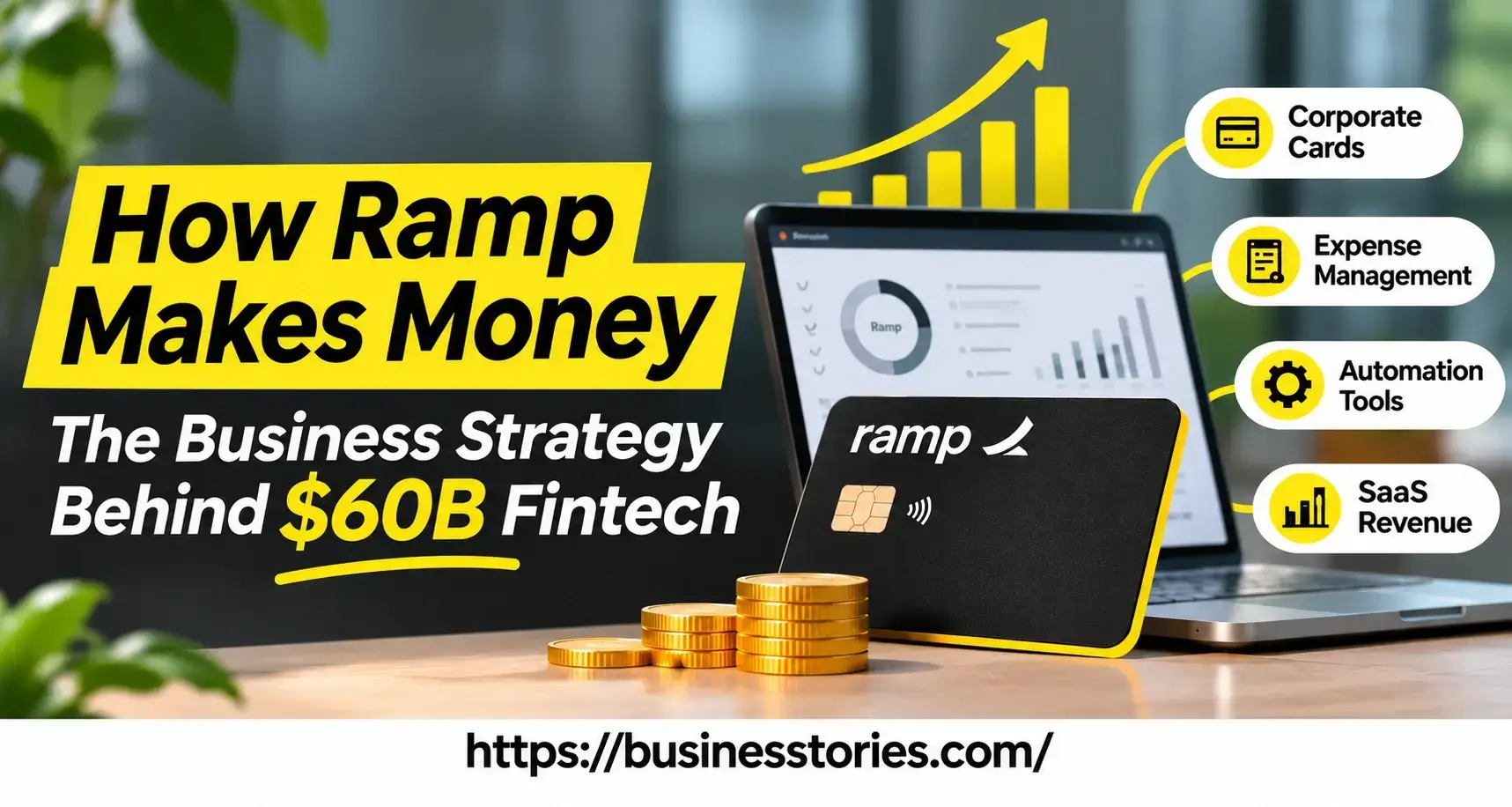
Ramp gives away its main product for free. Yet in October 2026, investors valued the company at $60 billion. So what is really going on behind the scenes? That puzzle is precisely why so many founders and investors want to know how Ramp makes money.
In this listicle, we simplify everything for you.
- First, you will see who Ramp is and how fast it has grown.
- Next, we walk through each of its revenue streams, one by one.
- Thereafter, we look at the free card strategy, the role of AI, and the real risks ahead.
- Finally, you will get simple lessons you can use in your own business.
Let’s dig in.
What Is Ramp? A Quick Look at the $60B Fintech
Ramp is a finance platform for US businesses. In simple terms, it helps companies track and control how they spend money. It started in 2019 with a corporate card. Today, however, it also offers bill pay, expense reports, procurement, travel booking, and a business cash account.
Eric Glyman, Karim Atiyeh, and Gene Lee founded the company. Before Ramp, Glyman and Atiyeh built Paribus, a savings app that Capital One later bought. That history matters. In fact, the whole Ramp idea grew from one simple belief: a card company should help you spend less, not more.
Ramp’s Growth in Numbers
The growth has been rapid. To start, Ramp hit $1 billion in annualized revenue in August 2025. Then, by October 2026, it passed $2 billion. Over the same stretch, its customer base grew to more than 85,000 businesses.
Meanwhile, the valuation climbed even faster:
| Date | Funding Round | Valuation |
| November 2025 | $300M primary round | $32 billion |
| June 2026 | $750M Series F | $44 billion |
| October 2026 | $1.85B round led by Dragoneer | $60 billion |
In total, Ramp has now raised about $5 billion. On top of that, the company said it had positive free cash flow by June 2026. That is rare for a startup growing at such a rapid pace. As a result, investors see Ramp as more than a hype story.
Who Uses Ramp?
Ramp serves everyone from small startups to big brands. For example, it lists Shopify, Figma, Notion, and Cursor as customers. Better still, more than 3,200 customers each bring Ramp at least $100,000 a year.
Here is a detail most articles miss. Many of Ramp’s best customers are fast-growing tech and AI firms. These companies spend heavily on software, cloud tools, and travel.
Because of these factors, a large share of their spending naturally flows through a card. In other words, Ramp picked a customer group whose costs fit its revenue model almost perfectly.
How Ramp Makes Money: 5 Core Revenue Streams
Thus, how does Ramp turn a free product into $2 billion a year? The answer is a mix of payment fees and software fees. Let’s look at each Ramp revenue stream in turn.
1. Interchange Fees on Every Card Swipe
This is the big one. Every time a business pays with a Ramp card, the seller pays a small fee. People call the fee an interchange fee. Ramp’s own help page explains that it keeps a share of this fee.
Notably, Ramp is a charge card, not a credit card. Customers pay their balance in full. So Ramp does not earn interest on unpaid debt. Instead, it earns from volume.
The more a business spends through Ramp, the more Ramp earns. At the same time, Ramp shares part of this fee back with customers as cashback. In its early days, Ramp offered 1.5% back on purchases.
2. Ramp Plus Subscriptions
Next comes software revenue. The basic plan costs $0. However, Ramp Plus costs $15 per user each month. Larger firms pay a custom price for Enterprise. On top of that, Ramp sells extras, such as procurement as an add-on. It even charges $0.65 for each federal 1099 tax form it files.
3. Treasury Spread on Business Cash
In January 2025, Ramp launched Ramp Treasury. With it, firms can park cash in a business account that earned 2.5% at launch. Meanwhile, Ramp earns a spread from its partner banks on those balances. Put simply, idle cash now makes money for both sides.
4. Bill Pay, Foreign Exchange, and Fast Payments
Ramp also earns fees on bill payments. Additionally, Ramp generates revenue from foreign exchange transactions when companies transfer money internationally. Same-day payments can also carry a fee.
5. Travel Booking Fees
Finally, Ramp has a travel tool. When a team books a flight or hotel through it, Ramp earns an affiliate fee.
| Revenue Stream | Who Pays | How It Works |
| Interchange fees | Merchants | A share of each card swipe |
| Ramp Plus | Customers | $15 per user each month |
| Treasury | Partner banks | A spread on stored cash |
| Payments and FX | Customers | Fees on bills and transfers |
| Travel | Travel partners | Fees on bookings |
The Free Card Strategy: Why Giving It Away Pays Off
At first, a free corporate card sounds like a losing bet. Yet it is the heart of the Ramp business model. Here is why it works.
Land with the Card, Then Expand
The free card gets a business in the door. Thereafter, Ramp offers bill pay, then treasury, then procurement. Each new tool adds a new way to earn. Indeed, Ramp says most of its customers now use two or more products.
This land-and-expand approach keeps the cost of winning a customer low. Over time, each customer becomes worth much more.
Solving the Savings Paradox
Now, here is the clever part. Ramp earns money when customers spend. Yet it promises to help them spend less. In fact, CEO Eric Glyman claims that firms switching to Ramp spend 5% less and grow 12% faster. So how can both be true?
The answer is the share of the wallet. Picture a company that spends $1 million a year. Before Ramp, maybe only 30% of that went on one card. The rest went through bank transfers, checks, and other cards.
After the switch, Ramp may handle 80% or more. As a result, total spending drops a little, but Ramp’s slice grows considerably. In short, Ramp wins by becoming the one place where money moves.
High Switching Costs Keep Customers Loyal
Once Ramp links to a firm’s accounting software, it becomes increasingly difficult to leave. Rules, approvals, and records all live inside it. As a result, customers tend to stay for years.
Think about it this way. A finance team that spent months setting up its rules will not rip them out to save a few dollars. So every new feature Ramp adds makes the platform a little stickier. Over time, that loyalty turns into steady, predictable revenue.
Try these strategies in your own business:
- Find the one tool your customer uses most often.
- Make that tool free and truly excellent.
- Then, charge for the extras that save real time or money.
How AI Turned Ramp Into a Finance Operating System
Today, AI sits at the center of Ramp’s growth strategy. Rather than adding a chatbot, Ramp built AI agents that do real finance work.
AI Agents That Catch Wasted Spend
Ramp’s agents check receipts, apply spending rules, and flag strange bills. For instance, in October 2025 alone, the system made more than 26 million decisions across over $10 billion in spending.
Along the way, it stopped over 511,000 out-of-policy purchases worth nearly $291 million. It even blocked a $49,000 fake invoice made with AI. Better yet, the results show up for customers.
By May 2026, the median Ramp customer had saved 50% more money and 32% more hours than a year before.
Payments Made by AI Agents
Ramp has also deepened its work with Visa. Together, they let AI agents make company payments with live controls. Ramp even offers a card built for AI agents to use. In addition, it sells tools to track how much a company spends on AI.
Imagine an AI tool that independently purchases cloud credits, for instance. Ramp’s card lets it pay right away. Meanwhile, the finance team still sets the limits and sees every charge. As a result, companies get speed without losing control.
Why AI Matters for How Ramp Earns Money
Here is the angle few people talk about. AI tools are now one of the fastest-growing costs for modern firms. Ramp sells tools to control that spending. Yet when those AI bills run through a Ramp card, Ramp also earns a swipe fee. So AI growth feeds Ramp from two sides.
On top of that, AI cuts Ramp’s own costs. Its internal tool, called Inspect, now writes more than two-thirds of Ramp’s code. Consequently, Ramp can serve more customers without hiring at the same pace. For a company valued at roughly 30 times its revenue, that boost to profit matters a lot.
Risks and Lessons From the Ramp Business Model
No business model is perfect. So before you copy Ramp, it helps to see where it could stumble.
The Key Risks Ahead
- A high price tag. At $60 billion, Ramp trades at roughly 30 times its yearly revenue run rate. That figure could appear excessive if growth slows.
- Tough rivals. Rippling has expanded its services to include cards, expense management, and bill payment. As a result, the two now compete head-to-head.
- Fee rules. US lawmakers have long debated limits on card swipe fees. Any cap would hit Ramp’s biggest income source.
- Spending cycles. When the economy slows, firms spend less. Lower spending means fewer swipe fees.
- Interest rates. Lower rates shrink the Treasury spread that Ramp earns on stored cash.
That said, Ramp has a real cushion. It already has a positive free cash flow. Plus, most customers use more than one product. Therefore, a decline in one revenue stream would not jeopardize the entire business. In fact, this spread of income is one of the smartest parts of the Ramp revenue model.
Lessons You Can Apply Today
Even so, Ramp’s playbook holds clear lessons for any founder. Here are five steps you can use right away:
- Charge for the flow, not the tool. Give away the software, then earn from the activity it creates.
- Tie your promise to customer results. Ramp sells savings. As a result, Ramp’s success increases in tandem with your own.
- Build your second product early. Do not wait until growth stalls to add new revenue. Ramp, for instance, added bill pay and treasury while its card was still growing fast.
- Use AI to lower your cost to serve. Better margins buy you time and freedom.
- Track share of wallet, not just sign-ups. In the end, how much a customer runs through you matters more than how many customers you have.
Conclusion
So, how Ramp makes money comes down to one smart idea. It gives away a fantastic corporate card and then earns on everything that flows through it. First, interchange fees bring in most of the revenue. Then, Ramp Plus, treasury balances, bill pay, foreign exchange, and travel bookings add more layers.
What makes the model special is the alignment. Ramp helps businesses spend less yet still grow because it captures a bigger share of their total spending. On top of that, AI agents now save customers time, catch wasted money, and cut Ramp’s own costs.
As a result, the company passed $2 billion in annualized revenue and reached a $60 billion valuation in October 2026. Still, the road ahead is not risk-free. Tough rivals, possible fee rules, and a high valuation all add pressure.
Even so, Ramp’s playbook offers clear lessons for founders everywhere. In particular, make your core tool free, charge for the activity it creates, and keep adding products that customers truly value.
Ready to put these ideas to work? Consider revisiting your business model today. Ask yourself where you could give more value away and earn from the flow instead. Then, explore more startup stories and founder playbooks on Businessstories.com.
FAQs About How Ramp Makes Money
1. Does Ramp charge businesses any monthly fees for its corporate card?
No, the Ramp corporate card and basic plan are free. However, businesses that want advanced spend management features can upgrade to Ramp Plus for $15 per user each month, while large firms pay custom Enterprise prices.
2. How Ramp makes money if its main corporate card is free to use?
Ramp earns most of its revenue from interchange fees that merchants pay on each card swipe. In addition, it makes money from Ramp Plus subscriptions, treasury balances, bill pay fees, foreign exchange, and travel booking fees.
3. What is Ramp’s current valuation and annualized revenue in late 2026?
In October 2026, Ramp raised $1.85 billion at a $60 billion valuation. At the same time, the company said its annualized revenue had passed $2 billion, with more than 85,000 businesses using its platform.
4. How does Ramp Treasury help the company earn more from business cash?
Ramp Treasury lets firms store operating cash in a business account that earned 2.5% at launch. Meanwhile, Ramp earns a spread from its partner banks on those balances, which adds steady revenue beyond card swipes.
5. Who are Ramp’s biggest competitors in the spend management market?
Ramp competes with Rippling, Brex, Navan, Bill, and American Express in corporate cards and spend management. Lately, Rippling has become its closest rival as it pushes into cards, expense tools, and bill payments.

Senior Business Analyst / Prduct Owner with 12+ years of experience driving data-driven insights, optimizing business processes, and delivering strategic IT solutions.