
Introduction
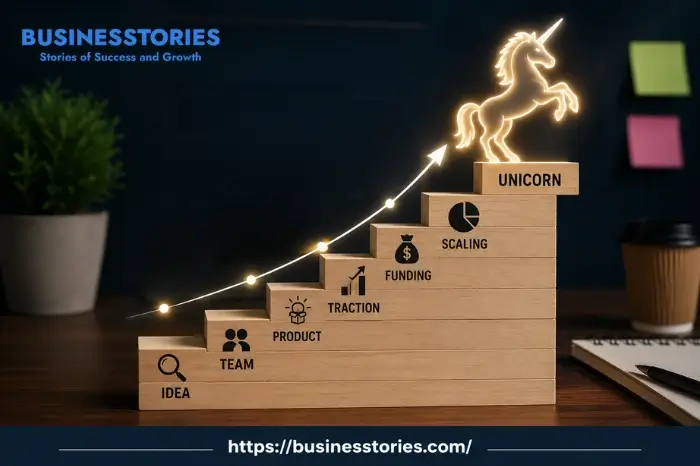
Many founders wonder how startups become unicorns as they pursue their ambitious dreams. A unicorn startup is a private company valued at $1 billion or more. However, the path is not magic. It is a mix of timing, product fit, smart execution, funding, and scale.
This article explains the full journey in simple steps. It also shows what matters most at each stage, from idea to scale. As a result, founders can focus on the right goals and avoid common mistakes.
1. Start With a Problem Worth Solving

Every unicorn begins with a painful, common problem. First, founders look for a gap in the market. Then they test whether people care enough to pay for a fix.
Airbnb, for example, started by solving a simple problem: finding affordable stays during crowded events. Because the pain was real, demand grew fast. In the same way, strong startups often win by making life easier, cheaper, or faster.
Unique insight: the best problems are not always the biggest. Instead, they are the ones where users feel the pain often and strongly.
2. Build a Product People Truly Want
Next comes product-market fit. This means the product solves the problem so well that users come back on their own. At this stage, growth feels easier because the product itself pulls people in.
To reach this point, teams should talk to users, test fast, and improve based on feedback. For example, Dropbox used a simple demo video early on. That helped the company prove demand before it scaled.
Unique insight: do not chase features too early. Instead, refine the core use case until users would feel pain if the product disappeared.
3. Find Early Traction and Proof of Demand
After the product works, startups need proof. This usually means early users, repeat use, and positive word of mouth. Therefore, traction becomes the bridge between product fit and real scale.
Founders can use waitlists, pilot users, referrals, and small paid tests. In addition, they should watch simple numbers like retention, activation, and conversion. These metrics show if growth is healthy.
Unique insight: traction is not just about signups. It is about habits. If users continue to return, the startup may be close to a bigger breakout.
4. Raise Capital at the Right Time
Most unicorns raise money to grow faster. However, funding works best when it follows traction, not hope. Investors want signs that the startup can use capital wisely.
According to many venture reports, companies that raise strong early rounds often use the money to hire talent, improve product, and enter new markets. Still, the best founders avoid overfunding too soon.
Unique insight: a startup should raise capital when it has a clear plan for each dollar. That discipline often matters more than the size of the round.
5. Scale Smartly Across Channels and Markets
Once demand is proven, the startup must scale. This may include paid ads, sales teams, partnerships, or new regions. However, growth should stay efficient.
Companies like Uber and Zoom grew by repeating a model that worked. They expanded step by step and kept improving the user experience. In addition, they built systems that could handle more users without breaking.
Unique insight: scaling is not only about more users. It is also about better systems, lower churn, and stronger unit economics.
6. Build a Strong Team and Culture
As startups grow, the team becomes a major advantage. Good hiring helps the company move faster and make better choices. At the same time, culture keeps people aligned.
Founders should hire for speed, skill, and values. Then they need clear goals, open communication, and simple ways to track progress. This helps the team stay focused during rapid growth.
Unique insight: unicorns often win because they scale leadership, not just headcount. The best teams learn faster than the market changes.
7. Reach Unicorn Status With Durable Growth
Unicorn status usually comes after years of steady progress. By this stage, the company has strong demand, a large market, and signs of future growth. Investors value that combination highly.
However, reaching $1 billion in value is not the final goal. The real aim is to build a business that lasts. Therefore, founders should keep improving the product, customer experience, and economics.
Unique insight: the market rewards companies that can grow without losing trust. A unicorn’s ability to maintain its status as a long-lasting success story rather than a fleeting trend is due to its sustainable growth.
Conclusion
How startups become unicorns is really a story of focus, patience, and smart growth. First, founders solve a real problem. Then they build a product people love, prove demand, raise capital at the right time, and scale with care. Along the way, they keep the team strong and the business efficient.
For founders, the key lesson is simple. Do not rush the valuation. Instead, build a company that customers trust and use often. That is the path that creates lasting value. If you are on this journey, keep testing, keep learning, and keep shipping.
How Startups Become Unicorns: FAQs
Q1: How do startups become unicorns?
A: It takes a large market, strong product-market fit, rapid growth, and smart fundraising. Often, unicorn startup growth also depends on timing and strong execution.
Q2: How long does it usually take to reach unicorn status?
A: There is no fixed timeline. Some companies grow in a few years, while others take much longer. The speed depends on demand, funding, and how quickly the team scales.
Q3: Why is product-market fit so important for unicorn growth?
A: Product-market fit shows that users truly want the product. Without it, growth is weak. With it, startup scale-up strategies become much easier and more efficient.
Q4: Can bootstrapped startups become unicorns too?
A: Yes, but it is harder. Bootstrapped companies can grow into unicorns if they have strong revenue, efficient growth, and a large market opportunity.
Q5: What are the most significant mistakes founders make on this journey?
A: Common mistakes include scaling too early, ignoring customer feedback, and hiring too fast. These issues can slow down startup valuation growth and hurt long-term success.

Market Research Analyst with 20+ years of experience delivering data-driven insights and strategic market intelligence.