
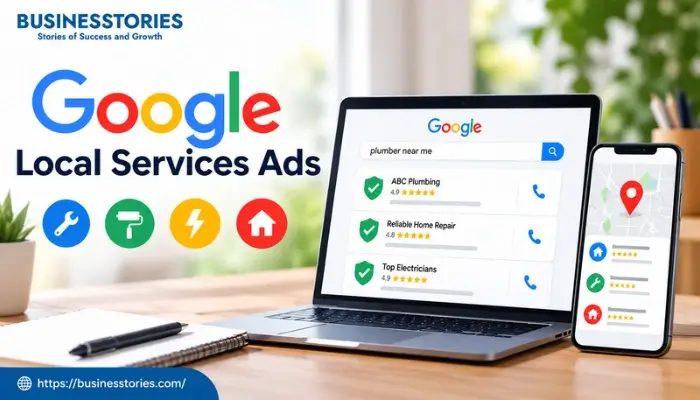
Have you ever searched “plumber near me” and noticed ads with a green checkmark above everything else? That is Google Local Services Ads in action. This platform has quickly become a popular way for local businesses to get leads. Moreover, it helps you avoid wasting money on clicks that go nowhere.
But is it actually worth your investment? In this guide, you will learn exactly what Google Local Services Ads are. You’ll also learn how they work, their cost, and if they suit your business. So, let’s break it down step by step.
What Are Google Local Services Ads?
Google Local Services Ads (LSA) is an advertising platform built for local, service-based businesses. For example, think of plumbers, electricians, HVAC techs, lawyers, and house cleaners. Unlike normal Google Ads, this platform charges you only when someone actually contacts your business. Therefore, you do not pay every time someone clicks.
These ads appear at the very top of Google search results. As a result, they sit above both organic listings and standard pay-per-click ads. So, when someone searches “roof repair near me,” your business could be the first thing they see.
Each listing also shows a trust badge. Specifically, you get either Google Guaranteed or Google Screened, depending on your industry. Google awards this badge only after your business passes screening. In fact, screening may include background checks, license checks, and insurance verification. Because of the badge, customers often trust these listings more than a random search result.
Local Services Ads is available for select categories only. Additionally, eligibility varies by location. Therefore, it is smart to check Google’s current list for your trade before you assume you qualify.
Here is a perspective that many listicles often overlook. LSA is not just an ad format. Instead, it functions as Google’s own verified marketplace for local trades. For instance, it competes directly with sites like Angi and Thumbtack.
However, instead of paying a directory a flat fee, you pay Google per contact. Your company receives its own trust badge instead of relying on someone else’s credibility. That shift matters, because it puts Google directly between you and the customer’s first impression.
How Do Google Local Services Ads Work?
Local Services Ads works differently than most Google advertising tools. First, there is no keyword bidding involved. Instead, you build a profile with your services, service area, and hours. Then, Google matches that profile to relevant local searches automatically.
The Trust Badge System
Once your business passes verification, Google grants a badge. For example, home service businesses typically get Google Guaranteed. This means Google may reimburse unhappy customers up to a lifetime cap. On the other hand, professional service businesses, like lawyers, get Google screened instead. After all, outcomes cannot be “guaranteed” in that field.
This badge is a strong trust signal. Furthermore, it comes directly from the search engine itself. Consequently, it frequently holds greater significance for customers than a standard review site badge.
The Pay-Per-Lead Pricing Model
Here is how the payment side actually works:
- First, set a weekly budget based on how many leads you can handle.
- Next, choose a bidding mode—either automatic (“Maximize Leads”) or a manual max bid per lead.
- Then, Google matches your ad to nearby, relevant searches.
- Thereafter, if your team misses a call from an LSA lead, you may still incur charges. Charges apply only for valid leads, which include a call, message, or booking.
- Finally, you can dispute invalid leads, like spam or wrong-service contacts, and get credited back.
Your ranking inside the ad results depends on three things. Namely, these are your bid, your profile quality, and how likely Google thinks that lead will convert. Therefore, a smaller business with fast response times can sometimes outrank a bigger competitor.
For instance, this happens when the competitor answers calls slowly. Sadly, this detail rarely receives mention, yet it holds significant practical importance in practice.
Google Local Services Ads vs. Traditional Google Ads
Many business owners already run standard Google Ads. Naturally, they wonder how Local Services Ads compares.
Traditional Google Ads uses pay-per-click (PPC) pricing. In other words, you pay for every click, whether or not that visitor ever contacts you. Additionally, it requires keyword research, ad copywriting, and ongoing landing page work. Local Services Ads skips all of that. Instead, Google handles the matching for you. Then, you only pay when a real lead comes through.
Cost-wise, the gap is meaningful. For example, SearchLight Digital’s 2026 benchmark looked at $6.72 million in spending across 888 contractors. As a result, they found the average cost per lead for home services LSA was just $53, with electrical leads averaging around $39.
Meanwhile, other industry benchmarks put average LSA cost per lead between $23 and $80 across most home service trades. By contrast, traditional Google Ads often costs $70 to over $200 per lead in competitive categories like roofing.
Placement differs too. Specifically, LSA listings appear above standard PPC ads, which gives them prime visibility. However, LSA only works for specific eligible categories. In contrast, regular Google Ads can promote almost anything, anywhere.
Here is the insight most comparisons miss. These platforms are not really rivals. Instead, they work best together. For instance, LSA captures ready-to-book customers cheaply. Meanwhile, traditional PPC and SEO fill in the gaps LSA does not cover. As a result, businesses that treat the LSA as an “either-or” choice often lose real revenue.
Key Benefits of Google Local Services Ads
For eligible businesses, this platform offers some clear advantages. So, let’s look at them below.
- Top-of-search visibility without bidding wars. First, LSA sits above both organic and paid results. As a result, your business gets prime placement without needing deep PPC skills.
- You pay for leads, not wasted clicks. Moreover, this is the biggest financial upside. For instance, a curious browser who clicks and leaves costs you nothing here. Instead, you only pay when someone actually calls, messages, or books.
- Built-in trust signals. Additionally, the Google Guaranteed and Google Screened badges act as instant credibility boosters. This feature matters a lot in trust-heavy industries like home repair.
- Simple budget management. Furthermore, since you manage a weekly lead budget instead of keyword bids, this platform is far friendlier for small business owners without a marketing team.
- Mobile-first, call-driven leads. Finally, most LSA leads arrive as direct phone calls. Therefore, this method often leads to faster booked jobs than a typical landing page visit.
Here is a unique way to see the process. LSA quietly levels the playing field. Historically, ranking at the top of a competitive search term required years of SEO or a big PPC budget. A small, responsive plumbing crew of two can now outrank a much larger competitor. How? Simply by answering the phone faster and keeping better reviews. Therefore, that is a real shift in who gets to compete for top visibility.
Potential Drawbacks and Limitations
No platform is perfect. Therefore, LSA has real limits that you should weigh first.
- Limited eligibility. First, LSA only covers specific categories and cities. So, if your trade or area is not supported, you simply cannot use it yet.
- Rising costs in busy markets. Moreover, lead prices have been climbing. For example, one 2025 benchmark found cost per lead rose for 69% of home service businesses. Additionally, the average increase was roughly 10.5% year over year. Furthermore, storm-driven trades like roofing can spike well above average during peak seasons.
- Less visibility into search terms. Also, unlike regular Google Ads, LSA does not show you the exact phrase someone searched. As a result, fine-tuned optimization becomes harder.
- Heavy dependence on reviews. Additionally, your visibility ties closely to your star rating and review count. Therefore, a newer business with few reviews may struggle to get leads, even with a healthy budget.
- Missed calls cost you twice. Finally, if your team misses a call from an LSA lead, you may still get charged for it. Worse, you also lose the customer.
Here is a point most articles overlook. LSA rewards operational discipline more than marketing skill. For instance, a business that answers phones slowly will likely underperform here, no matter how much budget it spends. Therefore, sometimes fixing internal processes should come before investing heavily in this platform, not after.
How Much Do Google Local Services Ads Cost?
There is no official price list. After all, Google only states that cost varies by location, job type, and bidding mode. However, real data gives us a solid picture.
First, SearchLight Digital’s 2026 benchmark showed the blended average cost per lead across home services was $53. Additionally, the cost per lead varied by trade. For example, electrical came in around $39, HVAC around $51, and plumbing around $57. Meanwhile, other benchmarks show a broader range of $23 to $80 across most trades. Naturally, emergency categories like roofing and water damage often run higher.
For comparison, that same SearchLight data reported an average booked-job value of $1,826. Moreover, it showed a return on ad spend of roughly 7.8x across all trades. In other words, for every dollar spent, businesses generated close to eight dollars in booked revenue on average. Clearly, that is a compelling number. However, it only works if your business can actually close a healthy share of the leads it gets.
Your actual cost will depend on several things. Namely, these include your trade, your local market, seasonality, your bidding mode, and your profile quality. Therefore, here is a practical tip. First, start with a modest budget, enough for 3 to 5 leads weekly. Then, track your close rate for a month before scaling up. This way, you avoid overcommitting before you know your real numbers.
Is Google Local Services Ads Worth It for Your Business?
This is the question that actually matters. Honestly, it depends more on your business than on the platform itself.
First, local services ads tend to pay off when you already have strong margins, solid reviews, and a quick, reliable follow-up process. If these pieces are in place, then LSA can become one of your most cost-efficient lead sources. In fact, it often beats traditional PPC on cost per lead and requires far less hands-on management.
On the other hand, it may not be worth it if your business often misses calls. Additionally, it may struggle if you have very few reviews or work on thin margins. In that case, a $50 to $80 lead cost eats too much profit. Therefore, it often makes more sense to fix those basics first.
Here is a helpful way to frame the situation. Think of Google Local Services Ads less as advertising and more as pay-per-performance customer acquisition. After all, you are not paying for exposure. Instead, you are paying for direct contact with a real potential customer. That is precisely why the ROI often looks impressive compared to traditional ads.
Conclusion
Google Local Services Ads offers something genuinely different from typical online advertising. First, instead of paying for clicks, you pay only for real leads. Moreover, Google backs your listing with a trust badge that customers recognize instantly. Therefore, for eligible service businesses, the program often means lower cost per lead, stronger conversion rates, and far less time spent managing campaigns.
That said, this platform is not automatically the right choice for everyone. After all, it rewards rapid response times, strong reviews, and healthy profit margins. Without these basics, even a well-funded LSA campaign may underperform. So, before investing heavily, take an honest look at how quickly your team answers calls. Additionally, check how strong your current reviews are.
The smartest approach usually is not “LSA instead of everything else.” Instead, treat it as one strong layer within a broader local marketing plan. For instance, pair it with your Google Business Profile, active review requests, and possibly traditional search ads for gaps LSA does not cover.
If your business qualifies, start small. First, set a modest weekly budget. Then, track your numbers closely for a few weeks. Finally, calculate your real cost per booked job before scaling. Ready to see if Google Local Services Ads fits your business? Check your eligibility today, request a few fresh reviews from happy customers, and give this platform a real test. After all, the groundwork you lay now will shape how well it performs later.
Frequently Asked Questions
1. How Much Does It Typically Cost to Run Google Local Services Ads?
Most home service businesses pay between $30 and $80 per lead through Google Local Services Ads, depending on trade and location. However, roofing and water damage leads cost more, while cleaning and landscaping leads usually cost less overall.
2. Is Google Local Services Ads Really Worth It for Small Businesses?
Yes, Google Local Services Ads for small businesses often work well if you already have strong reviews, quick call responses, and healthy profit margins. However, without these basics, the pay-per-lead cost may outweigh the return you get.
3. What Makes Google Local Services Ads Different From Regular PPC Ads?
Unlike regular PPC ads, Google Local Services Ads use a pay-per-lead pricing model instead of pay-per-click. Therefore, you only pay for a real customer contact. Moreover, Google verifies your business with a trust badge first.
4. Do I Need Great Customer Reviews for My Google Local Services Ads?
Yes, a strong review profile matters a lot for Google Local Services Ads ranking. In fact, many categories require a minimum number of reviews before your ad goes live. Additionally, higher ratings often bring better lead volume.
5. Can Google Local Services Ads Replace Traditional Google Ads Entirely?
Not usually. Instead, Google Local Services Ads works best alongside traditional Google Ads and SEO, not as a full replacement. After all, Local Services Ads covers only certain categories, so other channels are still relevant for broader visibility.

Tabassum Shaik is an Author, Researcher, and SEO Specialist with over 8 years of experience creating informative content on business, startups, entrepreneurship, marketing, technology, and digital trends. She specializes in researching industry trends and transforming complex topics into practical, easy-to-understand insights. Her goal is to help readers stay informed, learn new ideas, and make better business decisions.