
Introduction
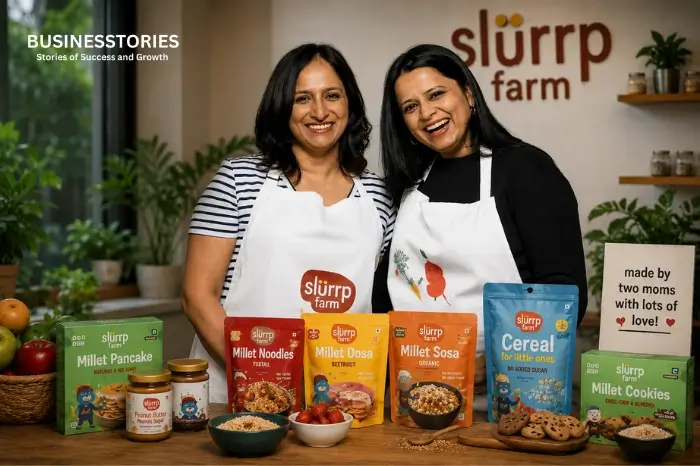
Every excellent brand starts with a problem. For Slurrp Farm, that problem was simple but frustrating. Two mothers could not find truly healthy, tasty food for their toddlers. So they built it themselves.
Founded in 2016 by Meghana Narayan and Shauravi Malik, Slurrp Farm has grown from a small home kitchen experiment into one of India’s most loved healthy kids’ food brands. Today, it is a ₹100+ crore business under its parent company, Wholsum Foods. The brand sells millet-based cereals, cookies, dosa mixes, pancakes, noodles, and more. All made without refined sugar, trans fat, or artificial preservatives.
This is not just a success story about revenue. It is a story about purpose-driven entrepreneurship, smart distribution, and the power of building trust with parents. In this article, we break down exactly how Slurrp Farm built its healthy food empire and what other brands can learn from it.
Slurrp Farm Origin Story: A Gap in the Market
Two Mothers, One Big Idea
Shauravi Malik and Meghana Narayan first met at a Diwali party in London. Both were accomplished professionals. Shauravi had worked at JP Morgan and Sir Richard Branson’s Virgin Group. Meghana was a McKinsey associate principal who led the public health practice. Despite their successful careers, both faced the same daily challenge of finding healthy, grain-rich food for their young children.
Most supermarket shelves, they found, offered only wheat- or rice-based products for kids. Many of these contained refined flour, excessive sugar, and artificial additives. The country boasts a rich tradition of diverse grains, including ragi, jowar, bajra, and amaranth. The situation felt like a significant missed opportunity.
So in October 2016, they decided to fill that gap. They started experimenting with their grandmothers’ traditional recipes. They began creating products that were both nutritious and genuinely delicious. The founders describe themselves not as co-founders but as “co-chasers.” They are always chasing their ideas forward with persistence.
Why Millets?
India has one of the world’s richest millet traditions. Yet, by the early 2010s, these supergrains had largely disappeared from urban plates. Slurrp Farm made a bold bet, bringing millets back. But Slurrp Farm made them fun, accessible, and tasty enough for children to enjoy.
This was a unique insight that most competitors had overlooked. Rather than compete on price with legacy brands like Nestle or MTR, Slurrp Farm chose to own the millet-based kids’ food category from the very beginning. That early category leadership became one of its greatest competitive advantages.
Slurrp Farm’s Product Strategy: Health Without Compromise
Clean Label, Premium Ingredients
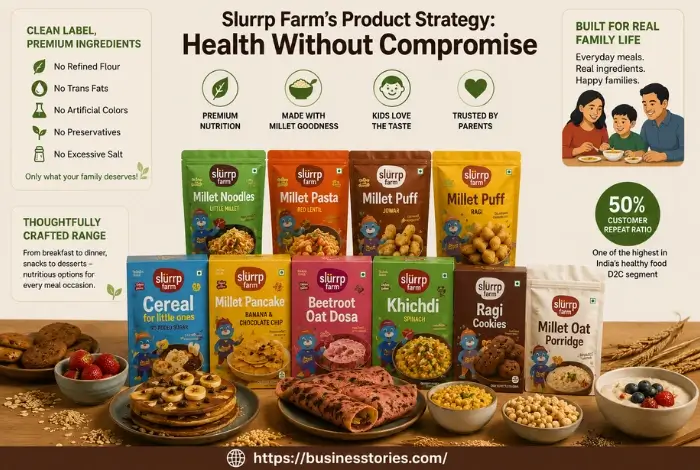
From day one, Slurrp Farm built its products around a clean-label promise. Every product is free from refined flour, trans fats, excessive salt, artificial colors, and preservatives. This commitment meant higher ingredient costs. Millets cost more per kilo than rice or wheat. Product prices were about 25% higher than comparable alternatives. Yet parents happily paid the premium. Why? Because they trusted the brand.
The product range grew thoughtfully over time. It now includes organic cereals, khichdi mixes, millet-oat porridge, banana-and-chocolate-chip pancakes, beetroot-oat dosa, ragi cookies, millet noodles, millet pasta, and savory puffs made from jowar and ragi. Each product is designed to be a nutritious substitute for everyday meals, not a niche health supplement.
Products Built for Real Family Life
One of Slurrp Farm’s smartest moves was targeting everyday meal occasions, not just snack time. By creating dosa mixes, khichdi mixes, and porridges, the brand placed itself right at the breakfast and mealtime table. These are the most repeated eating occasions in any household.
This approach gave Slurrp Farm a huge advantage in customer stickiness. Parents use a brand’s dosa mix every morning; they keep coming back. This strategy is partly why the brand reports a 50% customer repeat ratio, one of the highest in the healthy food D2C segment in India.
Slurrp Farm Growth Engine: Smart Multi-Channel Distribution
Going Where Parents Already Shop
Slurrp Farm understood early that convenience is as important as quality. Even the healthiest product fails if parents cannot easily find it. So the brand built a multi-channel distribution model that reaches parents on every platform they already use.
Today, e-commerce is the largest revenue contributor, accounting for about 40% of total sales. The brand is available on Amazon, Flipkart, BigBasket, FirstCry, and its own D2C website. Quick commerce platforms like Blinkit, Zepto, and Swiggy Instamart contribute another 35–40% of total sales. This remarkable share reflects how urgently parents reach for trusted brands when they need food fast.
Offline retail has also scaled significantly. As of 2024, Slurrp Farm products are available in approximately 5,000 stores across 80 cities in India. The brand also has a presence in the UAE, Singapore, the US, the UK, and Europe, across over 15 countries globally.
D2C as a Community Channel
While e-commerce drives the highest revenue, the brand’s Direct-to-Consumer (D2C) platform serves a deeper purpose. It is where Slurrp Farm builds trust and stays closely connected with families. Through its website and social media communities, the brand shares recipes, feeding tips, and parenting content that keeps mothers engaged long after a first purchase.
The founders built a Facebook community of mothers early on. This group became a go-to space for parenting challenges, recipe sharing, and product testimonials. This organic, community-led marketing approach costs far less than traditional advertising. It was significantly more credible with their target audience.
Funding, Investors, and Brand Credibility
From Angels to Sovereign Wealth Funds
Slurrp Farm started with the founders’ own savings and a small angel round from friends, family, and early believers. Since then, it has raised approximately $18 million across multiple funding rounds.
Key milestones include a Series A from Fireside Ventures in December 2020. In 2022, the Investment Corporation of Dubai (a sovereign wealth fund) led a Series B round. In January 2024, the company raised a $7.2 million round from Sharrp Ventures, Fireside Ventures, and Raed Capital.
Most recently, the brand raised ₹30 crore from Scarlet Ventures in an extended Series C round. This round pushed its post-money valuation to approximately ₹810 crore (around $90 million).
Perhaps the most visible investor is Bollywood star Anushka Sharma. She joined as both an investor and brand ambassador. Her involvement significantly boosted the brand’s visibility among young Indian mothers, exactly Slurrp Farm’s core audience.
Revenue Growth: A Consistent Upward Curve
The numbers tell a compelling story. It started with ₹5 crore in early revenues. Slurrp Farm grew to ₹6.8 crore in FY21. Then hit ₹19.15 crore in FY22. By FY23, revenue had doubled to ₹40 crore. In FY24, the company’s operating revenue reached ₹72.5 crore. In FY25, revenue grew by 30% to ₹95.6 crore.
The annualised run rate has already crossed the ₹100 crore mark. The brand is targeting ₹160 crore by the end of FY26. It also has a longer-term vision of ₹500 crore across both Slurrp Farm and its adult food brand, Millé.
Marketing That Builds Trust, Not Just Awareness
Speaking Directly to Mothers
Most food brands speak to everyone. Slurrp Farm speaks to one person: the Indian mother. We design every piece of content, every campaign, and every community interaction with her in mind. She wants food that is healthy and tasty. Worries about sugar, preservatives, and picky eaters. She trusts peer recommendations far more than television ads.
Slurrp Farm leaned on this insight brilliantly. Rather than running media campaigns, the brand focused on informative content, recipe videos, and community storytelling. Social media became the primary marketing channel. Facebook communities, Instagram Reels, and parenting blogs helped the brand reach its audience in a deeply personal and credible way.
The Role of Purpose in Marketing
Slurrp Farm’s mission, to change the way families approach food, is not a tagline. It shapes every product and every campaign. The brand has created educational content. It uses characters like Kiki and her Singing, Dancing Food, as well as Slurrp It Up, to make food education engaging for children. It has also partnered with schools and communities to embed nutrition conversations into everyday life.
This purpose-first approach has given Slurrp Farm a brand identity that goes well beyond its product catalog. Parents do not just buy the cookies. They buy into the brand’s values. That emotional connection is very difficult for competitors to replicate.
Surviving COVID and Emerging Stronger
The Pandemic Test
In February 2020, the founders were just about to break even. India went into one of the world’s strictest lockdowns. Revenue dropped to nearly zero almost overnight. The team had to act fast.
Slurrp Farm restructured its operations, slashed costs, and made a decisive shift. It doubled down on digital channels at a time when most small food brands were struggling. As India’s families moved indoors, demand for healthy, quick-to-cook food surged. Parents, now at home all day with their children, became more conscious than ever about what their kids were eating.
The result? Slurrp Farm saw 3x growth during the pandemic. What could have broken the business instead became its breakout moment. This resilience showed the strength of both products. The brand’s connection with its audience.
What’s Next: The Road to ₹500 Crore
Expanding Across India and the World
Slurrp Farm is now concentrating on increasing its presence in Tier II and III cities, where health-conscious consumption is rapidly growing. Government initiatives like Digital India and the UN-declared 2023 International Year of Millets have created strong tailwinds for the brand’s mission.
Internationally, the brand has already entered the US, the UK, Europe, the UAE, and Singapore. Primarily serving Indian diaspora families. As global interest in millets grows, Slurrp Farm is well positioned to ride this wave.
Building a House of Millet Brands
In 2023, Wholesome Foods launched Millé, a millet-based food brand for health-conscious adults. This is an extension of the millet platform. Beyond children’s food, signals the company’s ambition to build a complete family nutrition portfolio. Both brands collectively target a revenue goal of ₹500 crore.
Wholsum Foods is also a Certified B Corporation. It reflects its commitment to ethical sourcing, sustainable practices, and responsible governance. This certification adds another layer of credibility for a brand that has always put purpose at its core.
Conclusion
The Slurrp Farm story is deeply inspiring, not just for its numbers, but for what it stands for. Two mothers identified a real problem. Acted on it with courage and built something that genuinely improves how millions of Indian children eat.
From ₹5 crore in early revenues to a ₹100+ crore brand in under a decade, Slurrp Farm has shown that health, taste, and commercial success are not in conflict. They achieved these results by choosing clean ingredients, building a loyal community, embracing digital distribution, and staying true to their mission. The founders created a brand that parents trust deeply.
For entrepreneurs, the Slurrp Farm playbook offers clear lessons: start with a real problem. Build for a specific audience. Use the community as a growth channel, and never compromise on product quality. For parents, it offers something equally valuable. Food they can feel confident about giving their children every single day.
If you are a parent, explore Slurrp Farm’s range at slurrpfarm.com. If you are a founder, let this story remind you that the best businesses grow when purpose and profit move together.

Tabassum Shaik is an Author, Researcher, and SEO Specialist with over 8 years of experience creating informative content on business, startups, entrepreneurship, marketing, technology, and digital trends. She specializes in researching industry trends and transforming complex topics into practical, easy-to-understand insights. Her goal is to help readers stay informed, learn new ideas, and make better business decisions.