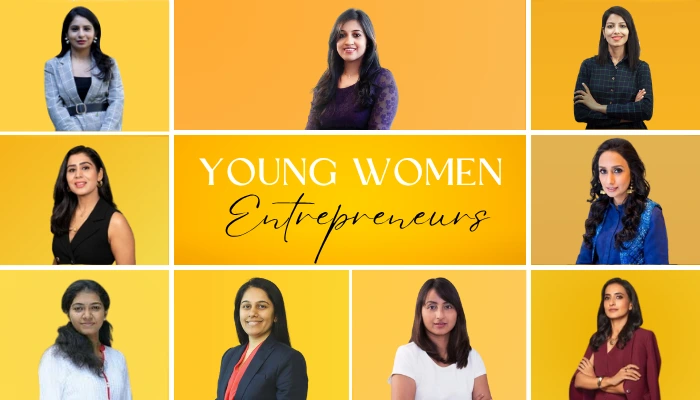
India now has more women in business than ever before. In fact, more than 1 lakh DPIIT-recognized startups now have at least one woman director or partner. Still, the founders who make headlines are few. So, who are the young women entrepreneurs who are truly transforming the industry?
In this guide, you’ll meet ten of them. Some sell lipstick and leggings. Others run private jets, fintech lenders, and AI tools for doctors. Each profile highlights what the individual has built, the associated numbers, and the challenges that most lists overlook.
Then, you’ll get simple steps to start your path. Let’s dive in.
Why Young Women Entrepreneurs Matter in India Today
First, let’s examine the overall landscape. Women are now central to India’s startup narrative. As of 31 January 2026, 212,283 entities held DPIIT startup recognition. Of these, 102,054 had at least one woman director or partner. That is close to half of all recognized startups.
However, the financial data presents a contrasting narrative. Women co-founded tech startups raised about $1.1 billion across 407 rounds in 2025, says Tracxn. That figure fell 9% from 2024.
Furthermore, investors now write fewer but bigger cheques. So many first-time women founders find it harder to raise their first round.
The gap shows up in rich lists too. For example, the Avendus Wealth–Hurun India U30 List 2025 named 79 young founders. Yet only six of them were women. Clearly, there is significant potential for growth.
So why should you care?
These female founders in India address issues that others overlook. They build for Indian skin tones, Indian body types, and Indian small towns. As a result, they reach customers that big global brands often miss.
Here’s a pattern most articles miss. Look closely at the ten women below. Almost every one of them was built for a pain she felt. Aditi Gupta felt shame about her period as a teen. Minu Margeret could not find suitable activewear for her frisbee games.
Garima Sawhney saw patients travel far for simple surgeries. In summary, their lived experience gives them a significant advantage. It helps them spot gaps long before investors do.
Furthermore, notice how many of them run a business with a spouse or close partner. Five of the ten co-founded with a husband. Some critics see the arrangement as a crutch. But founders often describe it as shared risk and shared stamina. Either way, it is a real trend worth knowing about.
Finally, these women show that “young” does not mean “new.” Many failed first, then pivoted, and then won. That story is relevant for anyone thinking of starting up.
Consumer Brand Builders: 5 Young Women Entrepreneurs Shaping What India Buys
These five successful young women entrepreneurs built brands you may already use. Their wins and their wobbles both hold useful lessons.
1. Ghazal Alagh – Mamaearth (Honasa Consumer)
Ghazal and her husband Varun started Mamaearth in 2016. At first, they wanted safe, toxin-free baby products. Today, their parent firm, Honasa, runs six brands, including The Derma Co. and Aqualogica.
In FY25, Honasa earned about ₹2,067 crore in revenue. Ghazal leads product and innovation. Notably, her team builds new products by tracking what people search for online. Even so, FY25 was tough, with profits down sharply after a distribution reset.
2. Vineeta Singh – SUGAR Cosmetics
Vineeta turned down a big job offer to start up. Her first ideas failed. Then, in 2015, she and Kaushik Mukherjee launched SUGAR for Indian skin tones. However, the journey has not been without its challenges.
In FY25, revenue fell about 20% to ₹404 crore, and losses nearly doubled. Later, SUGAR raised ₹145 crore at a near 80% valuation cut. Yet Vineeta told her team to keep building the business. That honesty is a lesson in itself.
3. Minu Margeret – BlissClub
Minu launched BlissClub in 2020 to make activewear for Indian women. Interestingly, she built a WhatsApp community before she built the product. Women shared their pain points, and she designed around them.
In FY25, revenue grew 51% to ₹131.6 crore, and losses shrank. Plus, she was the youngest woman on the Hurun India U35 List 2025.
4. Romita Mazumdar – Foxtale
Romita left investment banking to start Foxtale in 2021. Before launch, she spoke to over 3,000 women about their skin. Then, in 2025, Japan’s KOSÉ led a $30 million Series C. Foxtale also grew 150% in FY25.
Meanwhile, Romita has openly said some investors asked if she needed a male co-founder. She proved them wrong.
5. Aditi Gupta – Menstrupedia
Aditi grew up in a small town in Jharkhand, where periods were a taboo subject. So in 2012, she and Tuhin Paul created Menstrupedia, a comic that explains periods in simple words. They even crowdfunded ₹5.1 lakh, beating their ₹4 lakh goal.
Today, the comic exists in 15 languages. In short, she shows that a women-led startup can drive social change and still earn.
Tech, Finance, and Health Trailblazers: 5 More Young Women Entrepreneurs
Next, meet five founders who build in fields long run by men. These are young female founders in aviation, fintech, software, and health tech.
6. Ruchi Kalra – Oxyzo and OfBusiness
Ruchi spent nine years at McKinsey. Then she co-founded OfBusiness with her husband, Asish Mohapatra. Soon after, she started Oxyzo, a lender for small firms. Remarkably, she was nine months pregnant when the team founded it.
In March 2022, Oxyzo raised $200 million in its first round and became a unicorn. Investor Norwest called her India’s first female founder of a profitable fintech unicorn.
7. Kanika Tekriwal – JetSetGo
Kanika fought cancer in her early twenties. Then, at just 22, she founded JetSetGo in 2014. People often call it an “Uber for private jets.” Besides charters, the firm now manages aircraft for owners.
In fact, Kanika also set up what many call India’s first aircraft leasing company. In 2022, she became the youngest self-made woman on the Hurun rich list. Her story is pure grit.
8. Rajoshi Ghosh – Hasura
Rajoshi co-founded Hasura in 2017 with Tanmai Gopal. Hasura helps developers reach data fast through one API. In February 2022, it raised $100 million at a $1 billion valuation. That made it a unicorn.
Before that, she worked as a researcher at a Gartner tech incubator. Furthermore, Hasura was Rajoshi’s third venture. Her success was a result of the lessons she learned through difficult experiences.
9. Dr Garima Sawhney – Pristyn Care
Garima is a gynecologist who has done over 10,000 surgeries. She saw patients from small towns travelling hundreds of kilometres for care. So in 2018, she co-founded Pristyn Care to make planned surgery simple.
Three years later, the firm hit a $1.4 billion valuation after raising $96 million. In short, she turned a doctor’s frustration into a national health brand.
10. Devika Gholap – OptraSCAN
Devika is co-founder and chief product officer of OptraSCAN. The firm makes AI tools and scanners for digital pathology. At 28, she was the youngest woman on the Hurun India U30 List 2025.
Then, in July 2026, OptraSCAN won US FDA clearance for a digital pathology system. She is undoubtedly one of the next-generation female founders to keep an eye on.
How to Follow in Their Footsteps: 5 Simple Steps
Now, let’s turn these stories into action. Whether you’re 19 or 35, these steps can help you start.
Step 1: Start With a Problem You Feel
First, list three problems that annoy you every week. Then, ask ten friends if they feel the same pain. For example, Minu and Aditi both built for their struggles. You’ll make better decisions because you understand the issue well.
Step 2: Talk to Customers Before You Build
Next, please engage with actual buyers early on. Romita spoke to 3,000 women before Foxtale went live. Similarly, Minu built a WhatsApp group first. So start a small chat group or survey this week. It costs nothing, yet it saves months of guessing.
Step 3: Get Your Startup Recognized
Furthermore, register your company and apply for DPIIT startup recognition on the Startup India portal. This can unlock tax benefits and easier access to some funds.
Plus, it adds trust when you pitch to buyers and investors. To apply, you need a registered firm, a short note on your idea, and basic founder details. Best of all, the process is online and free. So set aside one weekend and get it done.
Step 4: Plan for Setbacks, Not Just Wins
Here’s the unique lesson from this list. Nearly every founder encounters obstacles. SUGAR took a big valuation cut. Mamaearth faced a challenging year. Hasura came after two earlier ventures.
So keep at least six months of cash in reserve. Furthermore, track your burn rate every month. That way, a difficult quarter won’t end your dream.
Step 5: Build Your Support Circle
Finally, find mentors, peers, and early backers. Many of these women raised money from fellow founders first. For instance, Ghazal Alagh invested in BlissClub. So join founder groups, attend startup events, and ask for warm intros.
Besides, many colleges and cities now run startup incubators. Check if one near you takes early ideas. Ultimately, a single outstanding introduction can transform everything.
Conclusion
To sum up, India’s young women entrepreneurs are building some of the country’s most exciting companies. From Ghazal Alagh’s Mamaearth to Devika Gholap’s AI pathology tools, these founders cover beauty, fashion, fintech, aviation, software, and health. Their reach is wide, and their impact is real.
Yet the path is not simple. Nearly half of recognized startups now have female directors. Still, women co-founded tech startups and raised only about $1.1 billion in 2025. Furthermore, just six women made the Hurun U30 list. So the funding gap remains wide.
Even so, the ten stories above share three clear lessons.
- First, build for a problem you truly feel.
- Second, talk to customers before you spend big.
- Third, expect setbacks and plan for them.
Vineeta, Ruchi, Kanika, and the others all faced challenging moments. However, they kept going, and that made the difference.
Now it’s your turn. Please choose one problem that you are passionate about. Then, take the first small step this week. Talk to ten people, start a WhatsApp group, or check the Startup India portal. After all, every founder on this list began with one small move.
Frequently Asked Questions
1. Who is the most successful young woman entrepreneur in India now?
By revenue, Ghazal Alagh stands out. Her company, Honasa Consumer, earned about ₹2,067 crore in FY25. However, Ruchi Kalra and Garima Sawhney also lead unicorns, so success depends on how you measure it.
2. Which young women entrepreneurs in India have built unicorn startups?
Several have. Ruchi Kalra co-founded Oxyzo, Rajoshi Ghosh co-founded Hasura, and Garima Sawhney co-founded Pristyn Care. Each firm crossed a $1 billion valuation. As a result, they rank among India’s top women-led unicorn founders.
3. How many startups in India have at least one woman director today?
As of January 2026, 102,054 DPIIT-recognized startups had at least one woman director or partner. That is nearly half of all recognized startups. So women’s role in Indian entrepreneurship keeps growing every year.
4. What can young women learn from top female founders in India now?
First, build for a problem you feel passionate about. Next, make it a point to talk to customers early and often. Furthermore, plan for setbacks by keeping a cash buffer. These simple habits helped most founders on this list grow lasting companies.
5. How can a young woman start a business in India with little money?
Begin with a small-scale venture that addresses a familiar problem. Then, test your idea through a WhatsApp group or survey. In addition, you should apply for DPIIT startup recognition. This low-cost route helps first-time women entrepreneurs in India build trust quickly.

Tabassum Shaik is an Author, Researcher, and SEO Specialist with over 8 years of experience creating informative content on business, startups, entrepreneurship, marketing, technology, and digital trends. She specializes in researching industry trends and transforming complex topics into practical, easy-to-understand insights. Her goal is to help readers stay informed, learn new ideas, and make better business decisions.