Picture a huge truck driving itself down a busy highway. No driver or rest stops. No fatigue. That future is nearer than you think. The Waabi autonomous trucking startup is making it happen right now.
Waabi uses generative AI to train self-driving trucks in a virtual world. This approach is faster, safer, and cheaper than anything the industry has tried before. So it is no surprise that investors have poured over $1 billion into the company since 2021.
But what exactly does Waabi do? And why is everyone in the freight world paying attention? Let’s find out.
The Big Problem Waabi Wants to Fix
The US trucking industry is in trouble. Trucks move about 72% of all freight in the country. Yet the industry faces a serious driver shortage. Accidents are costly. And pressure to cut fuel emissions keeps growing.
Traditional self-driving companies tried to fix the situation by testing trucks on real roads. They logged millions of miles and collected data from real traffic. But this approach is slow and expensive. It is also dangerous. A single catastrophic incident can significantly delay a company’s progress.
So Waabi’s founder, Raquel Urtasun, took a different path. She had spent years as chief scientist at Uber’s self-driving division. She closely observed the shortcomings of the traditional approach. When she started Waabi in 2021, she decided to build a world-class AI simulator instead.
The idea was simple. Train the AI in a virtual world first. Then send the trucks out on real roads. This approach saves time, cuts costs, and keeps people safe. And it works.
How Waabi World Trains Trucks in a Virtual World
The core of the Waabi autonomous trucking startup is a tool called Waabi World. This is a powerful, AI-driven simulator. It creates real-looking driving conditions in a virtual world.
Think of it as the best driving school for AI. But instead of one student, thousands of AI drivers learn at the same time.
Learning at Massive Scale
Waabi World uses generative AI to run many driving scenarios at once. One virtual truck might be handling a foggy highway. Another could be merging into heavy traffic. A third might face a sudden road hazard.
All these virtual trucks share what they learn. They update one shared AI model in real time. So the more scenarios Waabi World runs, the smarter the AI gets. This process happens fast. In fact, it would take a real truck years to gather the same data on public roads.
Testing Rare and Dangerous Situations
Most crashes happen in rare, unexpected moments. A tire blows out. A car cuts in without warning. A child runs into the road.
In Waabi World, you can test these edge cases as many times as needed. The AI faces these challenging situations again and again until it handles them safely. There are no real roads and no real risk. No real person is in danger.
So this is why Waabi moves faster than its rivals. It does not need a large fleet of test trucks or hundreds of safety drivers. The simulator does the heavy lifting.
Copilot4D: The AI That Sees What Happens Next
Waabi also built a smart AI model called Copilot4D. This model helps the truck predict what will happen around it in the next few seconds.
Predicting the Future on the Road
Copilot4D uses LiDAR sensor data to build a 3D map of the truck’s surroundings. LiDAR sends out laser pulses and measures how they bounce back. This gives the AI a precise picture of nearby cars, people, and objects.
Then, Copilot4D uses that data to predict how the scene will change. If a car ahead is speeding and drifting, the AI forecasts where it will be in 5 to 10 seconds. So the truck can plan a safe move before the danger even arrives.
Research from Waabi shows that Copilot4D beats existing models in point cloud forecasting. In simple terms, it outperforms other systems in road reading.
Learning Like a Child
But what makes this model clever is how it learns. Children learn by doing things, watching what happens, and adjusting. Copilot4D works the same way. It predicts how a scene will change, then checks if it was right. Over time, it gets very accurate.
Waabi World gives the model unlimited chances to practice. This means Copilot4D can improve at a speed no real-world testing program could match.
Waabi’s Funding and Key Partners
Furthermore, a startup is only as strong as its backers. The Waabi autonomous trucking startup has built a strong network of investors and partners.
Strong Backers from Day One
In 2024, Waabi raised $200 million in a Series B round. Uber and Khosla Ventures led the deal. Other investors included Nvidia, Volvo Group Venture Capital, Porsche, and Scania.
However, these are not just financial backers. Nvidia supplies its DRIVE Thor chip for the trucks. Volvo builds the physical trucks that run Waabi’s software. And Uber provides the freight network where those trucks do real work.
Uber Freight also signed a 10-year partnership with Waabi. The goal is to run billions of autonomous miles on the Uber Freight network over the next decade. This deal gives Waabi a clear path to scale fast.
A Historic $750 Million Series C
In January 2026, Waabi raised $750 million in a Series C round — the largest funding round in Canadian tech history. Khosla Ventures and G2 Venture Partners led the round. Uber also committed an additional $250 million contingent on hitting key milestones. Total possible funding: $1 billion.
As part of the deal, Waabi agreed to deploy at least 25,000 autonomous vehicles on the Uber platform. This includes both self-driving trucks and a new venture into robotaxis.
Yes, the same AI brain that drives a 40-ton truck will also power passenger vehicles. Waabi calls this its Physical AI Platform — one AI model that works across different vehicle types.
Waabi vs. Competitors: How It Stacks Up
Furthermore, the self-driving truck space has many players. Companies like Aurora, Kodiak Robotics, Bot Auto, and Tesla all want a slice of this market. So how does Waabi compare?
Aurora: The Closest Rival
Aurora is Waabi’s main competitor. It launched the first commercial driverless trucking route in the US in 2025. It runs between Dallas and Houston. That is a big milestone.
But here is the key point. Aurora has raised nearly $3.5 billion to reach that point. For a fraction of that price, Waabi has completed comparable work. The reason is Waabi’s AI-first approach. Less real-world testing means lower costs.
Moreover, when Aurora launched its service, it had a human observer in the cab. Waabi aims for fully driverless trucks with no one on board. The ultimate objective is to achieve this, and Waabi is actively pursuing it.
Capital Efficiency Is Waabi’s Real Edge
Vinod Khosla, founder of Khosla Ventures, made this point clearly. What past self-driving companies did with billions of dollars and giant teams, Waabi can do for far less. That is because Waabi’s simulator replaces expensive real-world test fleets and large data teams.
So for any entrepreneur watching this space, this experience is a powerful lesson. Smart technology design can replace raw spending. Waabi proves that a smarter starting point leads to a leaner and faster business.
What Comes Next for Waabi
The Waabi autonomous trucking startup has ambitious plans for the future. The company is growing its Texas operations and plans to expand across the full US market.
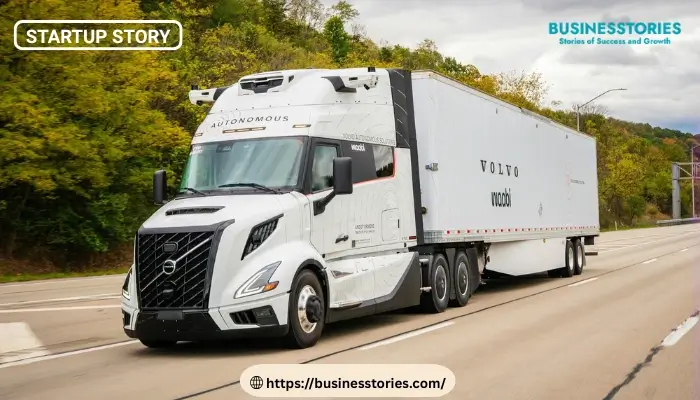
The Volvo VNL autonomous truck is already in production at Volvo’s Virginia factory. It has six redundant safety systems—dual braking, dual steering, dual computing, and more. This model is the truck that will carry real loads without a driver at the wheel.
Beyond trucking, the robotaxi expansion is underway. Waabi will deploy thousands of self-driving passenger vehicles on the Uber ride-hailing platform. Furthermore, each improvement in the truck AI makes the robotaxi AI better, and vice versa. This shared learning loop is a huge advantage.
So for anyone who follows AI and startups, Waabi is a must-watch. It shows what is possible when a founder starts with a bold idea and the right technical approach from day one.
Why the Simulation-First Approach Is a Game Changer for Startups
Most people think self-driving trucks need millions of real road miles to work. But Waabi’s story shows that it is not true. But a smart simulator can do far more—and it can do it faster.
So why haven’t other companies done this sooner? The brief explanation is that creating a top-notch simulator is a challenging task. It takes deep AI skills and years of hard work. Raquel Urtasun spent years studying these problems at the University of Toronto and at Uber. So when she started Waabi, she already had the tools to build Waabi World. Most founders did not.
A Lesson for Entrepreneurs
This is a huge insight for anyone building a startup. Waabi did not win by spending more money. It won by starting with a smarter idea. By building the simulator early, Waabi created a lasting cost edge. Rivals spend a lot on road testing. But Waabi runs the same tests for far less in its virtual world.
Furthermore, the data Waabi collects is far richer. In a simulator, every edge case can be tested on demand. Rare events don’t happen frequently in real life. A truck might drive for years before it sees a certain danger. But Waabi World can create danger today—and test it a million times.
Furthermore, the simulator gets better over time. Every new AI version also improves the simulator. So the whole system keeps getting smarter and smarter, too. This kind of advantage is rare in any industry. And it is why Waabi is growing so fast.
Conclusion
The Waabi autonomous trucking startup is reshaping how the world thinks about self-driving vehicles. It is not just about building trucks. Instead, it is creating a smarter way to develop AI for real-world applications.
By choosing to simulate first and drive second, Waabi cuts years of progress into months. The Waabi World simulator, the Copilot4D model, and its physical AI platform all work together to solve one of the hardest problems in tech.
The $1 billion in funding is not just a number. It is a signal that the industry believes Waabi has cracked the code. Uber, Nvidia, Volvo, and some of the world’s best investors are all betting on this Toronto-based startup.
If you are an entrepreneur, the key lesson from Waabi is its success. Do not copy what others do. Instead, find the flaw in the standard approach. Then build something better. Waabi did exactly that — and it is now on track to change how the world moves goods.
Want more stories like this? Explore startup stories at Businesstories.com.
Frequently Asked Questions
What does the Waabi autonomous trucking startup do?
Waabi builds AI-powered self-driving trucks for long-haul freight. It uses a generative AI simulator called Waabi World to train and test its trucks before they hit real roads.
Who founded Waabi?
Raquel Urtasun founded Waabi in 2021. She was the chief scientist at Uber’s self-driving division. She is also a computer science professor at the University of Toronto.
How much funding has Waabi raised?
Waabi has raised over $1 billion in total. This includes a $750 million Series C round in January 2026 and an extra $250 million milestone-based commitment from Uber.
How is Waabi different from Aurora?
Waabi trains its trucks mostly in a virtual simulator. This makes it far more cost-efficient than Aurora, which has spent nearly $3.5 billion on a similar goal. Waabi also aims for fully driverless trucks with no human on board.
What is Copilot4D?
Copilot4D is Waabi’s AI model that uses LiDAR data to predict how traffic will change up to 10 seconds into the future. It helps the truck react faster and drive more safely.

Tabassum Shaik is an Author, Researcher, and SEO Specialist with over 8 years of experience creating informative content on business, startups, entrepreneurship, marketing, technology, and digital trends. She specializes in researching industry trends and transforming complex topics into practical, easy-to-understand insights. Her goal is to help readers stay informed, learn new ideas, and make better business decisions.