
Introduction
Imagine a farm where small robots work all night. They spray, weed, and seed row by row. No driver and breaks. No soil damage. That is precisely what SwarmFarm Robotics makes possible today. The SwarmFarm Robotics startup story begins on a family farm in Queensland, Australia.
Andrew and Jocie Bate are real farmers. They run a 4,000-hectare crop property called “Bendee” near Gindie. In 2012, they asked a bold question: Is there a smarter way to farm? That one question changed everything.
Today, SwarmFarm is one of the top AgriTech automation startups in the world. In 2025, the company raised a huge $30 million Series B round. So, this journey is their story, from a dusty Queensland paddock to a global stage. Whether you farm, invest, or just love a fantastic startup story, read on.
The Problem That Started It All
Bigger Is Not Always Better
For decades, farmers chased bigger machines. Tractors got heavier. Tools got larger. But bigger was not always better. In fact, larger causes do real harm.
Andrew Bate saw this problem every day on his land. His soil at Bendee had deep black clay. Heavy machinery kept crushing the soil. That crushing, called “soil compaction,” damaged the very ground his crops needed. Yields dropped. Costs rose. And the problem kept getting worse.
So Andrew thought differently. Instead of one big machine, why not use many small ones? Small robots would barely touch the soil. They could work together like a swarm of bees. Best of all, they could run 24 hours a day without a human operator.
This idea went against the whole industry. Yet Andrew and Jocie trusted what they knew. They were farmers. They understood the land. And so SwarmFarm Robotics was born.
Partnering With Universities to Build a Prototype
In 2012, the Bates teamed up with two top universities. First, they worked with the Australian Centre for Field Robotics at the University of Sydney. Then, they joined forces with the Farm Robotics Unit at Queensland University of Technology. Together, they built their first robot, Agbot 1. It was a self-driving vehicle made for rough farm terrain.
This step was critical. It joined farmer wisdom with advanced robotics research. Moreover, it proved that autonomous farming robots could actually work in real fields. As a result, the project moved from dream to reality. That early proof set the stage for everything that came next.
The SwarmFarm Robotics Startup Story: Building the Product
The SwarmBot Platform: Small Machines, Big Impact
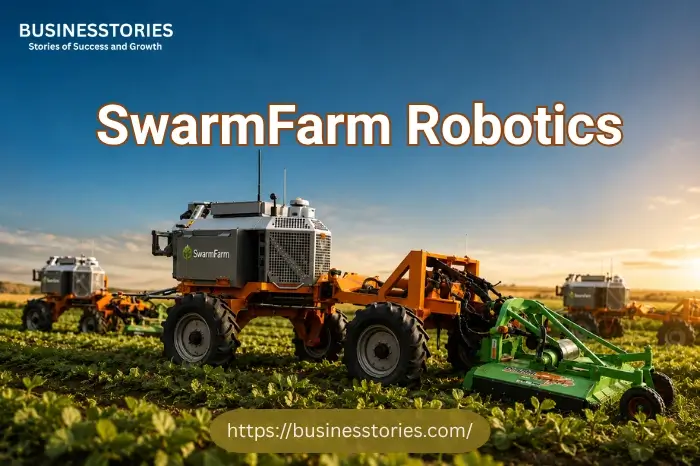
At the heart of SwarmFarm sits the SwarmBot. It is a small, lightweight, self-driving robot. Its can spray, weed, mow, and seed crops. It places inputs only where the plant needs them. So, farmers use far fewer chemicals and waste almost nothing.
The numbers tell a powerful story. SwarmBots now cover over 10 million acres across Australia. They saved an estimated 1.9 million liters of pesticide. They cut herbicide costs by up to 95% and reduced fuel emissions by 35%. Furthermore, these results come from real commercial farms, not lab trials.
One key feature stands out above all others. SwarmFarm designs its robots so that farmers can fix them on the spot. This matters a lot. A farmer in a remote area cannot wait three days for a repair team. So instead, they grab their tools and sort it out. That simple design choice builds huge trust.
SwarmConnect: The Open Ecosystem
SwarmFarm did not stop at building a robot. They also built a platform. The SwarmConnect ecosystem lets outside developers create apps that run on the SwarmBot. Think of it like an app store, but for farm robots.
This approach is rare. Most hardware companies keep their systems locked down. SwarmFarm did the opposite. By opening up the platform, they let partners build new tools fast. Farmers got more options. Partners got a direct route to market. And SwarmFarm grew without having to build everything itself. In short, everyone benefited.
SwarmFarm Robotics Funding: From Seed to Series B
Early Funding and Government Support
SwarmFarm’s funding journey shows steady, smart growth at every step. In 2018, Queensland’s Ignite Ideas fund gave the company an early boost. Then in 2020, SwarmFarm raised A$4.5 million in a round led by Tenacious Ventures and Artesian. The Queensland Business Development Fund also joined in.
The capital raised in 2020 was an important turning point for SwarmFarm. The team used it to grow their engineering staff and speed up robot production. By then, SwarmBots already covered more than 200,000 commercial acres.
Farmers were buying in. The model worked. Then, in 2022, SwarmFarm also secured an $856,000 grant from the Northern Australia Development Programme. That grant showed strong government belief in the technology.
Series A: AUD $12 Million
In February 2023, SwarmFarm closed a AUD $12 million Series A, led by Canadian AgTech fund Emmertech. Other backers included Tribe Global Ventures, Access Capital, Tenacious Ventures, and GrainInnovate.
By that point, the results were striking. SwarmBots had covered 1.3 million commercial acres. They had logged 64,000 hours of field time. They had also cut pesticide use by around 780 tons. Moreover, Emmertech’s Sean O’Connor said farmers were running their SwarmBots for over 3,000 hours a year, often leaving them in the field for 24 hours straight. Such real-world trust was more impactful than any pitch deck.
Series B: $30 Million — The Global Leap
In October 2025, SwarmFarm raised its biggest round yet, $30 million in Series B funding. A Belgian fund, Edaphon, led the raise. The Clean Energy Finance Corporation (CEFC) chipped in $7 million through its Powering Australia Technology Fund. QIC, Emmertech, Tenacious Ventures, and Artesian Capital all joined in.
The CEFC’s role was especially meaningful. It indicated that SwarmFarm is not just a farm tool. It is also a clean energy solution. CEFC Head of Growth Capital Malcolm Thornton put it simply: “SwarmFarm’s platform transforms how food is grown, using less fuel, fewer chemicals, and minimal soil disruption.”
So now SwarmFarm will use this funding to grow in North America, scale its factory in Toowoomba, and expand the SwarmConnect partner network. With 250+ robots already running across Australia, the global push has truly begun.
Why SwarmFarm Is Winning in a Crowded Market
A Farmer-Built Solution for Farmers
Many robot startups are built by tech engineers who have never set foot on a farm. SwarmFarm is entirely different. Andrew and Jocie Bate farm every single day. They tested their robots on their own land first. Only then did they sell to others. That real-world testing gives SwarmFarm a kind of trust that money cannot buy.
Their farmer-first thinking shows up in every product choice. The robots are light enough to protect the soil. They are simple enough to fix in a paddock. They also come with a lease model of AUD $86,000 per year, with a robot replacement after three years at no extra charge. These choices come from farming life, not from a boardroom.
The Swarm Intelligence Advantage
Old farm machines typically perform one large task using a single vehicle. SwarmFarm turns that idea upside down. Instead, a fleet of small robots shares the work. They cover more ground, more precisely, and with far less damage to the land. Furthermore, if one robot breaks down, the rest keep going. There is no single point of failure.
This model also grows easily. Want more output? Just add more bots. No new roads and new sheds. No new staff. As a result, farmers in North America, and eventually in developing countries, can access world-class farming technology without incurring massive upfront costs.
The Broader Impact: AgriTech Automation and Global Food Security
SwarmFarm: Within the AgriTech Revolution
SwarmFarm does not work in a bubble. It is part of a fast-growing wave of AgriTech automation startups changing how the world grows food. Labor costs are rising. Climate pressure is real. And the global population keeps growing. So, smart farming is no longer optional. It is essential.
What truly sets SwarmFarm apart is the evidence of its success. Many companies in the autonomous farming robot space are still running small pilots. SwarmFarm robots, by contrast, are working commercially on real farms right now. They cover millions of acres. They deliver real results every season. That track record is rare and difficult to copy.
Environmental and Social Benefits
Beyond profits, SwarmFarm creates genuine positive change in the world. SwarmBots apply chemicals only where plants need them. So, runoff drops, soil health improves, and farmers save money all at once. Furthermore, because the robots are light, the soil stays loose and healthy, which means better crops over time.
Interestingly, SwarmFarm also offers hope for smaller farms in developing nations. These farmers often lack money for big tractors. But they can afford to lease a SwarmBot. And with reliable internet connectivity, they can run the same tech as the largest farms in Australia. In other words, SwarmFarm assists in creating a more equitable environment for farmers globally.
Key Lessons From the SwarmFarm Robotics Startup Story
The SwarmFarm Robotics startup story holds clear lessons for anyone in the startup or AgriTech world.
- First, start with a real problem. The Bates did not invent a gadget and hunt for buyers. Instead, they experienced the problem daily on their land. Soil damage, chemical waste, and labor gaps drove every decision they made. That honesty led to solutions that actually work.
- Second, build for the farmer, not the investor. Every choice, from easy repairs to simple leasing, puts the farmer first. When you truly serve your users, customers come naturally.
- Third, open your platform. SwarmFarm grew its ecosystem by letting others build on it. As a result, SwarmFarm increased its value without needing to expand its team. That is smart, scalable thinking.
- Fourth, test it on your own farm first. Farmers trust results, not promises. So SwarmFarm ran their robots on the Bates’ own farm before going to market. That proof earned real trust fast.
- Fifth, expand globally gradually. SwarmFarm built strong roots in Australia before targeting North America. That steady, local-first approach created a foundation strong enough to hold global growth.
Conclusion: A Blueprint for the Future of Farming
The SwarmFarm Robotics startup story is truly inspiring. It shows that two farmers with a bold idea can change an entire industry. Andrew and Jocie Bate started with a problem in their paddock. Today, their solution runs on farms across two continents.
With $30 million in fresh capital, a proven product, and a growing platform ecosystem, SwarmFarm is on a clear path to global leadership in autonomous farming robots. They have already shown what small, smart machines can do at scale. SwarmFarm is just beginning its journey.
For farmers, SwarmFarm offers a smarter, cheaper, and greener way to grow crops. For investors, SwarmFarm shows exactly what a strong AgriTech automation startup looks like: real results, real adoption, and a real mission. And for the rest of us, SwarmFarm offers genuine hope that the future of food can be both productive and sustainable.
If this story inspired you, share it with a farmer or an investor. SwarmFarm is currently leading the charge in building the future of food.

Tabassum Shaik is an Author, Researcher, and SEO Specialist with over 8 years of experience creating informative content on business, startups, entrepreneurship, marketing, technology, and digital trends. She specializes in researching industry trends and transforming complex topics into practical, easy-to-understand insights. Her goal is to help readers stay informed, learn new ideas, and make better business decisions.