
What if one AI brain could run any robot on Earth? That bold idea drives Skild AI. This startup was founded in 2023 in Pittsburgh. It builds the world’s first unified robot model, called the Skild Brain. And the early results are stunning. In just a few months in 2025, it grew from zero to thirty million dollars in revenue. Its value exceeded 14 billion dollars.
Clearly, Skild AI is not just another tech startup. It is changing how robots learn and work. In this article, we look at its founding story, core technology, and why the world’s top investors are investing billions in its future.
Who Are the Founders Behind Skild AI?
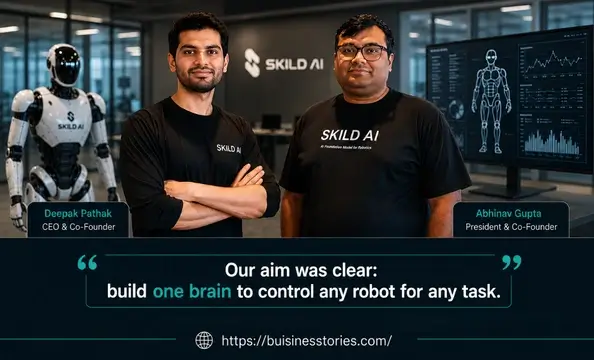
Deepak Pathak and Abhinav Gupta started Skild AI in 2023. Their aim was clear: build one brain to control any robot for any task. Both founders left their jobs as professors at Carnegie Mellon University (CMU) to pursue this dream. Together, they have over twenty-five years of experience in AI and robotics research.
Deepak Pathak — CEO and Co-Founder
Deepak grew up in India. He learned to code by writing programs on paper and testing them at a local internet cafe. He went on to earn a gold medal at IIT Kanpur in 2014 for the top grade in computer science. Then he did his PhD at UC Berkeley. After that, he worked at Facebook AI Research and later taught at CMU.
His research on curiosity-driven exploration is now famous in the AI world. It taught robots how to learn on their own, without constant human help. That idea now sits at the heart of the Skild Brain and is one reason the model can adapt to new robots so fast.
Abhinav Gupta — President and Co-Founder
Abhinav also started at IIT before earning his PhD at the University of Maryland. He later helped start Meta’s AI research lab. Researchers have cited his work on how robots perceive and grasp objects over seventy-five thousand times. He is one of the most cited researchers in the field.
As Sequoia Capital put it in its investment notes, these two founders had the rare tools to build in the real world what OpenAI had built online. And so far, the evidence backs that claim. Their combined track record in both research and real-world AI is virtually unmatched in the robotics space today.
What Is the Skild Brain and Why Does It Matter?
The Skild Brain is the core of everything Skild AI does. Think of it as an operating system for robots. But unlike most robot software today, the Skild Brain does not need to be retrained for each new robot or task. Instead, it works across many robot types at once. This includes humanoid robots, walking robots, robot arms, and mobile robots. The company calls this being omni-bodied.
The Problem with Old-Style Robot AI
Here is why this approach matters so much. Old robot AI is very narrow. A robot trained to sort boxes in a warehouse cannot also sweep a floor. Each task needs its code and its training data. That process is slow and costly. It also limits how broadly robots can be used across different settings.
Most companies in this space still follow that narrow path. Skild AI takes a smarter and more flexible route. Instead of building one system for one task, it builds a single brain that can tackle many tasks across many types of robots. That shift is a big deal for the whole robotics industry.
How the Skild Brain Learns
The Skild Brain trains on four key data sources. First, it trains in simulated worlds that create trillions of fake but realistic robot events. Second, it watches millions of online videos of humans doing everyday tasks. Third, it uses human-guided robot data, where people show robots how to act step by step. Fourth, it learns from real robots working in the field.
Each source makes the brain smarter. And as more robots use it in the real world, the model keeps getting better. This creates a powerful data flywheel — a self-improving loop that is difficult for any rival to copy. Furthermore, the more diverse the tasks and robot types, the stronger the model becomes.
Real-Time Adaptation — A Unique Edge
One of the most exciting features of the Skild Brain is its ability to change in real time. It can handle robots it has never been trained on before. It instantly adjusts to big changes, such as a robot losing a wheel, carrying extra weight, or being placed in an entirely new body. All of these changes happen without any extra training or fine-tuning.
As CEO Deepak Pathak explains, the model is forced to adapt rather than recall. That is how real intelligence works in nature. This level of flexibility sets Skild AI apart from every other robot company operating today. It also makes the Skild Brain far more useful in messy, real-world settings where things do not always go as planned.
How Skild AI Raised Over $1.8 Billion in Record Time
Skild AI’s funding story is one of the fastest in the history of robotics. And it tells you a lot about how much trust the global tech world has placed in this company and its mission.
In 2023, Lightspeed Venture Partners and Sequoia Capital led the company’s small seed round launch. Then, in July 2024, it raised three hundred million dollars in a Series A at a valuation of one-point-five billion dollars. Coatue, SoftBank, and Bezos Expeditions also joined that round, along with Felicis Ventures and General Catalyst.
By mid-2025, Skild AI closed a five-hundred-million-dollar Series B. That pushed its value to four-point-five billion dollars. Then, just seven months later, in January 2026, Skild AI closed a funding round of nearly one point four billion dollars, led by SoftBank Group. Total funding rose to over one point eight billion dollars. Its value hit over fourteen billion, a tripling in just seven months.
Other backers in that final round included NVIDIA’s venture arm NVentures, Jeff Bezos through Bezos Expeditions, Macquarie Capital, Samsung, LG Technology Ventures, Schneider Electric, CommonSpirit Health, and Salesforce Ventures. Lightspeed, Felicis, Coatue, and Sequoia all put in more money, too.
To put that in context, robotics startups as a whole raised thirteen-point-eight billion dollars in 2025, up from seven-point-eight billion in 2024. Skild AI captured a substantial share of that total. Furthermore, the company grew from zero to thirty million dollars in revenue in just a few months of 2025. That pace of growth is rare for any tech company, let alone one still building its core product.
Where Skild AI Deploys Its Technology Today
Skild AI is not just a lab project. It is already active across several real industries, and its reach is growing fast. Today, the company runs the Skild Brain in security and facility checks, last-mile delivery, warehouses, manufacturing plants, data centers, and building and construction sites.
In addition, Skild AI recently acquired Zebra Technologies’ robotics automation business. That move lets it plug the Skild Brain into full fleets of warehouse robots at scale. It also brings an existing set of enterprise customers and a proven fleet management system.
The Data Flywheel Effect in Action
Each new deployment does two key things at once. First, it helps the customer by doing complex, risky, or repeated tasks without human labor. Second, it sends fresh, real-world data back into the Skild brain. This makes the model even smarter over time.
As a result, every new customer who joins the platform helps improve results for all other customers, too. This network effect is a giant edge over rivals. Moreover, it means Skild AI’s advantage grows stronger over time, not weaker. The more robots it controls, the smarter the brain becomes. And the smarter the brain, the more useful it is. That loop is very difficult to break.
The Road to Consumer Robots
Looking ahead, Skild AI plans to bring its tech into consumer homes. Enterprise use comes first, but the bigger vision is to help robots handle daily tasks like cooking, cleaning, loading a dishwasher, and tidying up. That goal places Skild AI at the center of one of the biggest market opportunities of the next decade.
Think about how smartphones changed how we shop, talk, and work. Smart home robots could do the same for how we live day to day. Skild AI is developing the technology that will drive this transformation. If its vision plays out, the Skild Brain could become as essential to home robots as iOS is to iPhones.
What Sets Skild AI Apart from Its Rivals?
The robot AI market is growing fast. Companies like Covariant, Physical Intelligence, and Genesis AI are all working in this space. So what makes Skild AI stand out? The answer lies in its focus on broad, general learning across all robot types and tasks.
Most rivals still focus on specific tasks or hardware. Covariant targets warehouse pick-and-place tasks and claims very high accuracy rates. Physical Intelligence is building open-source models for robot control. Genesis AI creates rapid physics engines that train models three times faster than older tools. Each approach has real value. But each is also limited to a narrow set of use cases.
Skild AI trains its model across every robot type and task at once. That means its training data is far bigger and more varied than any single-task rival. Furthermore, its business model works like shared tech infrastructure. It licenses the Skild Brain through cloud APIs, similar to how Amazon Web Services sells compute power. Robot makers and enterprise buyers pay for smart AI rather than building it themselves.
This positions Skild AI as a key layer under the whole robotics industry. And its data moat grows stronger with every robot the Skild Brain controls. There is no open internet of robot data, so Skild AI built its own. That dataset becomes more valuable every day. And no new rival can catch up.
What the Future Holds for Skild AI and Physical AI
Skild AI is entering a major new phase of growth. Its fresh funding will go toward scaling its model, adding more real-world robot projects, and moving toward home robots. The company now has offices in Pittsburgh, the San Francisco Bay Area, and Bengaluru, India. That global footprint matches its global vision.
The broader robot market is moving very fast. Labor costs are rising around the world. AI is getting better and cheaper. Demand for smart and flexible robots is growing in health care, shipping, factories, and beyond. Industries that used to rely on human workers for risky or repeated tasks are now looking for robot solutions that can adapt to change. Skild AI is building exactly that.
Furthermore, key investors like Samsung, LG, and Schneider Electric are not just putting money in. They are also likely to become big customers and launch partners. That means Skild AI could see major enterprise contracts flowing from its investor base. That is a rare and powerful advantage for a company still in its early years of growth.
Looking further ahead, the goal is clear. Skild AI wants to create the same kind of platform shift for robots that Microsoft Windows created for PCs or that Android created for phones. One brain. Any robot. Any task. That vision is bold. But the team, the funding, and the technology all point in the same direction.
Conclusion: Why Skild AI Is a Startup to Watch Right Now
Skild AI is doing something that most companies only dream about. It is turning decades of profound research into a platform that could power every robot on Earth. From its roots at CMU to its record-breaking Series C led by SoftBank, the company has proven that bold ideas, backed by exceptional skills and decisive action, can create entirely new industries.
The Skild Brain is not just a clever product. It is the base layer of a new era in physical AI. As robots spread into warehouses, offices, hospitals, and homes, the need for a smart and flexible robot brain will only grow. And Skild AI is building that brain today.
For founders and investors, the startup is one of the most exciting companies to track right now. It gives tech enthusiasts a true glimpse of a future in which intelligent robots are just as ubiquitous as phones. And for business leaders, it signals that flexible, smart automation is coming to every industry faster than most people expect.
If you want to stay ahead of the robotics wave, follow Skild AI‘s progress, read its research papers, and watch how its real-world projects grow over the coming years. Right now, we are building the future of smart machines. And Skild AI is leading the way.
Frequently Asked Questions About Skild AI and Robotics
What is Skild AI?
Skild AI is a Pittsburgh-based startup that builds a universal AI model for robots. The Skild Brain model can control various types of robots without requiring retraining for each one.
Who founded Skild AI?
Deepak Pathak and Abhinav Gupta, both former professors at Carnegie Mellon University, co-founded Skild AI in 2023.
How much funding has Skild AI raised in total?
Skild AI has raised over one point eight billion dollars in total. This includes a one-point-four billion dollar Series C in January 2026, led by SoftBank Group.
What is the Skild Brain?
The Skild Brain is the company’s unified robot model. It learns from simulations, online videos, human-guided robot data, and live robot deployments to control any type of robot.
Where does Skild AI use its technology today?
Today, Skild AI works in security, last-mile delivery, warehouses, factories, data centers, and building sites. The company also plans to expand into everyday consumer homes in the future.

Tabassum Shaik is an Author, Researcher, and SEO Specialist with over 8 years of experience creating informative content on business, startups, entrepreneurship, marketing, technology, and digital trends. She specializes in researching industry trends and transforming complex topics into practical, easy-to-understand insights. Her goal is to help readers stay informed, learn new ideas, and make better business decisions.