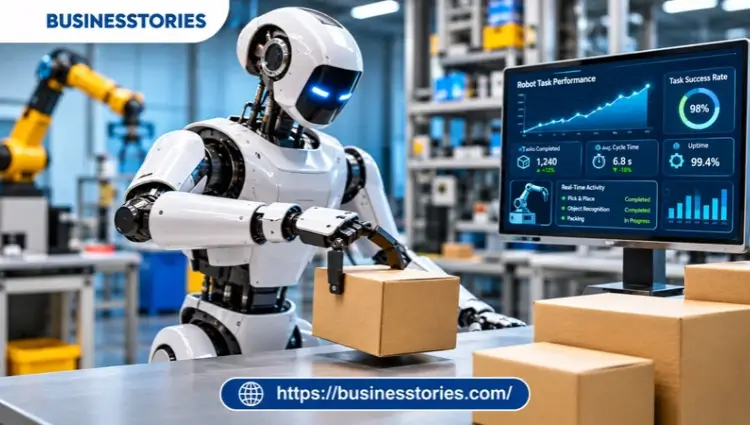
In April 2026, a robot used an air fryer it had never seen. Nobody had trained it for that task. A person simply talked it through the steps, and it worked. That robot ran on software from Physical Intelligence, a San Francisco startup building one AI “brain” for many kinds of robots.
In short, it makes robot foundation models. These AI models turn camera images and plain-language commands into arm and gripper moves. The company doesn’t build robots. Instead, it wants to be the software that robot makers plug in. Think of how apps plug into a chatbot model.
So what’s in this guide? You’ll see who founded it and how its π models work. Next, you’ll see where they do paid work today. Finally, we’ll look at what the price tag really says and how it stacks up against rivals.
Key Takeaways
- Physical Intelligence builds general-purpose AI models for robots, not robot hardware.
- Its newest model, π0.7, can handle some tasks it was never trained on.
- The company has raised about $2.1 billion and has no disclosed revenue.
- Bloomberg reported in October 2026 that it was in talks at a valuation near $20 billion.
- Real partners already use its models to fold laundry and pack warehouse orders.
What Is Physical Intelligence?
It’s a robotics AI company, also called Pi or π. It builds one model that can run many robot bodies and learn many tasks.
Think about how chatbots work. A developer doesn’t train a language model from scratch. They call an existing model and build on top of it. Robotics has never had that shortcut. So every robot team has had to build its own controllers, data pipelines and models first.
The company wants to change that. In a February 2026 post, it called its models a ready-made “physical intelligence layer” for robot builders. You provide both the robot and the specific task it needs to perform. Pi supplies the brain.
The core tech is a vision-language-action (VLA) model. Here is the simple version:
- Vision: the robot’s cameras show the model what’s in front of it.
- Language: a person gives an instruction, such as “clean the kitchen”.
- Action: the model outputs motor commands for the robot’s joints.
It begins as a large vision-language model, similar to those used in chatbots. Then it learns to output movement as well as words.
Here’s what most explainers miss. Robots can’t learn from the internet the way chatbots do. There’s no web-scale pile of “how to fold a shirt” motion data. Therefore, Pi must generate its data. So people guide robot arms by hand through tasks.
They do it in offices, homes, warehouses, and a test kitchen, according to Revenue Memo’s September 2026 analysis. That data is the real moat. It’s also the real cost.
Why should you care? If this approach works, a small firm could buy a cheap arm and rent a smart brain for it. That would make robots far more common in shops, kitchens, and small plants, from Ohio to Osaka.
Who Founded Physical Intelligence?
Seven co-founders started the company in early 2024. Most came from Google’s robotics teams, Stanford, or UC Berkeley.
The founding team includes:
- Karol Hausman, CEO, formerly at Google DeepMind
- Sergey Levine, a UC Berkeley professor
- Chelsea Finn, a Stanford professor
- Brian Ichter, from Google’s robotics research
- Lachy Groom, an early Stripe employee turned angel investor
- Quan Vuong and Adnan Esmail
That mix explains a lot. Levine and Finn are among the best-known names in robot learning. The groom is responsible for handling the financial and business aspects. He joined Stripe as roughly its 30th employee, and he later backed Figma, Notion, and Ramp.
So why did investors fund a team before it had a product? Simply put, they were betting on people. The company came out of stealth in March 2024 with a $70 million seed round led by Thrive Capital.
The culture is unusual, too. Groom told TechCrunch in January 2026 that he won’t provide investors a date for sales. At that point, the team had about 80 staff. It also bought stock robot arms at about $3,500 each.
It didn’t design its own hardware. In fact, Groom thinks the same arms could cost under $1,000 one day.
Our take: this “research first” stance is both the strength and the risk. This approach keeps the team focused on solving difficult problems. However, it also means the business is still a promise. Most startups chase revenue early. This one has chosen not to, and so far its backers have let it.
How Physical Intelligence Models Teach Robots to Think
With each release, the π models get better at one key skill: doing tasks they weren’t trained for. That’s the whole game.
| Model | Released | What changed |
| π0 | Oct 2024 | First generalist policy, trained on many tasks and robot types |
| π0-FAST | Jan 2025 | New action tokenizer that trains about 5x faster |
| π0.5 | Apr 2025 | Cleans kitchens and bedrooms in homes it never saw |
| π*0.6 | Nov 2025 | Learns from its own mistakes and human feedback |
| π0.7 | Apr 2026 | Can be steered by language and shows new skills |
Source: Physical Intelligence research blog, 2024–2026.
The big jump came with π0.5. It trained on a mix of data: other robots, web data, and verbal instructions. As a result, it could work in homes that weren’t in its training set.
Then π0.7 went further. In its April 2026 release, the company showed it running an air fryer with step-by-step verbal coaching. It also folded T-shirts on a robot arm that had no shirt-folding data. In simple terms, a skill acquired on one robot’s body was transferred to another.
In March 2026, Pi also added memory. Its MEM system lets models handle tasks longer than ten minutes.
Now, a reality check. These are company demos and research papers. They aren’t independent tests. In addition, the team itself admits that π0.7 can’t yet finish complex multi-step jobs from a single high-level command.
The open-source angle matters as well. Pi released the π0 weights and code in February 2025 through its openpi repository. That builds goodwill with researchers. On the other hand, it raises a fair question. If advanced robot brains become free, what exactly will customers pay for?
Physical Intelligence Valuation: From $400M to a Reported $20B
The Physical Intelligence valuation has climbed faster than almost any startup’s. This increase occurred despite the company having no recorded revenue. Here’s the timeline.
| Date | Round | Amount | Valuation |
| Mar 2024 | Seed | $70M | About $400M (reported) |
| Nov 2024 | Series A | $400M | $2.4B |
| Nov 2025 | Series B | $600M | $5.6B |
| May 2026 | Series C (filed, not announced) | About $1.05B | About $11B |
| Oct 2026 | In talks (Bloomberg) | At least $1B | About $20B |
Sources: Revenue Memo, 2026; Bloomberg, October 2026.
In total, the company has raised about $2.1 billion. Big names back it. They include Thrive Capital, Lux Capital, CapitalG, Jeff Bezos, and OpenAI.
Notice two things. First, the May 2026 round appears in corporate filings, but the company never announced it. Second, the $20 billion figure comes from talks, not a closed deal. Bloomberg said existing backers Avenir and Lux were in talks to lead.
What most guides miss: several investors also fund possible rivals. For example, CapitalG belongs to Alphabet. And Alphabet runs its own robot AI, Gemini Robotics. OpenAI restarted its robotics team, too. In effect, these backers are hedging. They want a stake in whoever wins. We’ve seen the same pattern across AI startups that run on research, not revenue.
So is the price fair? Honestly, nobody can say yet. With no public sales, the price tracks research wins and investor hunger. In short, this investment is a bet on a future market. It isn’t a bet on today’s sales.
Where Physical Intelligence Models Work Today
Pi’s models already run in a few paid jobs. The proof is small, but it’s real. Here are the three best examples.
Weave: Laundry Folding
Weave builds laundry-folding robots and runs them at a San Francisco laundromat. Folding is famously challenging for robots because clothes bend and shift.
According to Pi’s February 2026 partner report, adding Weave’s data to π0.6 training reduced the need for operator interventions by 50%. It also reduced missed grasps by 42%.
Ultra: Warehouse Packing
Ultra uses robots to pack online orders in US warehouses. Using π0.6, one robot ran a full shift at 96.4% autonomy. In other words, humans stepped in for only a small slice of the work.
The Pi API Beta
In October 2026, the company opened a Pi API beta. Developers upload robot data, fine-tune a model on Pi’s computers, and run it through a hosted gateway. Early users span heavy equipment, food prep, and factory work. For example, Almond trained its two-armed robot to deburr parts after four days of iteration.
Here’s the insight most coverage skips. Both Weave and Ultra did better once their data went into training. That’s the flywheel Pi is betting on. Every new site makes the next model better for everyone.
Over time, that loop could be harder to copy than any single model. However, the API tests also showed limits, such as network problems with cloud-run robots.
How Physical Intelligence Compares to Other Robotics Startups in 2026
Pi isn’t alone. Robotics startups in 2026 are raising record sums, and several chase the same “one brain, any robot” goal.
| Company | Approach | Latest reported valuation |
| Physical Intelligence | Software only; VLA models for any robot | About $11B (filed); ~$20B in talks |
| Skild AI | Software brain for many robot bodies | Over $14B (Jan 2026) |
| Figure AI | Builds its own humanoid robots and AI | $39B |
| Generalist AI | Robot foundation models | $2B (June 2026) |
Sources: TechCrunch, January 2026; Sacra; Revenue Memo, 2026.
The money is flowing fast. Global robotics funding hit $13.8 billion in 2025, up from $7.8 billion in 2024, based on Crunchbase data reported by Fintool in January 2026.
Skild AI is the closest rival. It’s a software-first company, too. Unlike Pi, though, it has disclosed revenue, and it has bought hardware businesses to move closer to customers.
Figure AI takes the opposite path. As our Figure AI startup story shows, it owns the full stack, from robot body to model.
Our view: Pi’s software-only plan is the riskiest and the most scalable at once. If it works, Pi could become the “Android for robots.” However, open models could also improve significantly.
Then robot brains turn into a cheap commodity. Meanwhile, Big Tech labs are building their own. That’s the tension to watch in 2027.
Conclusion
PI is chasing one clear goal: a single robot brain that works across bodies and tasks. Its π0.7 model shows early signs of that, with skills it was never taught.
Still, the business is unproven. The company has raised about $2.1 billion and shared no revenue. Its value now rests on research wins, a small set of real deployments, and a new developer API. Meanwhile, rivals like Skild AI and Figure AI are moving fast with their playbooks.
Here’s our bottom line. Physical Intelligence is the purest bet that robot brains will work the way chatbots did. If that happens, it wins big. The edge shrinks if robot brains become cheap and common.
Frequently Asked Questions
1. What does Physical Intelligence do?
It builds AI models that run robots. Its models take in what the robot sees plus a typed or spoken command. Then they tell the robot how to move. The company sells no hardware. Instead, robot makers use its models as a ready-made brain for their machines.
2. What is the Physical Intelligence valuation in 2026?
Corporate filings point to a valuation of about $11 billion in a May 2026 round. In October 2026, Bloomberg reported talks for new funding near $20 billion. The company hadn’t confirmed that deal at the time of writing.
3. Does Physical Intelligence have revenue?
Not that it has shared. The company has stayed research-first and set no public timeline for sales. Its Pi API beta, launched in October 2026, is the clearest step towards a paid product so far.
4. Who founded Physical Intelligence?
Seven people co-founded it in 2024. They are Karol Hausman (CEO), Sergey Levine, Chelsea Finn, Brian Ichter, Lachy Groom, Quan Vuong, and Adnan Esmail. Most came from Google’s robotics teams, Stanford, or UC Berkeley.
5. Can I buy Physical Intelligence stock?
No, you can’t buy shares on a public exchange. It’s a private firm, and it hasn’t filed for an IPO. Its investors include Thrive Capital, Lux Capital, CapitalG, Jeff Bezos, and OpenAI.

Tabassum Shaik is an Author, Researcher, and SEO Specialist with over 8 years of experience creating informative content on business, startups, entrepreneurship, marketing, technology, and digital trends. She specializes in researching industry trends and transforming complex topics into practical, easy-to-understand insights. Her goal is to help readers stay informed, learn new ideas, and make better business decisions.