
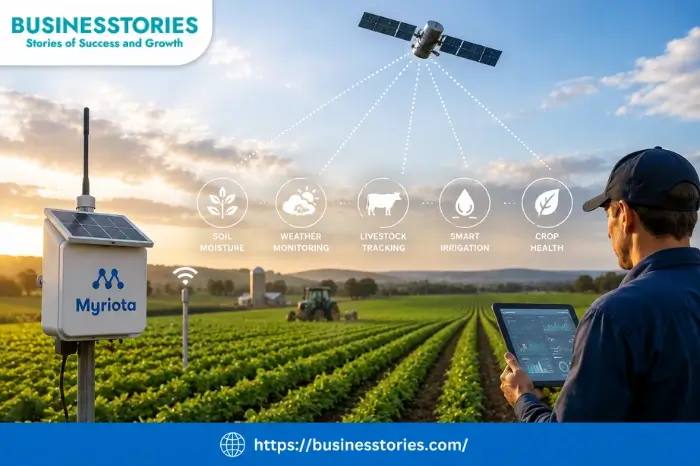
Think of a cattle station in the Northern Territory. There is no phone signal. There is no internet. Cattle roam across vast red land. Water troughs are spread over hundreds of kilometers. If a trough runs dry, animals can die. Often, no one finds out until it is too late. That is precisely the problem that Myriota Satellite IoT set out to solve.
Myriota started in 2015. It spun out of the University of South Australia. Today, it is one of Australia’s best tech success stories. It links thousands of remote sensors to the internet via a fleet of small, low-earth orbit satellites. No phone towers are needed. And no gateways are needed. No costly ground setup is needed at all.
For Australian farmers, this tech is a true game changer. It sends real data to places that never had it before. Furthermore, it does so at a tiny cost compared to old satellite systems. In this article, we look at Myriota’s startup story, its impact on smart farming, and why it matters far beyond the outback.
| Founded | 2015 — University of South Australia spin-out |
| Headquarters | Adelaide, South Australia (Lot Fourteen) |
| Co-founders | Dr David Haley (CTO) & Dr Alex Grant |
| Total Funding | Over AU$100 million raised to date |
| Latest Round | AU$50 million (Dec 2024) — NRFC & Main Sequence |
| Team Size | 75+ staff across 14 global locations |
| Key Sectors | Agriculture, Water, Defence, Mining |
| Patents | 60+ granted patents globally |
From a University Lab to the Outback
Every outstanding startup begins with a real problem. For Dr. David Haley and Dr. Alex Grant, the key question was simple. How do you link a remote sensor to the internet for just a few cents a day? Both men worked at the University of South Australia. Together, they saw a clear gap in the market.
As early as 2013, their team hit a world first. They sent IoT data directly to a small satellite. That result proved the idea was real. Then, in 2015, they turned their research into a business and launched Myriota. The core idea was smart and simple. They built a way to let satellites pick up very faint signals from tiny ground sensors.
They also added tools that save battery life. Together, these steps made low-cost satellite links for IoT sensors possible for the first time.
From day one, the founders put customers first. They spoke with farmers, water managers, and defense teams. They asked what those people truly needed. Then they built their platform around those real needs. That focus on the customer has guided Myriota ever since.
The early years were challenging. But the founders stayed patient. They got seed funds from Canadian firm exactEarth. That money paid for the prototypes and tests. Then, in 2018, the startup raised US$15 million in a Series A round.
Boeing HorizonX led the round. Notably, this was Boeing’s first big deal outside the United States. That backing sent a strong signal to the global market.
How Myriota Satellite IoT Works
To grasp Myriota, you first need to understand the problem it solves. Currently, about 90% of the Earth has no reliable mobile signal. For most firms, that is a mild issue. But for Australian farmers running vast stations, it is a daily crisis.
Direct to Orbit: No Towers Needed
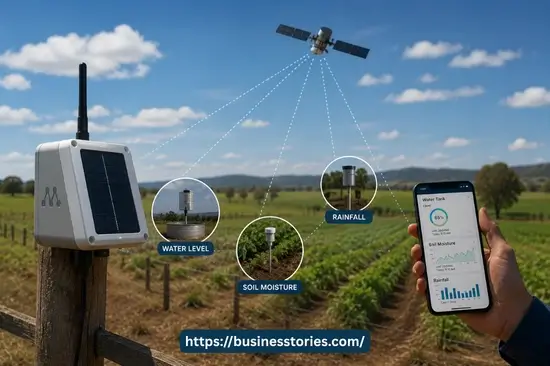
Myriota uses a direct-to-orbit model. This means it needs no extra ground hardware at all. No towers and gateways. No complex setup. A small, low-power module attaches to a sensor in the field. That sensor might track water tank levels, soil moisture, or rain totals. When a small satellite passes overhead, the module wakes up.
It sends a tiny data packet to the satellite. Then it goes back to sleep. The satellite picks up the signal and sends the data to a secure cloud app. From there, the farmer checks it on their phone. In this way, Myriota gets data from the most remote parts of Australia straight to a smartphone screen.
Low Cost and Long Battery Life
One of Myriota’s biggest wins is its low cost. It claims a total cost up to 50 times lower than rival satellite options. Devices can run for years on just two AA batteries. In some cases, they last over a decade. This approach works because the module sleeps almost all the time. It wakes only when a satellite is overhead. Then it sends the smallest data packet it can and goes back to sleep.
Furthermore, users pay only for what they send. There are no big data plans and no waste. For a station in the Northern Territory, such a plan can mean checking 50 water troughs for under AU$5 per trough each month. This price significantly impacts farmers who meticulously manage their finances.
The Myriota Module and FlexSense
The main hardware is the Myriota Module. It is a small, smart device that works with a giant range of sensors. It can log data on a set schedule or respond to a trigger event. Then it sends data securely to the satellite network.
The newer FlexSense product builds on these features. It lets farmers and builders set up a solution with very little tech skill. Together, these two products make setup fast and simple for almost anyone.
How Myriota Is Changing Australian Farms
Australia’s farms face unique problems. The land is vast and dry. Many areas have no mobile signal at all. For many years, farmers managed remote assets through long manual checks. That meant big drives, wasted fuel, and real risk.
A sensor linked to a satellite can do those checks for pennies. Myriota is making these checks a real daily practice across Australia.
Water Management: Every Drop Counts
Water is the top resource on any Australian farm. A dry trough or a leaking tank can be a disaster, especially in a drought. Myriota tackled this head-on. It joined forces with Queensland agtech firm Goanna Ag. Together, they built two key products: GoTank and GoRain.
GoTank checks the water levels in livestock tanks in real time. It tracks height, volume, and flow. It sends instant phone alerts when levels drop below safe limits. GoRain is a satellite rain gauge accurate to within plus or minus 2%.
During rain events, it sends readings every 10 minutes. Future versions will also link to weather forecasts and crop yield tools.
These are not small tests. The Victorian government ran an AU$12 million on-farm IoT trial. Goanna Ag was an approved supplier in that program. Farmers in fruit growing, dairy, sheep, and crop farms all took part. The results were clear. IoT sensors cut water waste, stopped livestock losses, and freed up farmer time for better work.
A report by Australia’s farm and water department showed a key finding. Digital farming could lift the gross value of farm output by 25% from 2014-15 levels. Myriota is a key tool in reaching that goal.
Livestock Tracking and Geofencing
Beyond water, Myriota’s platform also tracks livestock. Farmers can watch animal movement, set boundary alerts, and get instant phone warnings when animals stray. On big properties, the technology cuts mustering time a great deal. It also saves a lot of fuel. Plus, odd movement patterns can flag health issues early, before they turn into bigger problems.
Soil Monitoring and Smart Irrigation
Myriota also links to soil moisture sensors. These give farmers live ground data. So irrigation choices become smarter and more precise. Farmers waste less water. Crops get what they need, when they need it. Partner Grundfos uses Myriota’s network for its Solar Connect product.
That product makes sure remote pump and tank systems never fail without a warning. As a result, livestock always have water.
From Seed to AU$50 Million
Myriota’s funding story is a model of patience and smart choices. The team did not raise big sums early and spend fast. Instead, they constructed their business gradually. They proved their tech, added customers, and then brought in investors who knew deep tech well.
The First Rounds: Seed and Series A
The first seed round was AU$2.5 million from exactEarth. That money funded the prototypes and tests. Then, in 2018, Boeing HorizonX led a US$15 million Series A. Notably, that was Boeing’s first deal outside the United States.
Shortly after, Singtel Innov8, the venture arm of Singapore’s big telco, also joined as an investor. Furthermore, Right Click Capital came in through Australia’s ESVCLP program. Each investor brought not just money but real skills and strong networks.
Series B and Fast Growth
In 2020, Myriota closed a AU$28 million Series B led by Main Sequence Ventures. Main Sequence is the deep tech fund of CSIRO. As part of this deal, Myriota also bought satellite assets, ground stations, and spectrum rights from exactEarth.
That purchase boosted its reach in North America greatly. Now the company had real global reach on two continents.
The AU$50 Million Milestone in 2024
The biggest raise came in December 2024. Myriota secured AU$50 million in a round led by the National Reconstruction Fund, also known as NRFC. Notably, this was the NRFC’s first investment in Australia’s space sector. Main Sequence Ventures and Inter Valley Ventures also joined the round.
Together, these investments pushed Myriota’s total funding beyond AU$100 million. The money will pay for up to 100 new engineering jobs in South Australia. It will also drive global growth in Southeast Asia and Africa.
Building Australia’s Space Sector
Myriota is far more than a farm tech firm. It is a key part of Australia’s growing space sector. The company sits at Lot Fourteen in Adelaide. That precinct is also home to the Australian Space Agency.
Owning and Launching Satellites in Australia
Myriota owns and runs its satellites. These include the Kanyini satellite, designed and built in South Australia and launched in 2024. Beyond its own fleet, Myriota also uses space on dozens of other satellites from third parties.
It does this through its Space as a Service model. As a result, the network is more robust, more scalable, and more cost-effective than any single-fleet approach.
Furthermore, with help from the Australian Space Agency’s Moon to Mars plan, Myriota is now building a new low-cost satellite module. That module will support IoT links beyond Earth itself. It will let space agencies and firms monitor assets on the Moon and beyond.
This is a bold leap, from watching water tanks in the outback to helping with lunar missions.
Keeping Manufacturing in Australia
A key part of Myriota’s story is its promise to make all hardware in Australia. It has offices across North and South America, Europe, and more. However, South Australia produces 100% of its hardware. The NRFC aims to scale this output to meet rising global demand with its AU$25 million investment.
Furthermore, Myriota has launched the Myriota Impact and Access Fund. This program gives annual grants of up to AU$7,000 each to students from remote and regional areas who want to study STEM subjects.
The Myriota Habitat Partner Network
Myriota does not work alone. It has built a strong partner network called the Myriota Habitat. This group includes sensor makers, system builders, and product firms that all use the Myriota platform.
Partners include Goanna Ag for farming and Rain Harvesting Connect for water tracking. RF Technologies handles defense uses. By building this network, Myriota grows its reach far beyond what one team could do alone.
Smart Farming and Australia’s Future
Myriota’s story is about much more than satellites and sensors. It is about a big shift in how Australian farmers know their land. For many years, remote farming meant working in the dark. Farmers traveled hundreds of kilometers to check tanks.
They guessed at water needs based on memory. They lost animals to problems a sensor could have caught in minutes. That era is ending. Today, a farmer can sit at home and open an app. They can monitor every water trough on their property in near real time.
They can get a phone alert when a tank runs low. Also track their herd without leaving the house. All of this technology is now real, thanks to Myriota Satellite IoT.
The Scale of the Chance
Gartner predicts that global IoT spending will almost double to AU$991 billion by 2028. Australia’s vast, signal-poor land makes it the ideal test ground for satellite IoT tools. The lessons learned here, in hardware design, power use, and data work in harsh places, will shape the global sector for years to come.
Furthermore, Myriota’s platform scales very well. A small family farm can deploy one GoTank sensor and see real value right away. A large farm group with many sites can deploy tens of thousands of sensors across all locations. The same tech serves both, at a price that suits each one.
Green Gains and Less Waste
Satellite IoT also delivers real green gains. Smart irrigation cuts water waste by a huge deal. Early fault detection stops spills and soil damage. Remote checks also mean fewer farm vehicle trips, cutting fuel use and emissions. For Australia, a land under growing stress from climate change and drought, these gains are not a bonus. They are vital.
Conclusion
Myriota Satellite IoT began as a research idea in a university lab in South Australia. Today, it is a world leader in direct-to-orbit links. It has raised over AU$100 million, holds 60 or more patents, and links sensors across Earth’s most remote areas.
For Australian farming, the impact is already real. Farmers now check water tanks in real time. They track livestock across vast stations. They make smart watering choices using live soil data. Together, these tools are starting to unlock the 25% gain in farm output that digital farming has long promised.
But the story is far from done. Myriota has just begun its journey, closing its AU$50 million round, rapidly expanding its global partner network, and setting its sights on the Moon. The outback has already established a connection. The rest of the world will be the next focus for Myriota.
If you are a farmer, a tech builder, an investor, or just someone who loves a wonderful startup tale, Myriota’s journey is well worth knowing. Start by reading more inspiring Australian startup stories on Businesstories. Meet the innovators who are quietly building Australia’s tech future from the ground up.

Senior Business Analyst / Prduct Owner with 12+ years of experience driving data-driven insights, optimizing business processes, and delivering strategic IT solutions.