
Introduction
What if we told you that one of India’s most loved food brands started with just ₹50,000? Even better, it started in a tiny kitchen! That is precisely how iD Fresh Food began its amazing journey in 2005.
From a small 50-square-foot kitchen in Bengaluru, this startup grew into a brand worth over ₹5,000 crore. Today, it serves millions of households across India and the world.
The story of iD Fresh Food is not just about idlis and dosa batter. It is about five cousins who dared to dream big. Furthermore, it is about a founder who once failed in school but later spoke at Harvard. Most importantly, it is about building trust in an industry where freshness matters the most.
Today, iD Fresh Food operates in over 44 cities across India, the UAE, the US, the UK, Singapore, and Saudi Arabia. The company sells more than 65,000 kilograms of batter every single day. Moreover, the company recorded revenue of ₹688 crore in FY25. It is now preparing for a massive IPO by 2027. But how did they get here? Let us dive into the complete story.
The Humble Beginning: Two Brothers and a Dream
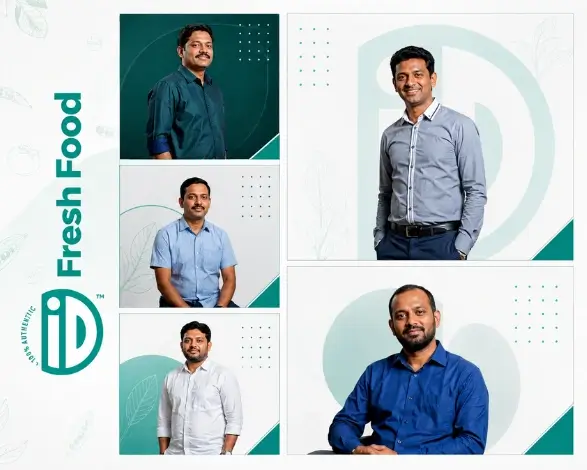
The story begins with PC Musthafa, a boy from Chennalode village in Kerala’s Wayanad district. His father worked as a daily-wage porter. Food was scarce. Breakfast was often a luxury. Musthafa actually failed Class 5. Later, he dropped out of school for a while.
But he had a burning desire to change his life. So, he returned to school. He completed his engineering from NIT Calicut. Later, he earned an MBA from IIM Bangalore. Along the way, he worked with big companies in India, Europe, and the Middle East. But something was missing.
Meanwhile, his cousins, Shamsudeen TK, Abdul Nazer, Jafar TK, and Noushad TA, were running a small kirana store in Bengaluru. They noticed something interesting. Many customers came asking for ready-made idli and dosa batter. However, the batter available in shops was often sold in unhygienic plastic packets. Sellers sealed them with rubber bands. Quality was poor. Customers were unhappy.
“Even though customers complained about poor quality, the demand was huge. So, we thought, ‘Why don’t we do it better?'” — PC Musthafa
The cousins realized something important. There was a huge gap in the market. People wanted fresh, clean, and trustworthy batter. Nobody was providing it at scale. That is when the idea for iD Fresh Food was born.
How iD Fresh Food Started Their Journey
In 2005, the five cousins pooled in ₹50,000 to start their venture. They rented a small 50-square-foot kitchen in Tippasandra, Bengaluru. The equipment was simple. They had one grinder, one mixer, a weighing machine, and a sealing machine. Additionally, they bought a second-hand scooter for deliveries.
The name “iD” came from two sources. It stands for Idli and Dosa. But Musthafa jokes that it could also refer to his IIM ID card! Either way, the brand was born.
They designed a simple logo. They paid ₹2,000 to a designer. Then, they found a packaging vendor. On day one, they made a profit of just ₹400. It was not much. However, it marked the beginning.
The Batter Blast: A Turning Point
The Incident That Changed Everything
Five months into the journey, something unexpected happened. iD Fresh Food had supplied a few batter packets to a local kirana store. The store did not have a refrigerator. The batter over-fermented in the heat. And then, a small blast occurred.
It was a devastating moment for the young team. The store owner was upset. Customers lost trust. The cousins found themselves in the same position as before.
But instead of giving up, they treated the incident as their biggest learning moment. Importantly, PC Musthafa says, “The blast helped us set right the packaging and manufacturing processes.”
Here is what they changed after the incident:
- Controlled fermentation technology: They developed a method to keep the batter fresh without preservatives.
- Better packaging: They redesigned their packets to prevent over-fermentation.
- Selective store partnerships: They only supplied to stores with proper refrigeration.
- Cold chain logistics: They built a strong cold supply chain from factory to store.
This incident provided them with a valuable lesson. In the fresh food business, trust is everything. You cannot cut corners. You cannot compromise on quality.
The Zero-Inventory Model
After the batter blast, iD Fresh Food implemented a unique zero-inventory model. Let us explain how it works:
- They manufacture batter only based on confirmed orders.
- Whatever they produce today gets dispatched the next morning.
- Stores receive fresh stock every single day
- Nothing sits in a warehouse for more than 24 hours.
This model ensures that customers always get the freshest product possible. Furthermore, it reduces waste. It also keeps operational expenses low. Today, business schools study this zero-inventory approach as a real-world case study.
Building the Brand: Innovation at Every Step
Product Innovation Beyond Batter
For the first few years, iD Fresh Food sold only idli and dosa batter. But the team knew they needed to grow. So, Abdul Nazer, who has a natural talent for cooking, became the company’s R&D head.
He started experimenting with new products. As a result, he created a whole range of fresh foods. These foods made life easier for Indian households.
| Product Category | Launch Year | Why It Worked |
| Idli/Dosa Batter | 2005 | Core product, preservative-free |
| Malabar Parota | 2012 | Ready-to-eat, traditional taste |
| Vada Batter | 2018 | “Squeeze and fry” innovation |
| Filter Coffee Liquid | 2018 | Instant, authentic South Indian coffee |
| Paneer & Curd | 2015 | Fresh dairy, no chemicals |
| Bread (iD Bread) | 2020 | Soft, preservative-free sandwich bread |
From 13-14 products a few years ago, the company now has over 35 SKUs (stock-keeping units). Each product follows the same principle: no preservatives, 100% natural, and a fresh taste.
The Vada Innovation That Went Viral
One of the most creative innovations from iD Fresh Food was the Vada Batter pack. Making vada at home can be a bit tricky. You need to get the batter consistency right. Then, you must shape it into a doughnut form. Many home cooks struggle with this task.
The iD team solved this problem with a simple idea. Therefore, they designed a packet with a nozzle. You just squeeze the batter directly into the frying pan. It comes out with a hole in the middle. Perfect vada shape, every time.
A video of this product went viral on the internet. In fact, the internet leaked it before Musthafa could present it at Harvard! The company turned the incident into a marketing win. The product sold out within five minutes of its launch at a Bengaluru store.
The Unmanned Cooler Campaign
When iD Fresh Food first started, many customers were skeptical. “How can packaged food be fresh?” they asked. So, to build trust, the team came up with a bold idea.
They placed unmanned coolers in select stores. Customers could pick up any product. Then, they left money in a box. No staff and supervision. No cameras. Just pure trust.
The result was surprising. Not only did customers pay honestly, but sales actually went up. Furthermore, this campaign won the “Best Food Marketing Idea 2016” award. It proved that trust works both ways. The message was clear: iD trusts its customers. Customers trust iD back.
The Funding Journey: From Bootstrap to Billion
Early Days: Self-Funded Growth
iD Fresh Food was bootstrapped for nearly a decade. The founders reinvested every rupee back into the business. Importantly, Musthafa sold his land in Wayanad for ₹40 lakh. He used the proceeds to fund expansion. Additionally, he pumped in another ₹30 lakh from his personal savings.
This self-funded approach had a big advantage. The founders never lost control of their vision. They made decisions based on what was right for the brand. They did not worry about what investors wanted.
| Year | Funding Round | Amount | Investor |
| 2014 | Series A | ₹35 Cr ($5.2M) | Helion Venture Partners |
| 2017 | Series B | $25M | Premji Invest |
| 2021 | Series C | ₹507 Cr | NewQuest + Premji Invest |
The Premji Invest Partnership
The funding from Premji Invest in 2017 significantly transformed the situation. Azim Premji’s investment arm saw huge potential in the fresh food category. As a result, with this capital, iD Fresh Food set up five large manufacturing facilities across India and the Middle East.
The company expanded from 10 cities to over 44. They entered new markets like Delhi, Hyderabad, Kolkata, and Ahmedabad. Moreover, international expansion to the UAE, the US, the UK, and Saudi Arabia followed soon after.
A 10X Return for Early Investors
In 2021, Helion Ventures, the first institutional investor, made a complete exit. They walked away with a 10X return on their original investment. This was a strong signal to the market. It indicated that iD Fresh Food was a solid bet.
The same year, NewQuest Capital Partners and Premji Invest together poured in ₹507 crore. This funding valued the company at over ₹2,000 crore. As a result, it set the stage for the unicorn journey.
Financial Performance: The Numbers Speak
Breaking the Loss Streak
Here is a surprising fact. Despite its popularity, iD Fresh Food operated at a loss for nearly two decades. The company prioritized growth and reinvestment over short-term profits.
But things changed dramatically in FY24. The company posted its first-ever profit. The company achieved a profit before tax (PBT) of ₹4.56 crore. In FY25, that number jumped nearly six times to ₹26.7 crore.
| Metric | FY24 | FY25 | Growth |
| Revenue from Operations | ₹558 Cr | ₹681 Cr | 22% |
| Total Revenue | ₹563 Cr | ₹688 Cr | 22.27% |
| Profit Before Tax | ₹4.56 Cr | ₹26.7 Cr | 486% |
The company now aims to grow 20–25% year over year while staying profitable. Their target is ₹1,100-1,200 crore in operating revenue by FY27.
Path to the IPO
PC Musthafa has been clear about his vision. iD Fresh Food is preparing for an IPO by October 2027. The company is not actively seeking more funding. However, there is buzz about a pre-IPO secondary sale worth around ₹1,200 crore.
Musthafa says, “We are looking at an IPO in two years. We want to create a publicly listed, ethical, multi-billion-dollar, made-in-India fresh food brand for the world.”
Global Expansion: From Bengaluru to the World
Entering New Markets
iD Fresh Food began its global journey in the UAE in 2012. Today, the brand operates in nine countries, including the following:
- India (44+ cities)
- United Arab Emirates
- United Kingdom
- Singapore
- United States
- Saudi Arabia
- Oman
- Bahrain
- Canada
The company has set up manufacturing hubs in Bengaluru, Hyderabad, Mumbai, Haryana, and Dubai. Each facility serves both local and export markets.
Understanding Local Tastes
One secret to iD Fresh Food‘s success in new markets is local adaptation. In North India, they tweaked their parota recipe. They matched it to local preferences. In the US, they focused on products that Indian families craved. In the Gulf, they catered to the large South Indian expat population.
The company recently entered 11 new cities in northern India. Furthermore, they plan to expand to 100 locations globally by 2027.
The Harvard Case Study: A Recognition of Excellence
From Village to Harvard
In 2021, iD Fresh Food achieved a remarkable milestone. The Harvard Business Review published a case study on the company. The case study was titled “iD Fresh Food: Scripting a Fresh Story.”
This was a long-held aspiration for PC Musthafa. As a student at IIM Bangalore, he had heard about Harvard case studies. Thus, he set a personal goal. He envisioned that one day, a Harvard case study would feature his company.
The case study examines how iD Fresh Food dealt with the difficulties associated with the COVID-19 pandemic. It looks at their supply chain decisions. Examines their focus on trust. It discusses their vision of becoming a ₹1,000 crore company.
Musthafa has since spoken at Harvard Business School, MIT Sloan, and the United Nations. His journey from a village in Kerala to these global platforms is powerful. It reminds us that dreams do come true with hard work and integrity.
Key Lessons from the Case Study
- Innovation through common sense: You don’t need complex technology to solve everyday problems.
- Ethics over profit: Turning down the Taj Hotel order because it didn’t align with values.
- Trust as a business strategy: The unmanned cooler campaign.
- Resilience in crisis: Pivoting from offline to online in three days during COVID-19.
What Makes iD Fresh Food a Unicorn?
The Secret Sauce
So, what really made iD Fresh Food a unicorn? Here are the key factors:
- First-Mover Advantage: iD Fresh Food was among the first to organize the unorganized fresh batter market. They turned a local, unstructured business into a national brand.
- Preservative-Free Promise: While competitors focused on extending shelf life, iD focused on freshness. Therefore, they built their entire supply chain around delivering fresh products within 24 hours.
- Zero-Inventory Model: This unique approach minimized waste. It reduced costs. It ensured customers always got fresh products.
- Product Innovation From vada batter with a nozzle to instant filter coffee, iD kept expanding its range. However, they stayed true to their core promise.
- Trust-Based Marketing: The unmanned cooler campaign and transparent packaging built deep customer loyalty.
- Strong Leadership: PC Musthafa’s journey from poverty to IIM to entrepreneurship inspired the entire team. His ethical approach to business became the company’s foundation.
The Market Opportunity
The ready-to-cook market in India is massive. The idli-dosa batter market alone is worth ₹5,000 crore. But less than 5% of it is organised. This means there is significant room for growth.
Similarly, the parota market is worth ₹1,000 crore. Again, it has low organisational penetration. iD Fresh Food is well-positioned to capture this growth.
Conclusion
The story of iD Fresh Food is more than a business success. It is a story of resilience, ethics, and the power of staying true to your values. From a failed Class 6 student to a Harvard case study, PC Musthafa’s journey inspires millions.
What began as a ₹50,000 experiment in a tiny kitchen now serves millions of families every day. The brand that once struggled to find 20 customers now partners with over 30,000 stores. Furthermore, the company that faced a better blast in its first year is now eyeing a billion-dollar IPO.
The key takeaway? You don’t need a fancy pedigree or deep pockets to build a unicorn. Need a clear vision. You need an enduring dedication to quality. You need the courage to put trust above shortcuts.
As iD Fresh Food prepares for its next chapter, global expansion, new products, and a public listing, one thing remains constant. The promise of freshness. The promise of trust. This promise originated in a small kitchen in Bengaluru.
What’s Next for You?
Feeling inspired by the iD Fresh Food story? Here is how you can take action:
- If you are an entrepreneur, focus on solving a real problem. Don’t chase funding. Build a business that makes a profit from day one.
- If you are a job seeker, seek companies that value ethics as much as growth. iD Fresh Food is always on the lookout for passionate people.
- If you are an investor: Watch this space. The iD Fresh Food IPO could be one of the most exciting public listings in the Indian consumer space.
- If you are a customer: Support brands that prioritize quality over shortcuts. Every packet of iD batter you buy supports a story of integrity.

Tabassum Shaik is an Author, Researcher, and SEO Specialist with over 8 years of experience creating informative content on business, startups, entrepreneurship, marketing, technology, and digital trends. She specializes in researching industry trends and transforming complex topics into practical, easy-to-understand insights. Her goal is to help readers stay informed, learn new ideas, and make better business decisions.