Introduction
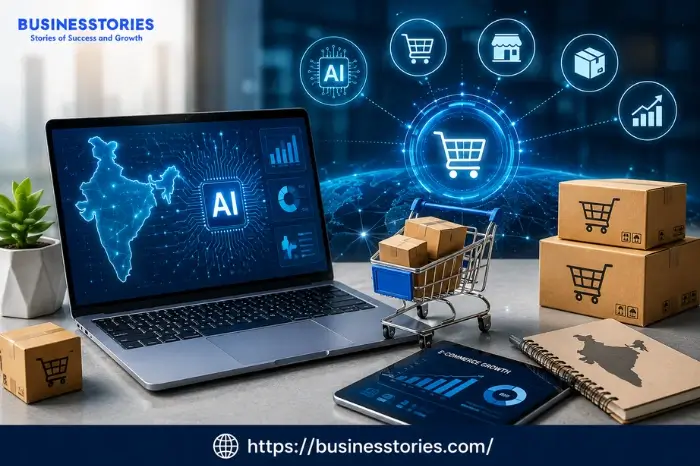
India’s AI-First SMB Boom is no longer a niche trend. It is becoming a new way to run, sell, and grow a business. Small and mid-sized businesses across the country are using AI to write messages, answer customers, plan stock, improve ads, and speed up daily work. As a result, commerce is becoming faster, smarter, and more personal.
This shift matters because SMBs constitute a giant share of India’s business base. Therefore, when they change, the market changes with them. This article explains what is driving the shift, why it matters now, and how founders, merchants, and brand teams can act on it.
Why the AI-First SMB Boom Matters Right Now
India is at a special point in its digital journey. More people are online, more payments are digital, and more small firms want simple tools that save time. At the same time, AI has become easier to use. It now sits inside chat tools, sales tools, design tools, and customer support systems. Therefore, a shop owner no longer needs a large team to act like a modern brand.
Instead, one person can move much faster with AI help. This matters because SMBs face tight margins and limited staff. They cannot afford waste. However, AI can reduce repeated work and help owners make better choices.
For example, an AI tool can draft product descriptions, suggest email subject lines, and group customers by behavior. In turn, such automation can improve conversion rates and lower support load.
Recent trend reports from business and technology analysts also point in the same direction. AI adoption is rising across marketing, operations, and customer service. In India, the trend is especially powerful because many firms are mobile-first and cost-aware.
Therefore, AI does not replace the local business model. Instead, it strengthens it. The unique insight here is simple: India is not just adopting AI. It is shaping a low-cost, high-speed model of AI commerce that other markets may copy later.
How AI Is Changing Daily Commerce for Small Businesses
The biggest change is not flashy. It is practical. AI helps SMBs do everyday tasks better and faster. First, it improves customer communication. A business can reply to questions at any hour. Next, it helps with content.
Many merchants now use AI to create product copy, social posts, and ad text in minutes. Furthermore, AI can help owners spot what is selling and what is not.
For example, a local fashion seller can use AI to test different product descriptions for the same item. Likewise, a food brand can use AI to answer repeat order questions and recommend add-ons. These small steps accumulate over time.
They save time, improve service, and support growth. Often, they also make the brand feel more active and modern. Another major shift is personalization. AI can help a business send more relevant offers to the right customer at the right time.
As a result, messages feel less random and more useful. This is important because Indian shoppers respond well to convenience and speed. The more profound insight is that AI is turning everyday commerce into a learning system. Each click, chat, and purchase can make the business smarter.
The Tools Powering the AI-First SMB Boom
Several types of tools are making this shift possible.
- The first is AI writing and content tools. These help with ads, captions, catalog pages, and customer replies.
- The second is AI support tools. They can handle common questions and free up human teams for harder issues.
- The third is AI analytics. These tools show patterns in sales, demand, and customer behavior.
There is also a strong rise in vernacular AI. This is important in India because many buyers and sellers prefer local languages.
Therefore, tools that support Hindi, Tamil, Bengali, Marathi, and other languages have a real edge. When AI speaks the customer’s language, trust grows. Furthermore, more people can use the software without training barriers.
Another growing layer is commerce automation. Inventory alerts, abandoned cart messages, lead scoring, and simple CRM tasks can now run with less manual work. In practice, this means fewer missed chances.
The unique angle is that the best AI tools for SMBs are not the most complex ones. They are the ones that fit into daily habits and remove friction without adding confusion.
The Big Benefits for Indian SMBs
The benefits are broad, but three stand out.
- First, AI helps businesses save time. That alone can change how a small team works.
- Second, it improves decision-making. Owners can look at data faster and act with more confidence.
- Third, it helps businesses look bigger than they are. A small team can now offer quick replies, polished content, and more consistent service.
There is also a growth benefit. AI can improve lead generation, ad testing, and customer follow-up. As a result, businesses may see stronger sales without hiring too many people. AI is the key to growth for many SMBs, allowing them to scale rather than remain stagnant.
AI can also help improve customer retention. When messages are timely and useful, shoppers are more likely to return. One less-discussed benefit is resilience. During busy seasons or supply shocks, AI can help teams react faster. It can flag low stock, detect a rise in support requests, or suggest what to promote next.
So, AI is not just a growth tool. It is also a stability tool. That is a useful shift for owners who must stay lean yet responsive.
What Holds SMBs Back — and How to Move Forward
Even with all the promise, adoption is not automatic. Many SMB owners still worry about cost, learning time, and trust. Some do not know which tools to use. Others fear that AI may feel too technical. In addition, many firms still work with poor data, which limits what AI can do. Therefore, the first step is not buying more tools. The first step is to identify and address one clear problem.
A smart action plan is straightforward to follow. Start with one task that wastes time, such as answering repeat questions or writing product copy. Then test a simple AI tool. Measure the result. After that, expand slowly. This approach lowers risk and builds confidence. It also helps the team learn by doing, which is often better than long training sessions.
The unique perspective here is that AI adoption is partly a trust project. SMBs do not just need better software. They need proof that the software works in real business life. Therefore, vendors that show clear results, local support, and simple onboarding will win. For business owners, the lesson is clear: begin small, test fast, and scale what works.
What is the future of commerce in India?
The future will likely be more conversational, more local, and more automated. Customers may ask questions through chat, voice, or social apps. Meanwhile, businesses will use AI to answer them instantly. Commerce will also become more predictive. Tools will suggest what to stock, what to promote, and when to reach out.
Over time, we may see more AI-native SMBs. These businesses will build AI into the core of the company instead of adding it later. As a result, they may move faster than older competitors. They may also serve niche markets better, because AI can help them personalize at scale. This is especially useful in India, where customer needs vary by language, city, and income group.
The deeper industry impact is exciting. If India’s SMBs adopt AI widely, they could raise service quality across retail, food, fashion, and local trade. They could also create a stronger digital supply chain. In other words, the AI-first SMB boom may not just change how firms sell. It may change how commerce itself works.
Conclusion
India’s AI-First SMB Boom is reshaping commerce in a practical, powerful way. It is helping small businesses save time, serve customers better, and make smarter choices. At the same time, it is giving local brands a chance to compete with larger players through speed, data, and better customer care. Although the shift is still early, the direction is clear.
AI is becoming a daily business tool, not just a future idea. Therefore, the SMBs that start now will likely gain the most later. If you run a business, begin with one simple task and improve it with AI. If you write about this trend, focus on real examples, clear benefits, and the human side of change. That is where the strongest story lives.

Market Research Analyst with 20+ years of experience delivering data-driven insights and strategic market intelligence.