
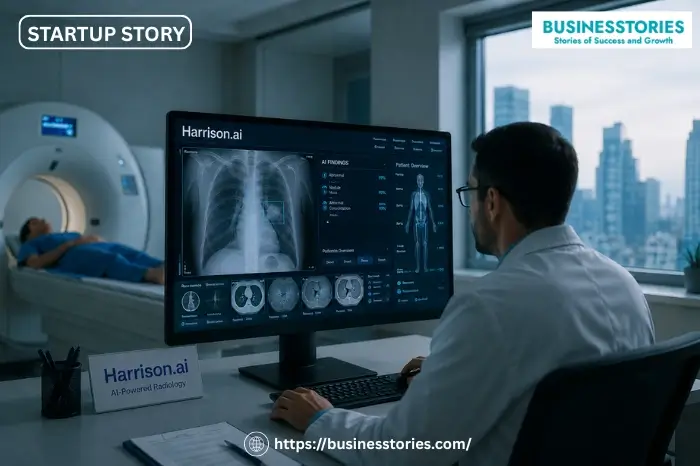
Hospitals all over the world face a growing problem. There are not enough scan doctors. Scans pile up. Diagnoses get delayed. Patients wait, and occasionally they wait too long. AI medical imaging is stepping in to help. And few startups are doing it as boldly as Harrison.ai.
This Sydney-based company gives doctors a strong second set of eyes. It helps health systems treat more patients faster and more safely than before.
So what is Harrison.ai, and why does it matter? In this article, we cover the problem it solves, how it works, and the real results it has delivered.
The Radiologist Shortage: A Crisis That Keeps Growing
First, let us look at the problem. The scan doctor shortage is real. It is severe. And it is getting worse.
Right now, there are about 345,000 scan doctors in the world. That averages out to just 45 per million people. But the gap between rich and poor countries is huge. High-income nations have 33% of all scan doctors.
Yet they serve only 16% of the world’s people. In low-income countries, fewer than 800 scan doctors cover nearly 700 million people. That is less than 2 per million.
The future looks even harder. Experts now predict a shortfall of about 725,000 scan doctors by 2050. Africa and Asia will face the worst gaps. A major report in The Lancet Oncology in 2026 warned of a coming “cancer crisis.”
It found that the world could be short by 100 million health workers by mid-century. Radiology and pathology alone make up about 16 million of those missing workers.
Even rich health systems are under strain. In the US, around 50% of imaging jobs in 2023 went unfilled. It now takes an average of 130 days to fill a full-time imaging post. In the UK, the NHS is short of over 1,100 scan doctors today. In Australia, backlogs are growing in both public and private hospitals.
So why not just train more scan doctors? The problem is time. Training takes over a decade. Meanwhile, demand grows every year as people age and imaging improves. AI diagnostic imaging offers a faster, scalable fix. And it can start working right now.
Harrison.ai: Born From a Doctor’s Simple Wish
Harrison.ai was founded in 2018 by two brothers: Dr. Aengus Tran and Dimitry Tran. Aengus is a practising doctor. Dimitry is a tech founder. Their story is a simple one.
Aengus became a doctor to help as many people as he could. But he soon saw the limit of what one doctor can do alone. So he turned to AI. Together, the brothers set out to build tools that would “scale the global capacity of quality healthcare.”
From the start, their focus was on radiology. It is one of the most data-rich fields in all of medicine. And it is one of the best fits for AI.
By 2020, they had teamed up with I-MED Radiology, one of Australia’s largest radiology networks. Together, they built a set of AI tools for clinical AI radiology. The platform launched under the brand Annalise.ai. In late 2025, the company folded everything under one brand: Harrison.ai. This made things simpler for doctors and health systems around the world.
The startup has attracted serious backing. It raised $129 million AUD in a Series B round in 2021. Then in early 2025, it raised $179 million in a Series C round, one of Australia’s largest ever. The Australian government also invested $32 million through its National Reconstruction Fund. That shows how much Australia values this company.
Today, Harrison.ai runs at over 1,000 sites on four continents. It holds clearance in over 40 countries. And it works with health systems in 15 countries.
How AI Medical Imaging Works at Harrison.ai
It helps to know exactly what Harrison.ai’s tools do. They are much more than a basic filter.
Chest X-Ray and Head CT Tools
Harrison.ai has two main tools. They help doctors read chest X-rays and head CT scans. These are the two most common types of scans done in hospitals every day.
The chest X-ray tool can find up to 124 findings in one scan. In less than 90 seconds, the head CT tool can identify up to 130 findings. A human doctor may take 20 to 30 minutes on one scan. They can still miss subtle signs, especially when they are tired at the end of a long day.
Speed matters a lot here. AI results come back in 20 seconds for chest X-rays and 90 seconds for head CTs. This is vital in emergency wards. Missing a finding can cost a life.
The tools also cut report times in real hospitals. Studies show an 11% drop in chest X-ray report times and a 9% drop in head CT report times. These gains free up doctors to focus on the hardest cases.
Harrison.rad.1: A Radiology-Specific AI Model
In 2024, Harrison.ai launched Harrison.rad.1. This is an AI model built for scan reading. It learned from millions of real scan images and expert-labelled reports. It’s outperformed models from OpenAI, Anthropic, Google, and others on a key medical AI test. It scored 82% on diagnostic questions.
In 2025, two leading US health bodies ran an independent test. Mass General Brigham and the American College of Radiology set it up. Trained scan doctors rated 65.4% of Harrison.rad.1’s reports as sound. Human reports scored 79.6%.
However, the gap is rapidly narrowing. Mass General Brigham said these AI tools are now improving “at breakneck speed.” By 2026, the company had launched Harrison.Rad 1.5, with even better results.
Worklist Prioritization: Getting Urgent Cases Seen First
One of the most useful features is work list prioritization. The AI checks all new cases as they come in. It flags the most urgent ones at the top of the list. So a patient with a brain bleed or a lung collapse moves to the front right away.
The system does not rely on a junior doctor to notice something urgent. The AI does it first, every time.
Real-World Results: From Australia to the NHS
Harrison.ai’s tools are not just tested in labs. They are running in real hospitals right now. And the results are solid.
South Australia Goes Statewide With AI Radiology
In November 2024, South Australia Medical Imaging (SAMI) achieved a major milestone. It became the first public radiology provider in Australia to deploy AI across a whole state. SAMI rolled out the Harrison.ai chest X-ray tool at all of its sites. The SAMI clinical director said it well.
When you process a huge volume of scans every day, any tool that boosts accuracy is welcome. The AI shows each finding with a location mark and a score. This helps doctors make better calls faster.
Half of Australia’s Radiologists Now Use Harrison.ai
Today, Harrison.ai’s tools are available to more than 50% of Australia’s radiologists. This is a significant achievement for a seven-year-old startup. Globally, the platform helps diagnose over six million patients per year.
With AI in place, hospitals can handle growing backlogs. They do not have to wait years for new doctors to train.
The NHS, Hong Kong, and the US
Across England, Harrison.ai now processes more than 35% of all chest X-rays. The company works with over 40 NHS Trusts. Its tools run in every public ED in Hong Kong. In the US, it has FDA clearance for many products. It also earns Medicare New Technology Add-on Payments of up to $241.39 per patient.
And it has won three FDA Breakthrough Device Designations, including one for a rare brain blockage called hydrocephalus.
Why Harrison.ai Is Different From Other AI Radiology Tools
Many companies are trying to build AI for radiology. So what sets Harrison.ai apart? Three things stand out: clinical grounding, data quality, and breadth.
Built by Clinicians, for Clinicians
A practising doctor founded Harrison.ai. That shows in every product choice. Each tool fits into the existing workflow. There is no new screen to learn. The AI shows its findings as a simple overlay in the doctor’s current software. The doctor sees what the AI found, where it found it, and how sure it is.
Dr. Ben Dobb, clinical lead at NHS Grampian, called the chest X-ray tool “a key safeguard, making sure no detail is missed.” The word ‘safeguard’ is key. Harrison.ai is not here to replace doctors. It is there to support them. That is what excellent AI-powered radiology looks like.
Training Data at Massive Scale
Harrison.ai trains on some of the world’s largest hand-labelled scan datasets. The chest X-ray model learned from over 782,000 unique scans. The head CT model drew on over 229,000 unique scans. Only trained doctors labelled the data. There were no outsourced workers. This care in data is why the tools work so well in real hospitals.
One Platform, Not Dozens of Tools
Most AI scan startups build one tool for one condition. Harrison.ai builds full platforms. Its chest CT tool alone finds up to 201 features in one workflow. This covers urgent conditions, cancers, and long-term diseases. Hospitals do not need ten tools from ten vendors. One platform covers all the findings their patients may have.
What the Future Holds for AI Diagnostic Imaging
Harrison.ai’s rise tells a bigger story. For years, AI in medicine had big promises but little proof. That era is now over. Tools like Harrison.ai have clearance in over 40 countries. They have clinical studies that back them up. And they show real results from millions of patients.
Next, the company is moving into pathology. Harrison.ai is already building AI tools to speed up lab work. The long-term goal is to bring these tools to billions of people with little access to scan doctors.
For founders and investors in health tech, Harrison.ai points the way. Start with a real patient problem. Build on real data. Work with doctors, not around them. This matters. Build trust with regulators, one step at a time. Focus on results that health systems can see.
Conclusion: AI Medical Imaging Is Rewriting the Rules
The radiologist shortage is not likely to resolve itself. People are ageing. Scan volumes are rising. Training pipelines are too slow to catch up. But AI medical imaging is changing what is possible. And Harrison.ai is leading that change—from Australia to every corner of the world.
Since 2018, this startup has grown from a simple idea into a platform used by over 3,500 clinicians at more than 1,000 sites on four continents. It’s helped diagnose six million patients. It has cut report times and surfaced urgent cases faster. It has given exhausted, overworked doctors a trusted second pair of eyes.
The company’s story is still being written. With $179 million in fresh funding, three FDA breakthrough designations, and a foundation model that rivals the best in the world, Harrison.ai is well placed to keep pushing clinical AI radiology forward.
If you run a hospital, invest in health tech, or work as a clinician, now is the time to pay close attention. Explore the evidence. Read the clinical studies. And ask how tools like these could change patient care in your own setting. The future of diagnosis is already here. And it is getting sharper every year.
Frequently Asked Questions
What is AI medical imaging?
AI medical imaging uses machine learning to analyze scans like X-rays, CT scans, and MRIs. These tools help doctors find and report findings faster. They support doctors; they do not replace them.
Who founded Harrison.ai?
Harrison.ai was founded in 2018 by brothers Dr. Aengus Tran, a physician, and Dimitry Tran, a tech entrepreneur. Both are based in Sydney, Australia.
How many findings can Harrison.ai detect on a chest X-ray?
The chest X-ray tool can find up to 124 radiological findings. Results are ready in as little as 20 seconds.
Is Harrison.ai approved by regulators?
Yes. Harrison.ai has clearance in over 40 countries. This includes FDA approvals in the US and sign-offs across Europe, Asia, and Australia.
Does Harrison.ai replace scan doctors?
No. Harrison.ai helps doctors work faster. But the final call always belongs to the human doctor.

Tabassum Shaik is an Author, Researcher, and SEO Specialist with over 8 years of experience creating informative content on business, startups, entrepreneurship, marketing, technology, and digital trends. She specializes in researching industry trends and transforming complex topics into practical, easy-to-understand insights. Her goal is to help readers stay informed, learn new ideas, and make better business decisions.