
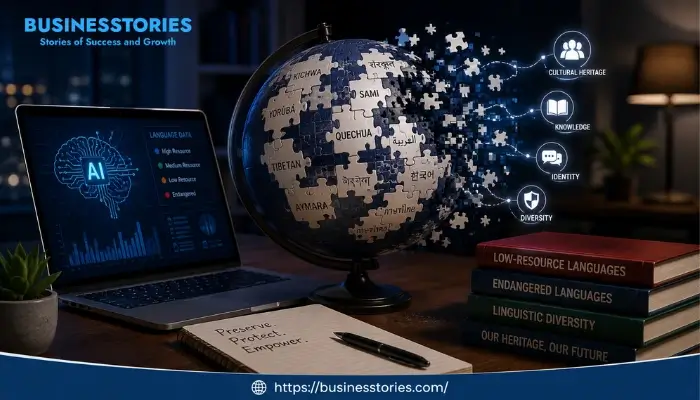
Every two weeks, a language dies forever. Its last speaker takes their final breath. And with that breath, centuries of wisdom, stories, and identity simply vanish. By the year 2060, UNESCO warns that close to 3,000 languages could face this same fate. That is nearly half of the 7,000 languages currently spoken, in fact. But there is a surprising twist to this story. The same AI technology many people fear might actually become the best tool to reverse this loss. Low-resource language models are a big breakthrough in artificial intelligence.
Regular AI systems like ChatGPT need billions of English training examples to work well. But these special models do something amazing. They learn from very little data. Occasionally, they only need a few hundred pages of text. As a result, they can learn the grammar, words, and structure of languages that big tech companies have always ignored.
So in this article, we will look at how low-resource language models could help save thousands of languages. You will learn the real facts behind the numbers. You will also see the tech making this work possible. And most importantly, you will find out what you can do to help. Because when a language dies, every one of us loses something priceless.
The Silent Crisis: Why 3,000 Languages Are at Risk
Language death does not happen all at once. Instead, it unfolds slowly across three or four generations. First, children stop learning the old language. Their parents think a major language will provide them better jobs. Next, the whole community becomes bilingual. Then only the elders speak the old tongue well. Finally, those elders pass away. And sadly, the language dies with them.
Take the case of Ainu in Japan. It was once spoken all across Hokkaido. Today, fewer than 10 native speakers remain alive. The Japanese government did give it official recognition in 2008. However, many years of forced blending had already caused deep harm. You can find similar stories on every continent. For example, Yuchi in Oklahoma is nearly gone. So is N|uu in South Africa. In fact, N|uu had just one surviving speaker back in 2021.
How Globalization Speeds Up Language Loss
Globalization links people through trade. But at the same time, it flattens language variety. English, Mandarin, Spanish, and Hindi rule the internet. They also dominate schools and global business. So smaller language groups face huge pressure to drop their mother tongues. The digital gap also makes this situation worse. Most websites, apps, and voice helpers completely lack support for small languages.
What makes this era different is the speed of loss. Languages have always died out over time. However, the current rate is nearly ten times faster than before. The Endangered Languages Project reports a stark number. A language now dies about every 14 days. So in the time it takes you to read this article, another group somewhere will step closer to permanent silence. Still, there is real hope.
The same digital tools that once hurt diversity now offer a fresh chance. Researchers have started building AI systems that learn from tiny data sets. These doors were shut tight just five years ago. Now they are opening up.
What Are Low-Resource Language Models and How Do They Work?
A low-resource language model is an AI system built for languages with very little digital data. Big models like GPT-4 need trillions of words from the web to train. But for many languages, that much data does not exist. Take Quechua. Around 8 million people speak it across the Andes Mountains. Yet it has almost no digital footprint. Or consider Igbo. Over 30 million Nigerians speak it. But it is barely represented online. So for these languages, a different approach is needed.
These smart models use tricks to beat the data shortage. Transfer learning lets a model trained on English adapt to a related small language. In addition, multilingual training helps the model spot common patterns across many tongues at once. Data addition methods also create more training samples from very limited sources. Together, these methods squeeze every drop of value from rare data.
Breakthrough Projects That Are Leading the Way
Several big projects are proving that low-resource language models can work well. Meta launched No Language Left Behind (NLLB) in 2022. Its goal was bold. It aimed to give top-quality translation for 200 languages. And many of these were low-resource ones. The early results were strong. They showed a 44% jump in translation quality for African and Indian languages. That was a giant leap forward for groups long ignored by big tech.
Meanwhile, Google’s 1,000 Languages Initiative takes an even wider view. The company wants to build one AI model for the world’s thousand most-spoken languages. At first, it focuses on the most widely used ones. However, its design is built to add low-resource languages over time.
At the same time, groups like Masakhane are rising from the ground up. This African NLP community builds free models for languages like Luganda, Amharic, and Swahili.
What sets these projects apart is the power of community. Instead of tech workers from Silicon Valley coming to save languages they do not know, these teams work with native speakers directly. They also partner with linguists and local schools. So the tech serves real needs rather than outside goals.
How Low-Resource Language Models Can Preserve Cultural Heritage
Language holds much more than just words. It carries stories, healing knowledge, nature wisdom, and unique worldviews. For example, the Cherokee language calls a river a living relative, not a thing to use. This one phrase holds a whole way of understanding nature. English cannot easily capture it. So low-resource language models give us a way to save this deep knowledge before it fades.
Real uses are already popping up around the world. In New Zealand, AI tools help young Māori students practice saying words and learn grammar. In Bolivia, researchers are using speech tools for Aymara to record stories from elders. As a result, they build digital archives that will outlast the current generation. These tools do not take the place of human teachers. But they do provide valuable support, especially where native speakers are scarce.
From Spoken Word to Digital Record
Many dying languages face a major challenge. They exist mostly in spoken form. There are no written rule books, no word lists, and no digital text collections. Speech-to-text models built for low-resource settings can bridge this gap. Communities can record elders sharing tales. Then the AI writes them down on its own. This way, groups can create written records from scratch with AI help. For the first time, they create a written tradition.
What is more, these models allow live translation between dying tongues and wider ones. An Aymara elder can speak in her language. A younger family member who mostly uses Spanish can understand her. The AI acts as the bridge between them. This link across ages matters deeply. After all, language passing depends on talk between grandparents and grandchildren.
The Ethical Challenges: Who Owns a Language Model?
Building low-resource language models raises significant moral questions. Who has the authority to say whether a group’s language is digitized? Who owns the final model? And who earns money from it? Native groups have real worries. They fear outsiders will take their language data without asking properly, without paying fairly, and without showing cultural respect.
This is why the idea of data control has become so key. Native data control says that groups should own and manage data about their people, land, and culture. This includes their languages. So tech firms and scholars must strike data deals that honor community rules. They cannot just assume open access anymore.
Building Trust Through True Partnership
The best projects follow a clear moral path. First, they get free, early, and informed yes-saying before gathering any language data. Second, they share model ownership with the community instead of keeping all rights. Third, they build local skills. They train local researchers and coders so the community can run and improve the tools on its own.
The Māori data control model from Aotearoa stands out as a guide. Māori groups have set clear rules for their language data. The rules say who may use it, how they may use it, and why they may use it. Tech teams that obey these rules do well. Those that skip them get shut out. This shows that honest AI work and culture keeping can lift each other when trust is firm.
What You Can Do: Simple Steps to Support Language Diversity
You do not need a fancy degree to help. Everyone can do something to keep the world’s languages alive. And your actions count more than you may realize.
- Learn about dying languages near you. Find out which native or small languages were spoken where you live long ago. Websites like the Endangered Languages Project offer maps and rich details to get you started.
- Provide support to groups doing saving work. Teams like The Language Conservancy, Living Tongues Institute, and Wikitongues need both money and helpers. Even small gifts pay for key tools like recorders, travel for language experts, and AI building costs.
- Pick and spread digital tools in small languages. When apps let you choose Welsh, Basque, or Hawaiian, pick those options. Users asking for these languages tell tech firms that serving varied tongues makes excellent business sense.
- Push for fair AI rules. Write to your leaders. Ask them how they will ensure AI helps all language groups, not just those already well covered online.
- If you speak a family language, use it daily. Speak it with your kids. Record talks with elders. Add your voice to free data sets like Mozilla Common Voice. Every clip you share builds a stronger base for future language tools.
Please remember one thing. Tech by itself cannot save a language. Languages live when groups value them and give them to the next wave of children. Low-resource language models are strong helpers. But they work best when they back up, rather than take over, the human ties at the core of language sharing.
The Road Ahead: What the Next Ten Years Hold
Looking out to 2035 and beyond, the path for low-resource language models looks quietly hopeful. Hardware costs keep falling. So AI training gets cheaper each year. Open tools like Hugging Face give anyone access to top NLP methods. Cloud costs are also dropping. And edge computing lets language apps run on simple phones instead of costly servers.
A few new trends are worth watching. Shared learning trains models across many phones without pooling private data in one place. This could ease the trust worries that kept some groups from sharing voice clips. Furthermore, few-shot learning keeps getting better. So models will soon need even less data to become beneficial.
Voice-copying tech, while hotly debated, might one day bring back the voices of speakers who have passed on for teaching use. Such technology raises new moral issues that groups must think through.
What AI Cannot Do: Honest Limits
Being honest means facing what AI simply cannot achieve. A language model cannot make kids want to learn their old family tongue. It cannot undo hundreds of years of colonial crushing. It cannot bring back the warmth of a grandma sharing tales in her words. The tech is a support, not a substitute. It cannot replace the social, political, and monetary work needed to keep varied languages alive.
Even so, a real push is building. Every month brings fresh studies, fresh tools, and fresh groups to the cause. The real question has changed. It is no longer just that AI can help dying languages. It clearly can. The real question is, will we put in enough cash, build enough trust, and move fast enough to save the 3,000 languages now hanging on the edge of silence?
Conclusion: A Choice Between Silence and Survival
The story of the world’s languages stands at a fork in the road. Down one path, we accept mass death as a sure fate. We let half of all human language history fade into nothing by 2060. Down the other path, we grab hold of low-resource language models. We pair them with community work to record, revive, and honor every tongue still spoken. The choice belongs to all of us. And the clock is ticking loudly.
In this piece, we looked at how low-resource language models offer a real rope to dying languages. From Meta’s No Language Left Behind push to ground-up teams like Masakhane, tech is showing that sparse data does not force digital hiding. We walked through the moral rules needed for fair building. We listed clear steps anyone can take. And we faced the honest limits of what AI can do.
What comes next rests on each of us. Scholars must keep improving these models while respecting group control. Leaders must fund saving work and write rules that guard language rights. Tech firms must put money into tones beyond those that boost next quarter’s gains. And you, yes you, must see that each language counts. When we drop a language, we lose a one-of-a-kind view of human thought, art, and life.
So start right now. Find out about dying tongues near your home. Back groups that work to keep them alive. And if you speak a family language, share it with pride with the young ones close to you. If we work side by side, we can make sure the world of 2060 rings with more voices, not less silence.
Frequently Asked Questions
What are low-resource language models in simple terms?
They are AI systems built to work with very little digital data. Unlike ChatGPT, which needs billions of examples, these models learn from small sets to understand and create text in rare languages.
How many languages will truly vanish by the year 2060?
UNESCO warns that close to 3,000 languages face death by 2060 if today’s trends hold. That is about 40% of all tongues now spoken across the globe.
Can AI truly save dying languages from becoming extinct?
AI cannot save languages all by itself. Yet low-resource language models give key tools for writing things down, live translation, and learning help that strongly backs group-led revival work.
Which big companies build low-resource language models?
Meta runs the NLLB project. Google pushes its 1,000 languages plan. At the same time, ground-up groups like Masakhane lead the way. Many schools and free-code teams also add tremendous value.
How can normal people help keep dying languages alive?
You can give funds to saving groups, learn about small tongues near you, pick apps in rare languages, add your voice to Common Voice, and push leaders to back fair AI rules.

Tabassum Shaik is an Author, Researcher, and SEO Specialist with over 8 years of experience creating informative content on business, startups, entrepreneurship, marketing, technology, and digital trends. She specializes in researching industry trends and transforming complex topics into practical, easy-to-understand insights. Her goal is to help readers stay informed, learn new ideas, and make better business decisions.